Manuals Plus: The Wrap-Up —
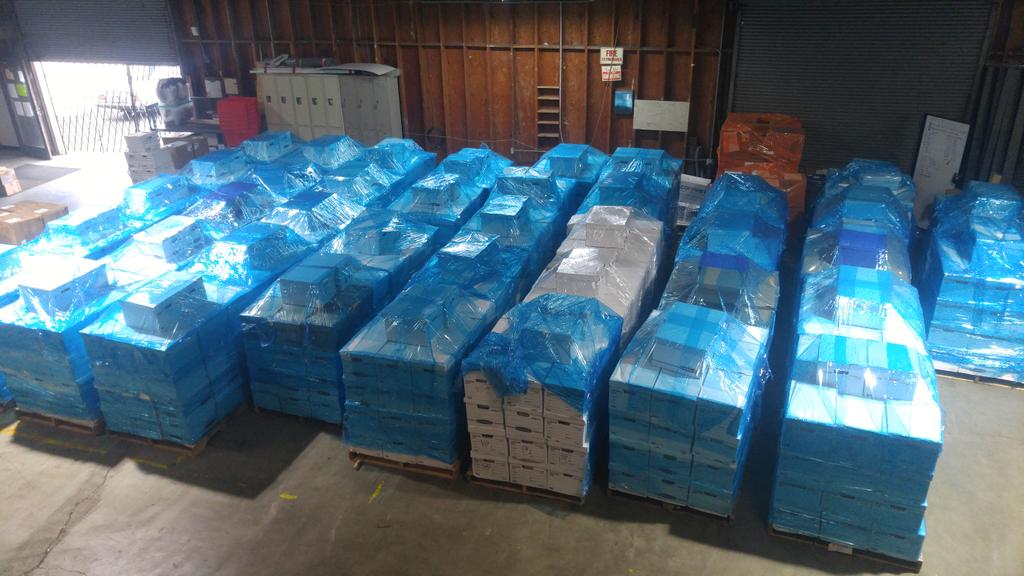
Just a little over ten years ago, I was notified about a big warehouse of manuals that was going to be discarded in a few days. Bursting with energy, I drove down, discussed things with the owner, and, soliciting and ringing a very loud bell, assembled dozens of people and tens of thousands of dollars over the course of saving this collection from being discarded. Naturally, the next step would simply be to digitize them all.
That took longer.
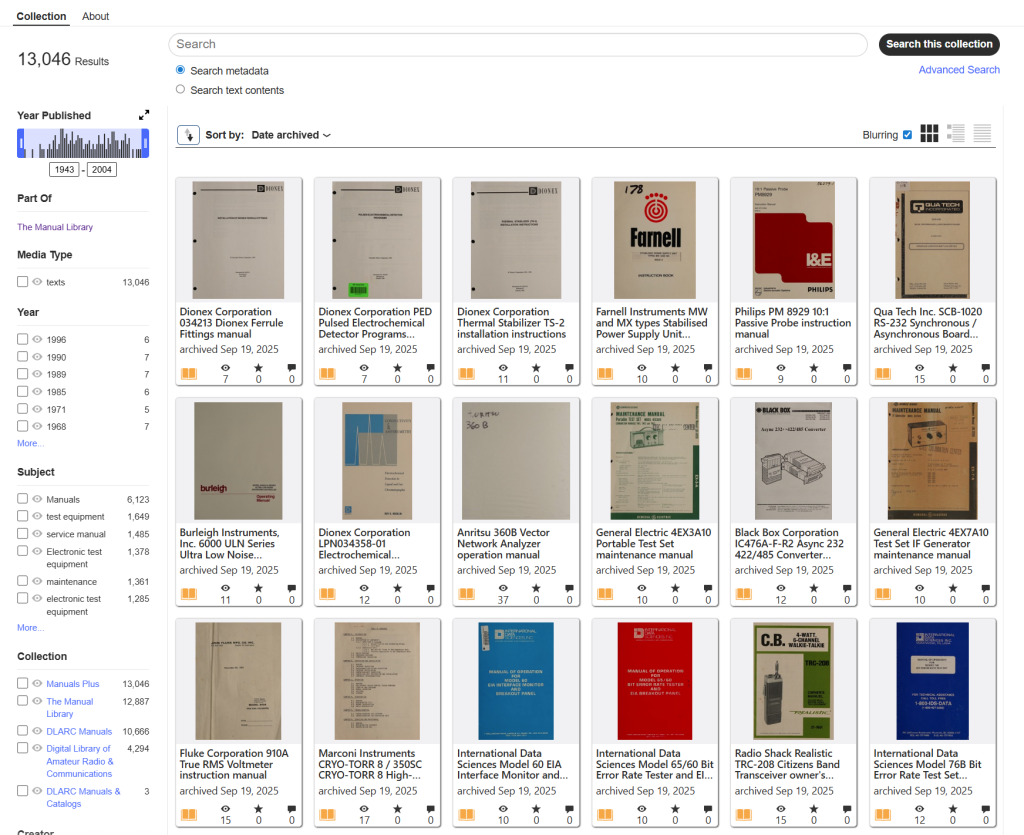
As of a short time ago, a collection of 13,000 manuals now lives on the Internet Archive. It is, essentially, all the manuals that will be digitized or could be digitized, sans sets I’ll explain about shortly.
In other words, the loop is now complete. Saved, stored, moved, now online for anyone to read.
If somehow you missed this apparently core event of what people think of when they think of me, there’s so many weblog posts it’s almost weird to list them all:
In Realtime: Saving 25,000 Manuals
In Realtime: Prepping for the Transfer of 25,000 Manuals
In Realtime: We are Barely Halfway Done
In Realtime: Day 2 Felt Like Week 4
In Realtime: It is Done (Done physically saving the manuals, anyway)
A Small Dark Detour
In Realtime: Post-Mortem
A Little Bit of the Manuals
In Realtime: Some Initial Sorting and the Power of Two
The Manual Rescue: A High and Low Day
The Manual Rescue: Take Two, and Please Help
In Realtime: Digital Heaven (And a Call for Donations)
That last one really felt like the end (dated February 2024), but in fact it took a little longer to finish it all off. And that happened this year.
For anyone who doesn’t want to scroll through a dozen long-winded and repetitive posts about the process (aka “I ain’t reading all that – I’m sorry, or congratulations”), I’ll summarize it as:
Was told about a warehouse of manuals being thrown out. Came down to discuss the situation. Negotiated a week hold. Got dozens of people to show up, thousands of dollars to pack it all up and move it and store it, moved it from one storage unit to another location (closed coffeehouse in a mall), moved it all to California, got volunteers to sort the hell out of it, ended up with dozens of pallets, determined some not to be scanned, a group covered it being scanned, we’re done.
Only took eleven years and one tiny heart attack.
And there we are: a collection of 13,000 manuals.
Let’s go quickly down some frequently-yelled questions from the crowd, and what’s next.
First, what do you mean there are some unscanned manuals?
Well, funny story. Two companies still have manuals as a product and as part of their product line and are preferring to go through them, as well as that, in the event they make them public, their scans will be much better and thorough than the pile in this collection. Those companies are HP (now Agilent Technologies and Keysight) and Tektronix. So, it made no sense to scan those pallets. We still have everything, and if it came down to it, manuals truly lost could be found, but the cost to speculatively scan them would have doubled everything, at least. So we have the manuals, just not digital forms.
Next, who ended up covering for all this scanning?
Money was really the reason this all took so long. Scanning thousands of manuals, some of them hundreds of pages long, is an expensive project unless you truly think you can just make Steven and His Epson Perfection scanner do this on the weekends. (You can’t.)
A round of soliciting general folks was beneficial to the tune of thousands, and that helped cover it. But the biggest boost came from the Digitial Library of Amateur Radio Communications (DLARC), a funded group whose mission for a few years has been to gather as much Amateur Radio history as possible. A signficant percentage of the manuals were radio-oriented, DLARC paid for the general scanning, and it all slid over the finish line as a result. Thank you, DLARC.
Do You Have Your Usual Buffet of Random Thoughts?
Always do.
Certainly, the whole of the project was a success, but along the scale of human time and effort, it was difficult. That was a lot of lifting, a lot of driving, a ton of money and a ton of emotional aspects far outweighing what one would expect for piles of paper. Of course, they’re not just piles of paper – they’re entire outlooks of how technology works, how to teach users to do their own maintenance and process to take care of equipment, and they’re evidence as well as celebration of the wonder of engineering. They have value on multiple levels to the contemporary space, and just the graphic design and typography alone could consume a summer.
The largest hold-up was neither will nor the effort – it was money and funding. Yes, you can get a few volunteers to do work, and if there was some sort of golden fifty manuals that everyone absolutely needed online, those could have been done – but doing hundreds of thousands of scanning of pages in an orderly, tracked and quality-assured methodology just takes funding. There’s an entire discussion in whether any volunteer effort should be used at all, and I can assure you that I did get contacted by or was shown individuals in the professional space who believed it better that the manuals go into a trash compactor than any volunteer labor be used, but that’s how it always is in life regarding what resources go where. If money had not been the object, this whole thing would have been done in months.
For when people inevitably say they were sure a different manual was available and it wasn’t HP or Tektronix and yet it appears not to be scanned, that means it was sold off before my team arrived, or it was lost before we arrived, or it was in some way basically jammed somewhere strange. Those volunteers were brutally intense going through that warehouse. The warehouse shots look bigger because there were sometimes a dozen copies per unique manual.
Everything else I ever wanted to say was in those dozen entries listed above, so if you want to settle back and enjoy those, go for it.
Also, I wish to shout out the heroic efforts of the Bitsavers Project, a completely-separate-from-me entirely independent effort to scan manuals, digital artifacts and more. They’ve done so much more, for so longer, and so consistently.
What’s Left?
These manuals have very basic metadata. If people see a manual needs more description, or better description, or they want to just note bad entries and so on, leave a review under the item and I’ll integrate it in. You can always do a full-text search across the manuals and you’ll see text you’re looking for (it’s the “search text contents” option under the collection search). All are welcome to contribute that as it strikes them.
Would You Do It All Over Again?
Like the Defenestrations of Prague, I’d do it again, even if it took a hundred years.
Categorised as: Uncategorized
Thank you for the update! I was there helping when the boxes were moved out of the mall and into the truck for the trip to California. So nice to see this project finally completed. Thank you for saving the manuals.
A decade? I remember reading the first breaking news of this here, it doesn’t feel that long ago. My Gods, we are getting old…Congratulations on the completion of this project. Am very happy that your efforts paid off.
Amazing! Congrats on saving this!