ASCII by Jason Scott

Jason Scott's Weblog

One Year Update: Jason and the Internet Archive —

I officially started work at the Internet Archive over a year ago.

Let’s remove any tension – it has been a fantastic year, where I have gotten more done in the way of preservation and computer history work than my entire previous 40 years combined. Internet Archive seems to like me, I really like them, and I’m staying.

Here I am with the boss:

Brewster and I are two rather different people, and although the Venn diagram of our interests does not intersect everywhere or even close to it, what we do share in terms of goals and passions is very similar. There’s no hidden agenda with this guy – the headquarters in SF isn’t secretly a meth lab, we’re not actually some lobbying group or anti-whatever think tank trying to destroy or anything. There is only the Mission, the goal to bring as much human knowledge as universally as possible, and to preserve and keep all matter of knowledge as reliably as possible.

Oh, there’s occasional office flare-ups and disagreements and I’m sure some clenched fists and not every day is an endless buffet of awesome, but every single person in this organization understands the Mission and pretty much 100% of the disagreement is how best to achieve that mission with what resources there are (or to gain new resources). That’s rather refreshing from, oh, let’s say, every other goddamn place I’ve worked at, where the goals of some people are “get to retirement age” combined with others who mostly have signed up for “do absolutely nothing until you either get bored and leave or get fired”. That’s not going on here. It was a shocking office culture to run into, everyone just kind of pressing in towards the overarching mission without being waylaid by one group trying to undermine the others for some other bonzo reason unrelated to what the place was going for. Again: People leave, people join this place, but they all understand that dream, that plan, that hope, that dream. Maybe this happens elsewhere, but not in my previous lines of work. So that’s somewhat mind-blowing on a daily basis.

I will feel really stupid if I start listing out names of co-workers and then miss some, so I will tell you that I have someone who is a “handler” for me, and she is far and away one of the best bosses I’ve ever had, and I’ve had a few really, really great bosses in my time. I have people I sit with when I’m in San Francisco who are brilliant, hardworking people (again, all aimed at this goal) who do stunning work. We have communication channels where various groups talk, and it’s like shoving your face into a Brilliance Fountain 24/7. I’m not making this stuff up to butter anyone.

Remember, this isn’t people all sitting around figuring out how to monetize farting or who are blowing up paradigms with slide-scale infradoobles using Ruby on Crack combined with Hibbledoo Middleware. This is a non-profit online library providing petabytes (petabytes!) of data to millions in the most efficient way possible. Speaking of which…

One of the job descriptions/goals for me was “bring in data”.

I just checked the internal tracker to see how I’ve been doing on the upload front. Very well, apparently – I have uploaded 120 terabytes of data. That’s into 82,438 individual items, which could be anything from texts or songs up through to .tar files of web captures. When I started, I said my goal was to upload a terabyte of data a month. As I am apparently doing ten times that amount, I’ll consider that goal met.

I’ve brought in so much “stuff”, in fact, that it would nearly impossible for me to tell you all of it. Let’s throw out some highlights.

I was asked to look into bringing in software. So, I started out with CD-ROM shareware discs, not dissimilar to what I have with cd.textfiles.com. Well, that has been a wild success. I am ready to declare The Internet Archive as the largest collection of shareware on the Internet. Seriously. First, there’s over 1,100 CD-ROMs and DVD-ROMs contained in the CD-ROM collection. But oh, it gets better. You see, functionality was added this year to allow you to browse inside the ISO images. Feast your eyes inside this CD-ROM, for example. You just add a slash at the end of the ISO image reference and there you are. But let’s go even further than that: Let’s take a GIF file of Winter from 1991: http://archive.org/download/SoMuchSharewareV1_918/SoMuchSharewareV1_1991.iso/GIFS/WINTER2H.GIF

You see how you can reference a file inside a CD-ROM image in a permanent URL that can be pulled from anywhere? That’s why, as far as I’m concerned, The Internet Archive now has well over four million shareware programs, artworks and documents online. At least. That’s a game changer. And this year? We’re going to double it.


Computer magazines. Lots and lots and lots of computer magazines. Out of print, fondly remembered and otherwise obscure magazines on a range of technical subjects, currently the province of attics and basements and long-unopened warehouses and a smattering of living spaces – now up and readable.

This collection of computer magazines as well as a smaller spanish-language set constitute  30 years of technical publication, and well over a thousand individual issues, many of those in the hundreds of pages rage, which means there’s a lot of history squished into all this data. I’ve already been informed of university and high school classes out there using these issues to bring up discussions of history or to point out aspects of computer technology that have shifted or changed. Some of the issues have indexes already (the Compute! Magazine collection is a shining example) and I hope more will get them over time. I’ve got lots more issues to add, too.

Manuals! Damn, do I love getting manuals up where people don’t have to search like crazy to find them. It actually saves the environment to some small amount, since people will happily buy older equipment knowing they can get the manual easily and make the use of the item. So manuals are a big deal:

Arcade manuals. DEC manuals. Synthesizer manuals. Commodore manuals. Whenever I track down a cache of these or get sent them, they go up. I want to be able to have someone grab any piece of equipment new or old and understand what exactly everything does on it, and maybe even the why.

Audio! Video! 59,000 open-licensed albums. 2,100 nights of live and club music. Hours of GET LAMP raw interviews. A complete port of 10 years of Jesse Thorn’s The Sound of Young America. Bit by Bit. There are many other such audio and video projects where I use scripts to get them into the archive as collections – part of my work has been writing stuff to inject massive amounts of data into archive.org’s servers to make it that the uploading is the least of the issues. Which brings us to:

FUCK YEAH, ARCHIVE TEAM. I can’t begin to really describe how much data Archive Team has brought in – so many people working together to take snapshots of important things that are being shut down with poor or no notice, as well as proactive “panic downloads” where we recognize things are on the outs and we grab as best a copy as we can.

Like the Internet Archive itself, Archive Team’s collections are not always meant to be short-term beneficial and in fact are pretty clunky – 50gb .tar files and the like. What they are meant to be is raw material for later efforts and rescue of lost data – the panic downloads are basically someone stepping in at the present time and running the duper just before a whole range of data disappears forever. Some of it will be absorbed into the Wayback machine. Some will be filleted for their GIFs or mp3s or who knows what else. And still others will result in data, meaningful first-generation data about how people used computers or how solutions were found to old problems. Or maybe we’ll just laugh at the hair.

I’d go off more on Archive Team but I’m scheduled for something like a half-dozen speaking engagements around the world this year related to it, so I’ll probably just link to those talks when they come out. Actually, here’s a talk I gave about it a couple months ago, which is hosted at, and took place, at the Internet archive.

As we speak, Archive Team is uploading something like 25 gigabytes an hour into the Internet Archive. Chew on that for a bit. So many good people, so much good work, on both sides of the wire.

This is getting a bit long, and I’ll split more out into entries this year to give context and meaning, but the upshot is that this has been a very successful year, a lot of amazing things are happening and continue to happen, and every single waking moment I spend related to this “job” is what I’ve always wanted to do.

And that’s pretty nice. Thanks for taking the gamble, Brewster!


What Selling Out Reads Like —

Over two and a half years ago, I wrote a statement on Sockington selling out, where I basically said the following:

“I am not going to sell Socks out.  Period.  Drag your “proposal” or ‘touching base” or “big idea” or “possibility” to your trash icon, or I’ll kindly take the time to do it for you.  The store is closed. It was never open.”

I also felt I had to clarify what “selling out” meant, and what I came up with was:

For me, “Selling Out” for something like Socks comes when the cat or myself are doing things we would never do on our own, and people give us money to convince us to do this. Oh, they may couch it as “paying for your time and effort” or “to help with your maintenance costs”, but it’s taking cash to do something otherwise never happening.

So in that spirit and knowing that, I will inform you I was contacted a month or two ago by a company that wanted me to sell Socks out. Do a promoted tweet, as they call it. As usual, I toy with these guys, so I needled them along and asked how much. $5000/tweet, they said.

Hmm.

Sockington (the actual grey cat) is now (we think) about seven. Penny (the actual orange cat) is now easily ten. Penny and Socks have both seen years of very nice health – no major issues, no overnight visits, you name it. They’re kept on a good diet and kept indoors and exercised and they’re in a rather beautiful home outside of Boston, a place of stairs to climb and rooms to run and general Cat Heaven.

But cats don’t live forever and let me tell you, being involved in the whole Sockington Twitter thing has told me an awful lot about how quickly things go with them. One day they’re purring in your lap and wondering when the next mealtime is, and the next day they’re very, very sadly meowing and you go to the Vet and the Vet suddenly drops in your lap some sort of terrible decision. And that decision is often one that, bluntly, translates to “For three thousand dollars, your cat will live for at least months and probably years, or we can kill it.”

So, call it the years piling on, but I had this rough idea in my head that it might be kind of sweet of Socks and Penny (and Tweetie, the third cat, who needed actual $1500 surgery a year or two ago) to have a couple tweets that ensured that the only decision in a future medical malady was how fast they could get back on their feet. Call it a wavering, a moment of weakness, maybe for some of you a “cold dose of reality”. But what the heck, it wouldn’t hurt to talk to these people.

It took a while, weeks really, but they eventually came back with actual things to sign. And, of course, because everyone in that sort of business is a bait-and-switch scumbag, it suddenly went from “$5000/tweet” to “$2500/two tweets”. And if that sounds awesome, it would be scripted by someone else, specifically to sell a product, a product that had nothing to do with cats.

Subsequently, I could see how this was going to go. With an Non-disclosure agreement attached, and more requirements than I could shake a stick at, it was going to be months of e-mails to get the actual money, money which, again, falls down into the “I sort of have access to that kind of money” level and which, like any such thing done, was a loss of principle and meaning in the name of some hocked-together justification. It’ll heal my cats!!!!!!!!

So while there was this tiny, tiny percentage of me going “hmm”, most of me got sickened by the entire enterprise within a day or two, and as the actual documents piled in, that pretty much settled it. So no, Socks continues to not push house cleaning products on his twitter feed. He continues to be a very strange, very odd little cat.

And as for my little bait-and-switch scumbag marketing guys, who wanted to make a cat tweet about some household product for a few bucks, and were willing to jerk me around for eyeballs? It turns out I don’t do that.

But what I will do is drop all the documents and contracts related to the deal.

So here we go, here’s everything they sent me.

  • W9 (Tax ID Number) request form, which is pretty standard, but still, it’s for a cat tweet.
  • Vendor Diversity form, in case there was a bonus diversity to the Sockington enterprise. like being a historically black college or if Socks lived in a generally downtrodden part of the countryside, just waiting to be lifted out of poverty.
  • Finally, here’s what you probably want to actually read: Sponsored Social Media Agreement 04-27-12 – a word-compatible .doc file of the terms of two Sockington tweets to promote the product in question.

Oh, it’s all in there – the kind of stuff you sign your life away with as “talent” in a promotion, the willingness to get involved in secrecy, in acting like oh, one day Socks decided to start tweeting about some sort of product, in a way unlike himself, and right off to those delicious million eyeballs.

Somewhere down there is this line:

Talent agrees that if Talent commits a material breach of any provision of this Agreement or at any time fails or refuses to fulfill Talent’s obligations hereunder, then Marketer or Agency may terminate this Agreement and Talent will not be entitled to any compensation. Talent further agrees that if Talent should die, or fail to fulfill Talent’s obligations hereunder due to illness, injury or accident so that, in Marketer’s or Agency’s judgment, Talent’s disability will preclude Talent from rendering the Services described above, then Marketer or Agency may terminate this Agreement and Talent will not be entitled to any compensation.

Since I didn’t sign, and I have told you about it, I guess that constitutes a “material pre-breach”, where I’ve already taken a big ol’ dump on the whole prospect of the cat being turned into a mouthpiece for said products. Oh well. I’ll get over it.

Enjoy the glimpse into how bad it can get.

And I’ll pet Sockington for you.


Javascript Hero: Well, That Was Fast. —

So, last year I had this dream to help encouraging the porting of MESS (the Multi-Emulator Super System) to Javascript. We used a Colecovision emulator in the system because MESS had a compilation option to do just that system (called mess-tiny) so we could focus on the main problems. We did it, and this past week we had a working Colecovision emulator (currently slow, no sound, but playable in many browsers). That took five months.

Within ONE DAY of getting this all working, the team has gotten the port working for a second platform: The Magnavox Odyssey 2 (1978). I don’t have all the details but we may be capable of making this work for all 326 emulated computer platforms in MESS, now. This is why I wanted this system to go forward – once we worked out bugs, the effort would leapfrog like crazy. (A special shout-out to DF Justin for getting this O2 emulation working so quickly.)

So, now that it can do the Odyssey 2, it was trivial for it to emulate a very famous piece of software: Munchkin/K.C. Munchkin, a program that was pulled off the shelves because of the first “Look and Feel” legal battle in software. Here, then, is an example page of how one might use this program in the future – a page where you read about the Odyssey 2, about K.C. Munchkin, and then you try K.C. Munchkin.

Now, we still have a long way to go on some things – for example, it ALWAYS tries to start the game when you reload, and we still have no sound, and it’s still very slow. But I hope that demonstration page shows what I’ve been shooting for – a world where you read about a piece of software, learn about the context of it, and then take it for a spin, right there, and try some things out. Just like we do with movies, with music, with documents.

That’s pretty amazing.


Javascript Hero: Success / Your Big Moment —

The Javascript MESS project, where we’re porting MESS to Javascript, is now chugging along very nicely. The time for action is now. I’m very excited! This is where you get to pitch in, in a variety of ways.

Let me state the goal again: take the MESS project, which is a massive open-sourced effort to emulate every possible computer system and console that exists, and make it run in a window in a browser. In doing so, allow anyone with a web browser of reasonable power the ability to experience, in great convenience, many of the aspects of any previously made software in human history. This is a very lofty goal.

Some of this has been discussed before, but if this is the first time you’re hearing of it, let me quickly go over it.

  • After deciding to go with a Javascript port of MESS, I needed coders comfortable with the idea. I did not need people telling me it was impossible or not to do it. Luckily I got a few key examples of the first group and could ignore the second.
  • The plan, hatched with a couple of people, was to use Emscripten to convert MESS source code to something running in Javascript. This would require people competent in Emscripten, Emscripten source code, MESS source code, and Javascript. More pushback, more nay-sayers. But we found them.
  • A month or two ago, we got a public-domain colecovision cart to render using this setup. But no keypresses. Now we have keypresses.

The running joke for me was “WHERE ARE MY SMURFS”. The acid test for me, the proof this was possible, was a window running a playable copy of Smurfs: Rescue in Gargamel’s Castle, which was truly a terrible game but one I played over at my friend Paul’s house in 1982. As the team tirelessly ran through the dozens and dozens of tweaks, on the addition of features to Emscripten and the makefile mods to MESS, “WHERE ARE MY SMURFS”.

And now the smurfs have come:

Oh, make no mistake: It’s slow as molasses. (Running at 12% speed on my browser on a pretty high-powered machine) It has no sound (we’re working on it). And the keys can sometimes be grabbed away by other processes and materials. (Key bindings are a bitch, and still being hacked away at.) But it works. Multiple people took me aside to “help” me by explaining how it was entirely impossible this could ever happen. But it happened. It works.

It even lets you use the internal menu of the MESS program: here it is letting you know about the CPU and the video output:

We did some tests with multiple Colecovision cartridges – it plays most. (Not all, of course, depending on how well MESS emulates anything and a bunch of other factors.) So right now it can do about 100 cartridges. It’s proof of concept.

But now we’re expanding out.

Next we’re going after the Magnavox Odyssey², specifically to be able to run K.C. Munchkin, a historically important console game pulled in the early salvos of the “look and feel” wars started by Atari. We’re also trying for the Apple II.

This is where the payoff comes, you see – the MESS emulator can emulate 632 unique systems with 1,668 total system variations. 632! As we build frameworks for compilation, we’ll have javascript emulators for all of these, all able to follow the MESS development cycle, which is enormously aggressive.

So how can you help?

  • We need testers. I didn’t want to drag people in until we started having something for them to see – and now we do. We need people to run through items as we add them, to find weirdness and missing items and the rest.
  • We need Javascript coders. Emscripten produces, not surprisingly, some pretty tangled code in compilation. Someone might find ways to make individual compilations faster, speeding up these items that much more. Maybe we’re missing some settings that will make the output work better on more platforms.
  • We need you to improve MESS. My dream is that this project will ensure, once and for all, that any work you throw into the MESS emulator will have instant, worldwide effect, as improvements on emulation will show up in browser windows everywhere. It’s not some obscure thing – I want these to end up being general purpose computer utilities that people use to portray older computers in windows, and your work will be very prominent. Read up on them and join them.

Please come to #jsmess on EFnet or e-mail me. Get involved. If you were on the wall wondering if the thing could ever even work, it does. It works. Now help us make it work well.


Haircut and a Holocaust —

This post is kind of a bummer, although it does have a somewhat happy ending.

I don’t discuss my own family history before my being born all that often – mostly out of privacy, partially out of not having been there, and maybe a dash of “too busy on other subjects”, but I wanted to mention how I changed my mind on something, and maybe others will change their mind too.

I had kind of a thing going, an intention to not really set foot in Germany. It’s actually hard to avoid an entire country, especially once you start travelling nearby, and while I did end up taking a train through Germany, and at one point I had to transfer planes at an airport in Germany as well, I was kind of avoiding the place.

You see, World War II wasn’t all that great to some lines of my family. We lost enough family members through direct, specific murder that in a few cases we don’t even know what their names were. At this point, pretty much all relatives same-generation connected to them are gone, so I’ll mention it, but let’s just set that down here. Really bad situation. entire branches of family hauled off and killed. Sorry, can’t sugar-coat that.

So somewhere along that line, I had come up with some rough decision that that was it for my visiting Germany, Germany had killed quite enough of the family, thanks, and I wasn’t going to go there. Obviously I ended up taking a train through the country on the way to another one and the I transferred a plane at one point. But somehow, going directly there seemed wrong, somehow.

Here it is, 2012, and I accepted an invitation to come speak about Geocities in Germany later this year. Let me mention why.

On my way down to MAGfest in Maryland to do some documentary screening and filming, I found myself at 9am looking for something to eat. So I pulled off Interstate 95, in Aberdeen, Maryland, and looked for a breakfast. As I was driving down this exit road, I spied a barbershop. Well, heck, I could use a haircut, I thought – I was definitely looking scruffy and a small trim would go well with my outfit and efforts to film people at MAGfest.

So that was how I found myself at the All-American Barber Shop. It was a tiny affair, set into a strip mall as it was, and was itself a little run-down, but I’ve had plenty of haircuts, and you can’t judge what you’re going to get just because the old guy with the scissors has a few scant tools at his disposal, versus some chrome-and-rainbows megacut place in the middle of a city. So I caught them as they were opening, and I got to be haircut #1.

It was the barber and his, well, I assume buddy – he might have been another haircut guy who was off-duty or just a bullshittin’ friend who showed up for the opening shift when nobody, at 9am on a thursday, is thinking “man, I could use a haircut toot sweet before heading in late to work”. I can’t tell you much about them except they were full-gray old, and the barber, my barber, was in a suit and the other person was in a tracksuit.

So, the hair’s getting cut and these two guys are chatting, and of course they’re going all over the map based on what the news on the radio is blasting. Some discussion of war hit the radio, and they were talking about this or that, and they mentioned the relatively low casualties of the recent wars. Being a historian, I casually referenced the Battle of Verdun, which, look it up, is pretty astounding – hundreds of thousands of deaths over a small territory in the course of ten months. Oh, you know me – always throwing in where I shouldn’t.

So then, with my hair getting cut in my little plastic sheet that I’m wearing, I hear the tracksuited man reference how there were lots of terrible deaths, except of course that whole “millions of jews in world war II thing”.

Uh oh, I thought, did he just

So for the next 10 minutes or so, I get to hear these two guys discussing how overblown that killed-jews number is, how most of them just left, that it wasn’t that many people anyway. They went on for quite a while, touching on a pretty wide range of related topics, referencing learned items from some “pamphlets” one of them had – “they tell you stuff you would not believe!” stuck out as a phrase in there. Yes, I am sure I would not believe most of what you apparently read in your literature.

So, I have this very old pair of scissors. I mean, really old. Somewhat rusty, although sharp enough that it has function. They come from my great-uncle Sam, who, I can assure you, had a number tattooed on his arm, who had watched his infant son killed in front of him, who had nearly all his immediate family forcibly hauled off and never seen again, and who, after being processed inside an actual, real concentration camp, scaled the fence and refugee’d himself into the US. I promise you, this really happened. And when he got here, the job he ended up having for many, many years, until he died like someone should die if there’s justice, of a heart attack while shoveling the snow out of his suburban driveway, was that of a barber.

So I keep those scissors, you see, because they went through a lot and yet they still work, and I like to keep him fresh in my mind.

So these two gentlemen, happily denying that anything like that happened, who were tossing off “facts” and “figures” like it was all some sort of distant hoax put on as a prank by some 1940s yids, well, they helped me realize something.

My family wasn’t murdered by Germans. They were murdered by a mindset.

A mindset that really doesn’t know a border, one that doesn’t really tolerate getting out of line, and which, once you dehumanize or destroy something a ways away, be it miles or thousands of miles away, can infest and infect for decades, reducing something very real into the realm of chuckling derision by two idiots in a crappy barber shop called the “All American Barber”.

So I’m going to Germany. I’ll be speaking about Geocities.

You can’t bring scissors on a plane. That’s the only reason I won’t be bringing them.


Taking the Sears Time Machine for a Test Drive —

I tried one of those experiments, where a lot of people know something might work, but nobody wants to put down the bucks to see if it will. So I decided to go for it.

Sears, that venerable chain of mail catalogs-turned-stores-turned-K-Mart-Meal, has a Parts Direct website where, in theory, you can buy anything they ever sold. Naturally, some parts become discontinued, as old parts often do. You wouldn’t be surprised to hear a warehouse dumped old items, especially old technology/computer parts, long ago. What you would be surprised about is if they still offered replacement parts for computers that have not been for sale for 25 years.

Enter the Atari 400.

Man, I get so happy looking at this thing, because it brings me way the hell back to when it first came out – I was about 11 when I would see it at the mall, and that price tag, about $500, seemed almost attainable, almost within reach. (It wasn’t; I was dirt poor at the time.) Ironically, that keyboard, that flat touch-panel keyboard, made it irresistible to me, even though older-me knows, looking at it, what an utter pain in the ass it would be to use it for any amount of time. The colors were so rich, the font so distinct, I just fell in love with it.

(As it turns out, I ended up getting the Atari 800, a more expensive model in the same family that had all the things that the 400 lacked, and I was a much happier person, if a few years past the drooling child who wanted that computer so badly.)

Here’s what the Sears catalog page for the Atari 400 looked like:

I am much older since then – in fact, it’s been 30 years since my endless staring at the Atari 400 at Service Merchandise. So imagine my surprise when I found out that the parts for Atari 400s were still available at the Sears Parts website. Along with, I might add, diagrams to help you understand the parts:

Remember, there’s a big market for used computer parts. Big, big, big. Vintage computer groups get together and trade items. People trade software, t-shirts, stickers, hardware, you name it. The better in shape, the more valuable. In nearly every trade of older hardware, be it computers or car parts or scientific equipment or tools, there’s the concept of NEW OLD STOCK, which is where something was made, at the factory, sealed up, and then never touched again. You pull it out of the bag (assuming the cultural aspects of your group allow it), and it is new, like you just stepped back in time. It is the year it came out, and you’ve stopped down to get your new toy. It’s right here. That experience can almost be priceless, although be rest assured that there is almost always an actual price. A high one, in fact.

But on this page, for a moment, it appeared that you could, against all odds and reason, order Atari 400 replacement parts as if they’d never gone out of style, never dropped out in favor of the later models and the march of progress. A lot of people might say “well, it would never actually happen” and not waste the time to go through the pain of ordering,  putting money on the line, and then waiting however long to see if New Old Stock Atari parts arrived in the mail like it was no big thing.

I am not a lot of people.

I ordered 46-33811-3 (SPEAKER ASSE), 46-353101-3 (PCB MOTHER), 46-691496-3 (TV SW BOX), and 46-353099-3 (PCB RAM BD). If you’re looking at the diagram above, that’s numbers 5 and 9 and two other parts not shown. I chose the ones that were hardest to replace with newer versions; power supplies, for example, could be reborn a thousand new ways (and have been). One exception: The TV SW BOX, i.e. RF Modulator, which could easily be replaced but was $12, so I could see how well the system worked, assuming they had actually gone through the trouble of finding a new RF modulator replacement.

Let’s not waste your time with suspense. The experiment’s result is Sears Doesn’t Have Shit.

On one hand, hooray, that’s $250 I get back. On the other hand, it means an end to my dream of having a box arrive on my front porch, with a Sears mark, and opening it to find a perfect Atari 400 part packaged like “Pac-Man Fever” is blasting on the radio behind me and I have not yet kissed anyone.

So, a small tangent to this.

Sears in the 1970s was at the end of when department stores, in general, actually gave a damn about their products, about the customers, and about doing things right. There were problems, to be sure, but some things were very, very sacred. And with a history spanning either 80 or 100 years depending on how you looked at it, Sears, Roebuck and Co. treated the maintenance of the products they sold as inherently sacred. To that extent, in the 1970s, Atari had to provide Sears with ways to repair, maintain, and inspect the Atari 400. This resulted in a repairman’s manual for same. (Thanks to Charliecron for this image);

Can you imagine many contemporary companies having this situation for, say, a hard drive or a flat-screen TV? A custom, in-house manual for their repair department to be able to take the item in and fix it back into working order? Those times are, on the whole, pretty much gone.

And they have to be – margins are smaller than ever, integration is still vertical but not in the name of making things better, and who cares, we’re going to throw all this crap out in 2 years when we add a whooziz to it.

In 2004, Sears was bought out by K-Mart, itself a venerable company but one much less aimed towards the kind of item maintenance and appliance/electronics focus Sears had from its tool catalog days. And I don’t really need to talk about how chain stores’ fortunes have risen and fallen dramatically over the past few decades, other to say that a lot of things were flung away through the fortunes raised and lost.

Apparently some of those things were Atari parts.

CONCLUSION: PARTS UNAVAILABLE – STICK WITH E-BAY.


On the On the Media —

BROOKE GLADSTONE:  This is On the Media. I’m Brooke Gladstone.

BOB GARFIELD:  And I’m Bob Garfield. Once we put photos in a scrapbook. Today we put them on Flickr. Once we chronicled our days in a diary. Now we update our Facebook page. Once we kept Super 8 movies of our kids. These days we post videos on YouTube. Once upon a time, we also put things on GeoCities and Friendster and Google Video. But now – they’re long gone.

Well, Jason Scott operates on the premise that every repository of user-generated content online will one day die but that the content we put there is worth saving. He leads an ad hoc group of archivists called the Archive Team, who swoop in to salvage material when a site is closing. Still, he wishes the users would render his service obsolete. And so, he urges everyone who begins to post to prepare for the end.

JASON SCOTT:  Anytime you want to join up with anything, any kind of service that lets you do things for free, the first question is, where is your export function, where can I grab a copy from your site of the material? If they say, we’re working on it, then they’re lying to you. It should be as easy for them to do that as anything else. So if they do have an export function, use it. People put their lives online and then one day wake up and realize it’s not there anymore. They are keeping their memories on spinning magnetic pieces of metal.

BOB GARFIELD:  That somebody else owns.

JASON SCOTT:  Yes.

BOB GARFIELD:  Set the scene for me. You get the notice of some service that is on its way out, what do you do?

JASON SCOTT:  It’s helpful to understand that there’s a whole bunch of services out there, where you might have millions of accounts – things like GeoCities, Friendster, you know, even places like Foursquare and Flickr, where people have been encouraged to, for free, upload things they made or are doing, and then at some point someone moves a check mark from column A to column B, and they decide, eh, after this next financial quarter I think we’ll be taking this down. And the amount of time they give you is – basically random.

I’ve seen everything from six months to 48 hours. And all these people who may not have even thought about this site for – years suddenly are having it taken away. They might not be alive, they may not know how to get to their old account. They may not be checking that email.

And so, what we did was come up with this idea of the Archive Team, a collection of archivists, developers, and we would do our best to take one snapshot of the place, put it into an archive and give people the option of getting some of their data back.

BOB GARFIELD:  Give me some example. What sites have you rushed in to salvage what is stored there?

JASON SCOTT:  There were a couple of sites that did podcasts – Podango, MyPodcast. And what would happen is, is they would literally give you four or five days to get off – thousands of shows, thousands of episodes. So we go in and we’ve pulled down hundreds and hundreds of shows and thousands of episodes.

Poetry.com, that was a company where people were basically making their poems available, and it had about 14 million written poems. And the company basically announced, we’re shutting down, we’re going to give you about a month, hope you enjoyed your time [LAUGHS] with your poetry. So we went in and we started downloading it, and what we discovered, to our great surprise, was they started blocking us from downloading the poetry.

BOB GARFIELD:  What was the relationship between you and the authors at the time? Did they express frustration that they couldn’t get at their stuff?

JASON SCOTT:  One of the things that always breaks our heart is that one of these companies will announce they’re shutting down, and they’ll put it into a blog post – “Goodbye, it’s been great,” and then all the comments will be, “Please help me, how do I save this? I can’t find my husband’s password, he died two years ago.” You know, we get compared to firemen. You’d go in and you try to grab what you can.

So we grabbed the most popular poems, based on their viewer counts, and then we tried to sequentially go through and get as many poems as we could.

BOB GARFIELD:  Well, there’s a little vigilantism you’re describing here. Tell me about the legality?

JASON SCOTT:  Oh man, you know, the thing is we all know that this country is a little psychotic about copyright, right? I mean, just a little bit. We’re not selling what we’re putting here. We’re not putting ads on it and putting it back up again. We’re definitely not giving it to other businesses and selling it to them, you know?

Some of these things have no commercial value whatsoever, some of them might have commercial value, but the fact is, is that we are literally being that guy that hopefully in 20 years, 50 years someone goes, “Oh, thank goodness they were here at that point.”

Sites that block us are extremely rare because we find these companies have actually given up not just watching them but even caring about them.

BOB GARFIELD:  Now, much of what anyone posts is trivial, and if it gets lost, who cares. Is most of what you bring back just kind of, I don’t know, junk?

JASON SCOTT:  You know, the example that I give is a Civil War letter to a wife from her husband who was on the front lines. It might be the most trivial thing just saying, hope the cows are okay, hope you’re fine, but there’s so much other information coded in there.

There could be a water mark showing that a company that said it never worked for that side did, in fact, sell paper to that side. It could be a certain kind of ink. It could be that that one front guy became a general, and this is one of the few cases of him signing his own name.

I know it’s a stretch but there are people right now taking some of the things we download and doing cultural analysis: “This is what happens when life went online, this is what happened when people reached a larger audience than their genetic line had ever reached. What did they do, given that power?”

And so, even though we might objectively say this is trivial, I wouldn’t want these read out to me one by one forever, everything historical that we see is because a whole line of people said, “Let’s now throw out that box, let’s not delete that tape, let’s not get rid of those pictures.” And I don’t want to be the guy who decided, okay, this is good, this is bad and then a hundred years later be hated.

BOB GARFIELD:  Jason, thank you very much.

JASON SCOTT:  Thank you.

BOB GARFIELD:  Jason Scott leads the Archive Team.

So, we can leave the interview at that, but I won’t. If you want to read on, that’s your choice.

As a semi-professional attention getter, I end up being interviewed a lot, especially when some hot new thing is attached to me. In the current realm, that hot new thing is Archive Team. It’s got what the hungry news producer wants: a humanity-endearing goal (preserve), a bad guy (everyone who is deleting user data for money reasons), and a guy who’s up for being really loud and really intense (me). There’s a lot more to Archive Team than just me, of course, but as it is I am sucked into studios for discussing this whole mess quite frequently.

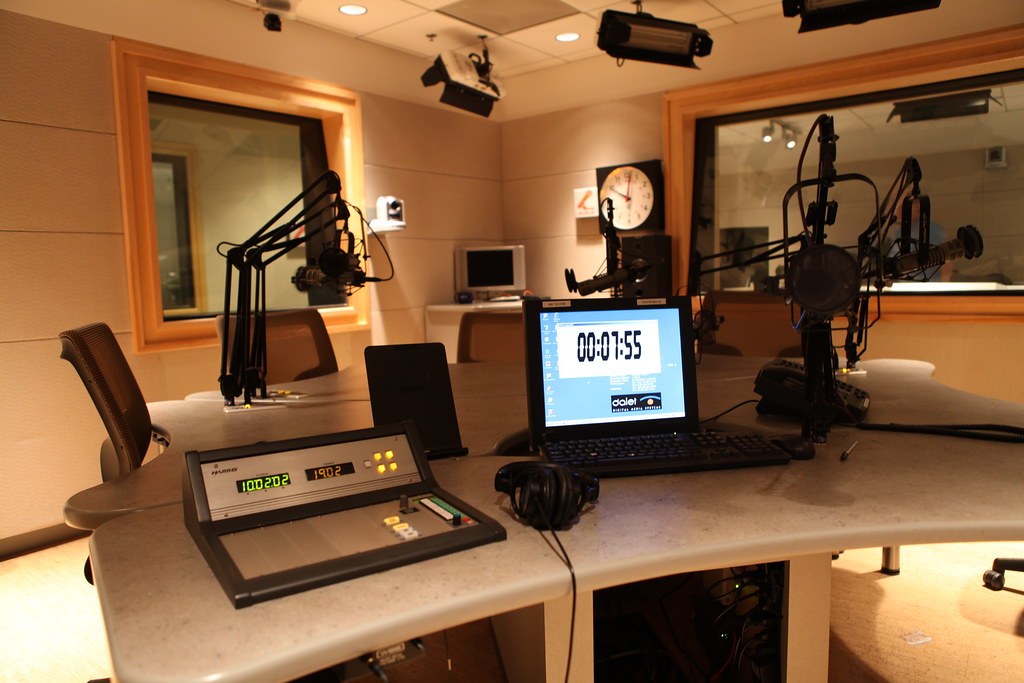
I was interviewed by the BBC for a show called “Click!“, the results of which are available, to some extent, at this link. To do this, the BBC rented space near where I was in San Francisco that week – they actually used a studio called KQED. Here’s some shots from that:

In this particular case, the engineer was a little off the ball, dragging on with the previous setup so that the rented time that the BBC had was cut by a half-hour. We got on track pretty quickly, and my two hosts were very talented at bringing the whole thing a sort of growly-sexy “now, we’re all having a bit of a fun, but what of the deeper meaning” vibe that I only really see in English programs. I was coy about the names of companies Archive Team was targeting that week, mostly because I didn’t want it to filter into boardrooms and cause a panic mode, but the BBC guys sussed out which companies I was talking about anyway, so kudos for doing a little legwork. As you can see from the photos, you sit at a desk and have a huge microphone, as well as seats for other guests and speakers with everyone looking at you. KQED is a hell of a nice studio, and it was a pleasure to be in there.

Perhaps it’s a little jarring that you don’t see your hosts, and will never see them, but the people involved tend to be professionals and end up making it like the greatest-sounding phone call of your life. It’s a fun gig and I will happily continue to do them.

So contact came in from a producer of the NPR show “On the Media” to discuss Archive Team, and it’s obvious they wanted it because of a relatively recent magazine writeup, as well as wanting it right away. After some back and forth discussion, I ended up on the phone with the producer for a “pre-interview”, which a person used to podcasts might not have experienced – basically, the producer conducts almost an entire actual interview to determine whether or not you’re retarded. If you’re not retarded, you get to go on to an actual interview with the host, at some point down the line. Most shows can’t afford to rent a studio, much less throw a human being at you to spend an hour interviewing, but when they do this, it generally means you’re dealing with a top tier organization.

As I said before, I get pulled into Archive Team representation a lot right now, but for the past half-dozen years or so, I’ve actually been on a secondary mission/goal – to spread and share as much of my life outlook and learned lessons to as many people who are prepared to receive it. To that end, I’ve tried to share with other like-minded compatriots whatever it is possible to share, so that my ideas and the things I care about outlive and outreach me. It’s a nice goal.

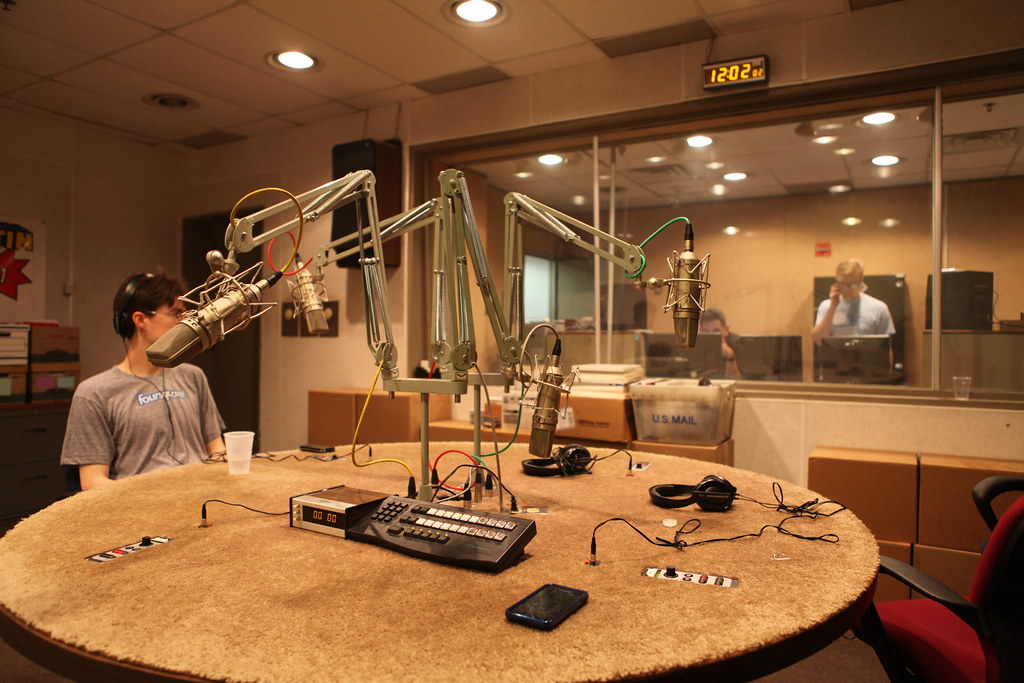
And that’s why I was in a studio in Austin, Texas, during the South by Southwest Festival, to speak about Archive Team with the NPR “On the Media” show. And why I brought along Astrid, one of the Archive Team members who happened to also be at South by Southwest. Here’s what the studio we were at for it looked like:

I was trying to show Astrid how the pros work, so she could learn how to react quickly to whiplash questions and clarification requests from one of the bigger names. Unfortunately, it didn’t work out that way.

After the 20 minute delay getting started while we cooled our heels (and by the way, the engineer for our session, David Alvarez in the window there, was pro beyond pro and a pleasure to work with), we were finally connected with my interviewer.

I should have sussed out what the next 35 minutes were going to be like when the VERY FIRST part of the conversation went this way:

JASON: Hi, how are you doing?

BOB: (Pause) I’ll be a lot better later.

What followed was a stumbling, barely coherent host jumping all over the place, and peppering questions of all variant quality, interspersed with commands to his engineer/producer, the kinds of things you generally want to say POST interview. Not here.

I think the best moment, however, and one which thankfully didn’t make it to the final cut, was when we were discussing Archive Team’s proactive methods, Bob told the story of OJ being arrested for threatening someone at gunpoint over his own property and going to jail for years, and asked how we’re different. Nice one.

Anyway, I was mostly sad after all this because I could see how disappointed Astrid was. I’m not saying they made Astrid cry, but what a better use of our time if we’d been in the place of greatness. We were not.

Is the final work a nice one? Yes, someone in the On the Media organization edited the hell out of that thing. Does that mean I should shut up and take it? Nah. I’m telling you how it went down in the event that someone else gets Bob on the wrong side of the bed one morning and thinks it was them or their fault. It wasn’t.

If I have to give one piece of advice I’ve learned over the years of dealing with news media of all stripe, it’s that you get all kinds. The ones who respect you and make the audience informed about your subject while adding their own insight – those jewels should be given your respect and time. (Kim Zetter, call me, we’ll do lunch.) But if you find yourself on the ass end of a paddling for nothing other than a lazy or distracted or resentful scribe, hang up or resolve never to deal with them again, if you don’t realize it until it’s too late. Trust me, there’ll be others.

Hey, I warned you about reading further!


…and here we are. —

It took a lot to get me to move the ASCII weblog. A ton, a mass. You have to be a certain high quality of assmunch to get me to throw half a day into the fire and slowly, painfully move 9 years of website, of individual, unique quirks and odd choices, buried under the sands of time and forgotten lore. You have to be that awful that I find the need to get away, as fast as I can, and then subject myself to untold additional hours fixing up the resulting mess.

Dreamhost is all that.

I don’t have any desire to go into the full details, other than to say I watched my dreamhost accounts get compromised, I watched test directories I set far apart into new users get compromised, and as my site would regularly get taken over for google-bot-oriented spam, I could then see the pain, the misery, the sadness of trying to figure out what I needed to do. Counter this with the fact that when the chips were down on several occasions, Dreamhost kicked me so hard into the curb my forehead still says “protect our rivers” backwards, and it just came down to “oh, I really gotta get out of here”.

Finally, while I was getting some very nice and kind attention from Jeff Atwood on his Codinghorror website, the machine this was hosted on went down, and then it came back a day later, and the load has been 112 or greater on that thing since then. I don’t care about the excuses; the site flat out stopped functioning. It was dead.

Well, they did it – I’m gone. I still have stuff over there, but the march has begun. If I have anything in my defense, it’s that when I started with this 9 years ago, things weren’t so bad. But like all shared hosting, the bloom comes off the rose and the next time you look up, your head is being slammed against the footboard and there’s nothing but slack-jawed dimwithood when you try and make things better.

I’m now hosting with TQhosting, who have been hosting the main textfiles.com site for years now, to perfection. Sorry it took me so long, folks.

Let’s get back to writing, shall we?


Listen! (A Lost Project) —

A while back, I was asked to take some of my recordings of telephone conference lines and arrange them into some sort of recording or demonstrative collage. The idea was that it would be a cornerstone of a presentation and appearance at an event. Over time, I decided the event was not something I wanted to be part of, but in the meantime, I’d created a collage of telephone conference recordings, as a prototype. As I figure I spent some time on it, and some folks enjoy my editing, I thought I’d drop it here.

It’s about 20 minutes, uses a bunch of CC-SA music, and combines probably 20-30 clips from various voicemails, conference calls and the like from the audio.textfiles.com website.

It’s a little strange, a little jarring, occasionally transcendental. I guess the best name for it is “Listen!” because that word shows up a few times in there. The influence of the Negativland KPFA show Over the Edge should be obvious. And if it’s not… you should really check out the Negativland KPFA show Over the Edge!

Enjoy it with my compliments.

Listen!


Javascript Hero: A Hero Appears —

Last October, I gave a call to arms on this very weblog to help port MESS to Javascript.

Five months later, I want to share a working protoype.

So, with the caveat of it only working in the Google Chrome browser, of it only showing you a single Colecovision cartridge, and of it having no sound or keyboard input, allow me to introduce to you the working prototype at:

http://jsmess.textfiles.com/

If it doesn’t work for you, then I’ll tell you it looks like this:

The rest of this entry is just discussing the details, the repercussions, and the plans for this project. Summary: FUCKING AWESOME.

Obviously, the half-dozen people working on this project weren’t spending all waking hours in the last five months on getting us to where we are now. In a few cases, weeks went by as people lived lives, or we were waiting for someone to get off work, or just the occasional miscommunication and “oh hell, I thought you were doing the git push” sort of thing. The main project discussion, for a long time, has been here, if the nuts and bolts of the shared development project interests you.

The primary push has been to use the Javascript converter Emscripten to port MESS over to Javascript, and making that happen required a lot of bugfixes, some on the MESS side but also on the Emscripten side. It also required modifying makefiles, disabling assembly language routines, and bumping into all sorts of oddness. The primary developers of this whole project have been Justin de Vesine, Alon Zakai, and Justin Kerk, although there’s a lot more who have stuck their noses in in various fashions. Some stuck their noses in to tell us this was all impossible; the less said of those folks, the better.

The resulting Javascript file, mess.js, is 16 megabytes. Due to modern browser capabilities, it is pre-compressed down to 2 megabytes for transfer, but then it expands, and we run into the current situation that this sucker horks a ton of RAM. (In fact, it appears this does run in some versions of Firefox, but it really wrecks it when doing so, so I’m not going to count it.) This is, like I said, the prototype. We’re just working to make it function, and then we’ll expand back into making it function well and be much more efficient.

What’s important to me is that the prototype, the proof-of-concept, is an emulation of a Colecovision running a homebrew cartridge, Cosmo Fighter 2, by Marcel De Kogel. It’s a Colecovision running in a window! We chose Cosmo Fighter 2 because it kicks into a demo mode immediately, needing no keypress, so you can see the scrolling starfield and the text and the general speed of the thing right away. It bodes well. Obviously, as we head upward into more contemporary systems (the MESS emulator emulates such late-model systems as well as really old ones), the slowdown going through javascript going through a browser going through an OS may in fact be legitimate murder. But let’s not get ahead of ourselves with the fault-finding.

What we have here is Pat Crowther yelling “We Have Cave!“. It’s Neil Armstrong going “Holy shit“. It is a seriously big deal and it’s going to get bigger.

I think people forget how we used to tell people how things sounded and how they looked. We used to tell people this new song was really awesome. Now we can not only link to that song, we can link to a specific part of that song. And we might have said we saw something funny or amazing on a show, and we can now embed that specific event right into a webpage, and show them. OK. you probably sort of get how incredible that is, or at least that it happens, but sit back and think again what that does: it means that items of a visual and audio nature are as ubiquitous as the words we used to describe those items. This song is awesome; listen to how awesome this song is. This dude is fucking hilarious on this show; see how hilarious he is. Or, if your bend is more academic: this bird emits a unique cry; here is the cry it emits. The algorithm results in a very interesting outcome – come see the algorithm’s visual result.

As we press forward on JSMESS, the Javascript MESS project, we’re proposing to do the same to computing experience. We’re going to make things that happened on computers into an embeddable object on computers. Yes, you can certainly download a disk image, download an emulator, run the disk image on the emulator and then be able to see an old program run, but that’s a lot different than, say, putting up 10 windows in a webpage where if you click on any of them, you can immediately see what every major spreadsheet program on the Apple II looked and felt like. It’s nothing near as awesome as being able show you how Print Shop developed over the years. Or let you see, side by side, how the Atari and the Apple version of a program behaved. Once we’re done here, it’ll be trivial, a calling with a few options, a pittance of effort. The experience of any moment of computing in the past 50 years as an embeddable object. And once we’re done with that… then we can focus on the really amazing stuff.

While the team has things under control right now, it never hurts to have a few more people hang out and see what’s going on. The work is being discussed on the EFNet IRC network, in the channel #jsmess. If that doesn’t sound like your cup of tea, that’s fine. I’ll keep you appraised of future milestones.

Everything’s going to change.

It’s going to be very exciting.