ASCII by Jason Scott

Jason Scott's Weblog

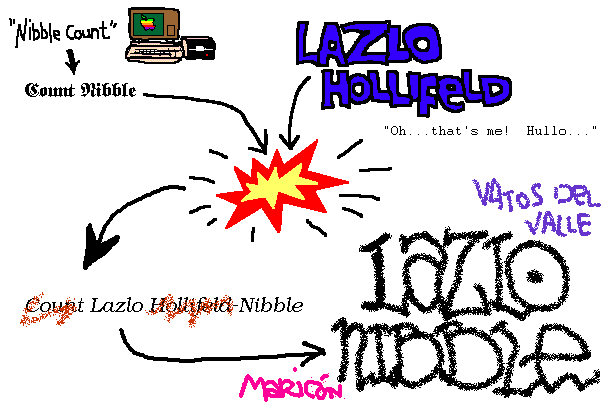
AN APPRECIATION OF COUNT LAZLO HOLLIFELD NIBBLE /\/oo\/\ —

I am occasionally going to reprint articles elsewhere, for this relatively new audience. This is from a year or two ago. Write your own, too; you’ll be glad you did.


It’s too easy in life to forget the people who helped make you what you
are, who inspired you and gave you the early lessons you took to heart.
Sometimes, what they have to teach you is so basic to your personality
that you don’t even recognize that they come from somewhere else besides
you.


I’ve got a number of people like that in my past, and every once in a
while, if I’m lucky, a memory comes back to the surface about that person
that takes me back to those formative years. Today, that memory is of
Count Nibble.


By the early 1980’s, I’d already found my calling: collecting textfiles on
BBSes. I was throwing them to floppies as fast as I could, logging onto a
board and not stopping until I had entirely leeched their G-File or Text
sections clean of everything I’d not seen before. If the site required
validation, that was fine; I marked them down, entered what I needed to, and
got back on the next day, validated, and sucked them clean. I was a kid
with a mission, barely into my teens, thinking he could make a name for
himself with a collection.


But after a while, you can get discouraged
by file after
bland file, all
written like they were notes to themselves and left on the BBS by mistake.
I grabbed all these files out of a sense of duty to my collecting, but I
would barely read them as they went by. My own writing style wasn’t so
hot either, and I was producing the typical kind of
sub-par writing
one might expect from a clueless suburban kid. But I knew quality when it
went by: those 80-column, upper/lowercase writings, long, well-thought out,
almost as if they were “professional” in a pile of amateurish jotted notes.


I forget where it first happened, probably on an Ascii Express (AE) Line
that had a bunch of files on it, but I came into contact with the work of
Count Nibble, and everything changed.


He was certainly memorable with his unique signature, an ASCII bat that
stared at you after his name:

/\/oo\/\

But beyond this piece of cleverness stood a white-hot light of talent
that blinded me to the other works appearing on the boards.


Here was a guy who could not only write, but who organized his text and
thoughts with a practiced, steady hand. While in the adult world one might
have access to high-quality text all the time, this was a huge rarity in
the teenage-weighted places I found myself online. It was like a breath of
fresh air when you didn’t even realize how choking the room had become.
The 80-column screen wasn’t empty to Nibble; it was a
canvas he
painted his words onto
, taking advantage of the unique properties of
ASCII and ensuring that all things were in their rightful place. It wasn’t
just about throwing in lines and ASCII artwork to jazz up the piece; he
used space and breaks
to organize his thoughts so that it all seemed that much more important.
Capitals became headers, dashes became breaks, and when you got to the
bottom of the text you felt you’d learned something, not just subjected
to someone’s lame opinion for 3 paragraphs.


He produced the Countlegger Series, a collection of textfiles written by
others, meaning he was also a collector. But where I was happy enough to just
have all these files, he would create these
compilations that
he would distribute on BBSes and AEs for others to download. I might have
had eighty or ninety percent of these files in my collection, but the way he
listed them in the contents made me excited anew for them; he showed me the
treasure I didn’t know I had.


He even took
files by
others that perhaps lacked spelling or clarity and fixed them up, not wiping
out their names but simply adding his own, showing his own mark of quality.
This was a moral lesson, of sorts, that he passed on to me; I never took
someone else’s work and threw my name on it just because I thought it would
bring me glory. I might fix it up and credit my editing of the file, but this
was to put my own name behind my work to make someone else’s work clearer.
Plagarism and theft seemed unfathomable after seeing Nibble’s efforts.


Lazlo had his own BBS, the Terrapin Station in 505, which was itself mysterious
and interesting to me; I had no knowledge of New Mexico whatsoever, and it
was a rare BBS indeed coming out of the area code. This only added to his
mystery. I only got on there a few times, but I made it a point of reading
what I could. His Grateful Dead reference didn’t rub off on me (and in fact
went over my head, setting me up for a shock of recognition years later) but
his attitude and approach to running his BBS sure did, and I know I ran
my own BBS, The Works, in a similar fashion when I started it a year or two
later.


If we ever talked at that time, it was probably furtive, a few minutes
in a chat session on his board. But what would I have to say or offer? I
was 15, just happy to be there in his work, enjoying the talent and care
he put into his online persona. There were lots of people I hung out with
and transferred files and went to parties with, but Nibble was there, in
the background, in another distant place, a goal to live up to.


Ultimately, Nibble drifted away into the world of the Internet and Usenet long
before I had a chance to, where he gained a name for himself making absolutely
fantastic
Discographies and mailing
lists
for bands that I, independently, had come to like very much.
Gone from BBSes and moved on, he found a new home and expressed himself
just as wonderfully there.


Like most stories, this could have ended with these memories, but a number
of years ago I was searching for his name and happily stumbled upon
Count Nibble’s Homepage. With
all the same talent he’d shown a decade and a half earlier, Lazlo Nibble
now provided
the history about
himself I had never known
, a
retrospective
of his Apple II days

and best of all,
the
files he’d written back then
. Some he’d even gotten from
textfiles.com! As an added bonus, he even explained
the story
of his name and why it kept changing
.


Time had not dulled his talent, the world wide web had not diminished
his efforts, and my own growing up had not fogged the perspective he’d
bestowed upon me. Rare do mentors live up to such standards.


So thank you, Count Nibble. You helped make me what I am.


– Jason Scott

December 9, 2002


Documentary Triptychs —

A old high-school chum of mine, Terry Tocantins (pronounced TOH can TEENS), was the producer for a rather unique and interesting documentary called “A Galaxy Far, Far Away”, which told the story of a group of hardcore fans who waited outside a theatre for 30 days before the premiere of the new Star Wars film, The Phantom Menace.

Except that it’s not a unique documentary. I have found three films dealing specifically with the group of hardcore fans who waited outside the theatre for 30 days: A Galaxy Far, Far Away, Starwoids, and Millenium’s End: The Fandom Menance.

In fact, the “Waiting in front of Star Wars” Documentary genre has a “grandfather” in Tatooine or Bust, a documentary about fans camped out in front of the re-release of Star Wars (the original) in 1997. This filmmaker also made “Star Wars or Bust”, which I am not counting among the three because it’s 15 minute film and more a quick overview than anything else. There’s also The PhanDom Menace, but that concentrates on the AUSTRALIAN build-up to the 1999 release.

And have no fear, if you’re concerned the more general “documentary about fans waiting out in front of highly-anticipated films” genre going under, because we will soon be able to experience Ringers: Lord of the Fans, covering, well, you guessed it.

These are what I call “Documentary Triptychs”, sets of multiple documentaries which are all aimed at the exact same subject, but usually not the exact same way. To any casual observer, of course, they are in fact the same thing, but that’s where advertising and marketing is supposed to separate the winners from the losers.

Generally, there tends to a Hertz, an Avis, and a Rent-a-Wreck. By this, I mean a certain documentary pulls out in front, another documentary is behind it but likely similar in relevance and energy, and then there’s that third one, the one we don’t like to talk about. The third one usually trails the two by a significant amount, and seems to have been made for either five bucks or in 10 minutes.

Just the other day, I learned about Uber Goober: The Movie, which calls itself “A Film About Gamers”, that is, players of role-playing games. It was on DVD, so I immediately bought a copy. I then wondered if there were any other such films. Some considerable searching revealed Life With the Dice Bag, a “Documentary about Role Playing Games and the people who play them”. I have no idea why this was so hard to find, but that’s nothing compared to Dragons in the Basement, a documentary by Dave Arneson, the got-the-credit-in-a-lawsuit co-creator of Dungeons and Dragons. This thing is buried next to wherever they store Lawn Darts. With considerable effort, I found mentions of it here, here (wherein we learn the actual director is not Arneson but John Kentner), and here. And here. Nearly completed in 2000? It’s 2004? That’s a REAL Rent-a-wreck. Well, at least we have Jesse Spiro’s equally-obscure-and-hard-to-find-but done Dungeons and Dragons Experience… And there’s your triptych.

You can do this with a lot of obscure stuff and documentaries. DVD technology now means we have some amazing projects out there, things that would never have otherwise seen the light of day. And now we get three of them.

Well, except in the case of Pixelvision. I think that documentary genre’s closed out.


How It’s Done: Digitizing and Culling —

I’m going to go over the process of taking my video footage to where I can edit it. I’m doing this because there’s a relative dearth of explanation from people how they do things, and it’s just a nice thing to leave it up where others can find it on a search.

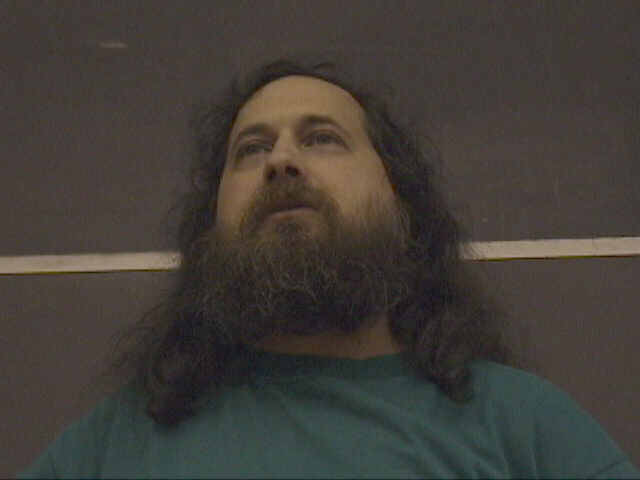
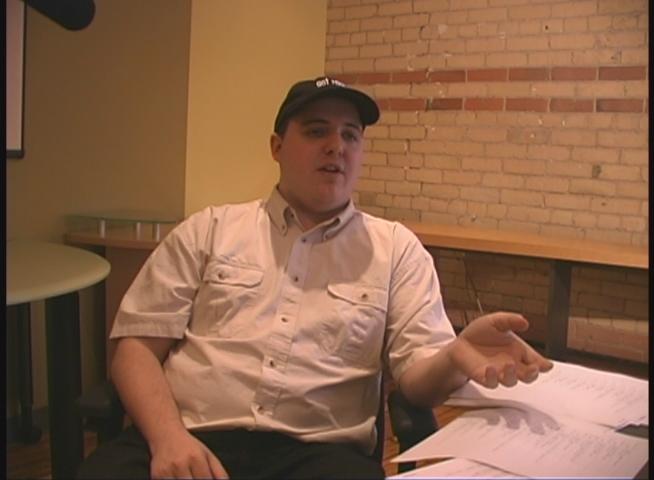
I made the decision when doing pre-production of the documentary that it would be on video. The cost difference is both breathtaking and depressing; while there is no question that there’s a noticable difference in image quality (simply compare this video shot of Richard Stallman and this film shot of Richard Stallman) the costs of film are many times more than even rather expensive video setups. I simply concentrated on shooting the video like film and lighting it as best I could with pretty good results.

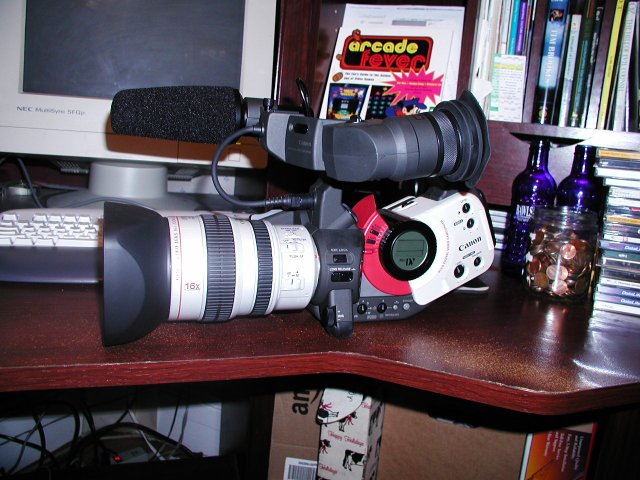
I recorded my documentary on a Canon XL-1 with a special attachment (that cost $200) to plug in an XLR boom microphone. The tape format is Mini-DV and the tapes cost me roughly $3 apiece because I bought them in a 100-pack. (So it was $300, but I had more than enough tapes to finish the filming without re-buying.) The Canon XL-1 is very light, very easy to use, and expensive by some standards and cheap by others. I paid $2700 for my camera at a time that they were generally going for $3900 (mine had been a floor model at B&H Photo for a while.)

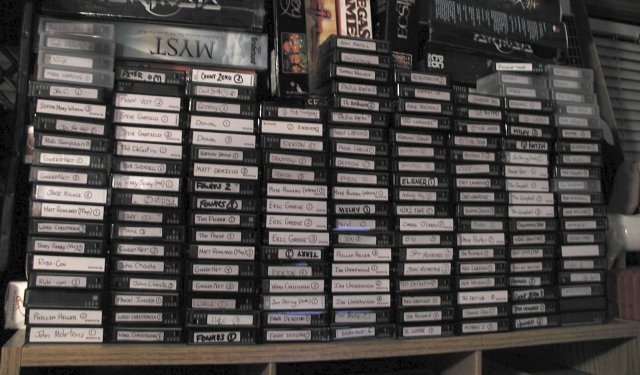
The result of several years of filming yielded a pile of Mini-DV tapes with labels on them telling me where they were recorded. These were stored in a large box:

tapebox.jpg

Since I’m getting towards the tail end of the production, I’ve got a much smaller pile to show there, but in fact there are over 200 tapes in the set. This isn’t counting little tapes I used to record versions of videotapes, specific events, or other additional footage.

To edit the footage, I need to take the information on the Mini-DV tape and put it on a computer. Currently, this is the setup I use to digitize these tapes:

rig.jpg

I’ll go through the different components so they’re all explained.

The laptop has a program called Vegas Video on it. It used to be called Sonic Foundry Vegas Video, but now is called Sony Vegas since Sony bought out that part of the company. This program has a video capturing program (called, basically Vegas Video Capture) which pulls the digital recording from a Mini-DV tape in a device and turns it into a large file.

This requires a device that will play the tape, and in fact my XL-1 has a digital video out (also known as Firewire or IEEE 1394) to plug directly into my laptop. But instead of using the camera this way, which would lead to unneeded wear and tear, I purchased a Mini-DV Videotape Recorder (VTR) called the Panasonic DV-1000:

dv1000.jpg

This item cost me $1,000 to purchase in 2003, and has been very worth it in terms of less wear and tear on the camera. Otherwise, the only way to transfer the data of these hundreds of tapes would be to run them through the camera, one by one, which would wear out the mechanism that much faster. It’s got lots of features I don’t use in the slightest, and can take input from a variety of connectors, meaning that if I choose to I could record my TV shows or old VCR tapes onto it, which would be wasteful… but nice!

This brings up the issue of where to put the digitized video and audio. Each digitized tape works out to roughly 13 gigabytes of data before being edited. This is, by most standards, an awful lot of disk space. So, to accomplish this, I buy very large drives. Here’s what one looks like:

usbdrive.jpg

This is a 250 gigabyte drive, hooked up via USB 2 to the laptop. It can transfer data fast enough to write out the video flowing in from the VTR and through the laptop, with processing power left over to show me a video/audio preview. (When doing this on my main machine, I can’t do video/audio preview without losing frames.)

At the end of this process, I end up with a collection of large files on the USB drive, which I then hook up to my editing machine and begin going through.

….and now you know.


The Disks of Mister Keegan —

Throughout the production of the documentary, there have been a number of projects I have picked up, related yet not related, which have sat and waited for me to get to them. Some of these projects involve doing work with the possessions of others that I have been holding for (in some cases) upwards of two years. This has been understandably troubling to these folks, since even though they weren’t using them per se, they still liked having them around.

Such is the case with the Apple II disk collection secured for me from one Jeff Keegan, who was interviewed for the documentary a good while back and who still stands as one of my favorites. The reason he stands as a favorite was that Jeff was somehow able to channel his early BBS days almost perfectly, a rarer feat than you might think. The sound is good, the shots are interesting (with his two pinball machines in the background) and the subject matter is almost 100 percent about bulletin boards, another rare feat; 2 hours of clips and quotes.

He mentioned he had his old Apple II disks around at his parents’ house, and when I was invited some months later to a party (Jeff and I live near each other), he had a whole stack of disks for me to take with me. Months passed until recently, when I set up an Apple II transfer station to allow me to move the data from the disks to images in windows.

I will take a moment to explain this process, should anyone be interested and not have looked up how this is done. It’s actually pretty enjoyable to do and contains some cool aspects.

The best device for reading an Apple II disk is an Apple II, but then you lose a lot of the advantages of modern operating systems, such as internet connectivity, multi-window ease, and, oh, subdirectories. What would be an ideal situation is the use of these Apple II disks on your modern machine, but how do you make this happen?

There are a number of emulators out there that emulate Apple machines to various degrees of accuracy. On Windows, my personal front runner is the confusingly multi branched emulator AppleWin. But in fact there’s a bunch of them. There’s Apple II emulators for the Macintosh and Linux and a host of other platforms as well.

All of these emulators need disk images. That is, binary files that have the information that would normally be placed inside a 5 1/4″ floppy disk (or a later 3.5″ PRODOS disk) but sitting, quietly, inside a file on your hard drive. Because of the fact that early-adopted emulators were of arcade games, and those arcade games used ROM chips to store their programs, these disk images are now called “ROMs”. Fighting this lexigraphical mutation has been the source of a lot of lost energy.

So, the way that these images are transferred from Apple IIs to PCs is via a wonderful program called Apple Disk Transfer, or ADT. through a serial connection between the two machines. Through what I consider one of the coolest software maneuvers I have witnessed, you type in two commands on the Apple II (which aim all serial connection input as if it were being typed) and then it proceeds to enter in the Apple II client in machine language via the serial connection. It is very hard to describe how absolutely thrilling this is, to see an innocent Apple II taken control of and turned into a disk transfer station before your eyes. After it comes up as the client, of course, you can transfer disks to and from the Apple to your PC. the “and from” is very helpful because there is a disk image for making your Apple into a client from the get-go, from booting a floppy. It’s also cool because you can take your disk images and theoretically copy them to new floppies, getting pristine copies of your software back. I say theoretically because it’s very very difficult to buy compatible floppies; not the sort of thing you can go down to the store and do. Believe me, I have tried.

This is what my Apple II looks like when it’s functioning as a client:

applepc.jpg

All those white squares are bad blocks on the floppy; this is a particularly unhappy floppy. I found a lot of unhappy floppies in Jeff’s collection, worn out and nearly dead from years of disuse. This is the nature of things, when you have a material that depends on magnetism and is stored under anything but ideal conditions. However, for every dead sector I got a lot of completely fine disks, brimming with cool stuff.

All in all, 221 disks were rescued from oblivion by this process, turned from tiny artifacts to easily transferred files. Compressed, the whole collection is 9.75mb (expanding to 25 megabytes). Some of the disks are commercial games, cracked and made easy to copy (the client cannot transfer copy-protected software), others are interesting public domain disks and utlities that Jeff or his family downloaded. And, of course, some of the disks are his BBS, Xevious, that he ran for a while in the mid 1980’s.

Most interesting to me along my own lines, of course, are two types of files: straight textfiles downloaded from BBSes and ASCII Express lines, as well as “pirate utilities”, a small amazing sub-set of Apple II programs where people could create their own “crack screens” to put in the front of programs. These are great artifacts to me and the textfiles are on their way to my site.

Many people have taken their old collections and done this process. In fact, there are places you can go to get thousands of them. One can debate the morality or ideal situations regarding this occurence, but I am tired of doing so. More than likely, if there was a program you yourself did not write that you have in your memory, it’s somewhere in that collection. But if you made your own stuff, or downloaded your own messages or ran your own BBS, please consider transferring your data or arranging to send it to me. You’ll be glad you did.

Ironically, while I’m doing all this work and adding this entry, I am currently editing an interview with the Midwest Pirates’ Guild (an Apple II cracking group, also known as MPG) and Greg Schaefer, creator of GBBS and GBBS Pro, Apple II BBS programs that shaped a lot of BBS history. History? I’m soaking in it.


BBS Documentary Update —

It is a surreal feeling, having pushed a rock up a hill for a very long time, to find the load suddenly lighter. In fact, as you consider it, the rock is not just getting lighter, but is possibly moving on its own. At that point, it will dawn on you that you have in fact pushed the rock over the summit of the hill and you are following it on the way down the other side. This is a excellent time to hold on tightly.

Such is the case currently, where three years of production are now flying together at a head, combining the research and information I’ve been sent from hundreds of people with the 200 interviews I conducted throughout the continent. Where before I was quietly mulling through footage and considering the next moves, it’s now a case of finishing up the last few hours of culling, assembling the sequences, and putting the whole thing together before it becomes a DVD set.

People ask me when it’ll be ready. I tell them I intend it to be ready for the end of the year. I still think that’s the case. This is much later than I intended and originally announced, but that’s because I am, after all, a single person. The constant motto is “Quality Trumps Deadlines”, since I’m not working on the same goals and pressures that most people are in these sorts of projects. I think the extra time it took me to assemble many of the interviews worked out in favor of a better creation.

What got me really fueled was committing to show “footage” at DEFCON XII, a convention in Las Vegas. I promised people would be seeing some preview footage, and as the day grew closer this promise was somewhat challenged by the complete lack of any actual footage to show.

With a week before the show, I stopped culling footage and instead turned towards creating something that would show what the episodes were like, using actual clips from interviews. It took nearly the whole week (one of the sequences was finished hours before the flight to Las Vegas) but in the end I produced a 16 minute run-through of six of the seven episodes, along with a new trailer and some other related material. While it was close, I didn’t end up in my hotel room furiously piecing things together on a laptop, so there are small victories involved.

The actual talk I gave bookending this footage is already archived on archive.org, sans the audio of the 16-minute clip (you miss too much stuff with it in there). The audience seemed to recieve it well, and reacted to it positively, so I know I’m onto something.

There have been some consistently asked questions in recent months, and so an actual and real “Frequently Asked Questions” list is building up. Let me answer some of them here, so they’re in one place.

This will definitely be a three-DVD set sold via myself and a number of partnering organizations in the style of amazon.com or perhaps fusecon.com. It will retail somewhere in the range of fifty dollars. I am not splitting up the DVDs, I am not selling it on VHS. The production will be released under a Creative Commons license. It is multiple separate episodes, not one long movie. It will be subtitled as an option. There will be easter eggs. There are people who are really cool and who you really admire who will be on the DVD, but there will be people who are cool and who you admire who will not. This does not make them any less cool and admirable, or mean I don’t think they are. Perhaps there will be a short version that plays for an hour and goes on TV, but it’s not overly important to me that there be one. It’s also not important to me that it be on cable TV or regular TV; with a beautiful digital format that gives you full on-demand navigation and many hours of footage, why would it be?

I can promise you that there’s definitely a “there” there, that is, the final works are definitely something substantial and interesting, especially if you know about BBSes in some fashion. If you don’t know about BBSes but can operate a computer with comfort, then you will likely find it interesting and substantial as well. It will have ways to “ramp up” on the subject enough to then watch the episodes. I will be very proud of the final product and will look forward to the positive and negative comments I’ll be recieving for months after it arrives.

I am not pleased with myself that I let things go on so long between updates; but I kept falling into not wanting to sound boring and uneventful. The editing process itself is not boring to me, but describing the victories, I find them very quiet: a particularly good line, an item in the background falling off a way, or an amazing counterpoint to a statement made thousands of miles away and months ago. I interviewed some smart people indeed.

Onward. Expect that in September you will be able to pre-order this documentary.


Unusual Documentary Wrap-Up —

I thought I’d mention a few documentaries I’m aware of that are either out or coming out, since I know that I would appreciate the same in their shoes. Time will tell if my release date (which is the end of this year) will coincide with theirs. It nearly goes without saying that I intend to purchase all of these as they become available.

Chuck Olsen has been spending a significant amount of time on what he calls the Blogumentary, an overview of The Weblog and its characters and present-day existence. He has spent no small amount of time on this, and his approach and writing mirrors a lot of my thoughts with the BBS Documentary. He and I disagree on a number of (minor) points, but that’s why he’s doing what he’s doing and I’m not. Unlike a lot of documentaries in progress, his example footage page is extensive and informative, and lets people make decisions about the project right off.

Greg Meletic’s documentary, The Future of Pinball, has been in production for well over a couple years, and yet there is almost nothing out there linking to it. It almost feels conspiratorial. This is a documentary covering the last great attempt by one of the last big American pinball companies, Williams, to revitalize Pinball by creating a next-generation system. Called Pinball 2000, it turned pinball machines into heavily modular systems, with the arcades and venues buying the husk and then being able to get new playing fields and art for the machines as new games came out. Unfortunately, the boat was missed and Williams got out of Pinball, but Meletic’s documentary gives us some of the story. His People Page reveals that he interviewed a number of real heavyweights for this project, people whose knowledge of pinball adds up to many decades.

Without going too much into controversial waters, I’ll buy a copy of Michael Moore Hates America and put it next to my DVDs of Fahrenheit 911 and Bowling for Columbine. I have a big shelf and there’s plenty of room. And yeah, I bought a copy of Outfoxed, too.

The Joystick Generation has been in production for quite some time, and I’ve been watching the progress, such as it is, by sneaking around and finding both the production company and ultimately the filmmaker’s personal website. His actual weblog reads like a man lost, missing direction, hanging out in Thailand working on his joystick generation movie AND a new one on 8-bit music….. but I hold out faith for the boy. I have to; he’s one of us.

I’ve been watching and waiting for the release of Bang the Machine for so long, I’m starting to think the whole thing is a myth. The website went away for a while but seems to be back. This overview of Street Fighter championships was made a couple years ago and it’s just a matter of waiting, I guess. And to pair it up really strangely, at the HOPE conference I spoke at in NYC, the 2600 team finally released the DVD version of Freedom Downtime. This movie about the Free Kevin movement (of which 2600 was the main supporter) is really enjoyable to watch, and has a mass of extra footage on the DVD.

I am no longer convinced that Gamers, Frag, and Oh Kay Computer will ever be released. A shame.

More of these documentaries as I find them. And let me know if there’s ones I should know about.


HOPE Conference Speech: “Preserving Digital History” —

The talk I gave at the Fifth HOPE Conference over the weekend is now available online. “Saving Digital History, a Quick and Dirty Guide” is an overview of the issues and perspectives in collecting digital artifacts, an explanation of how integrity and perfection are not always salient attributes, and a good heaping bucket of odd trivia.

I record all my own talks, augmenting what the conferences do themselves (in the case of HOPE, they had an excellent staff and stage manager that kept things going smoothly), and this allows me to be quick with the full content. It also falls into my general theme of life: save things yourself if you want them to be saved.

I also have a number of photographs I took in three galleries.


An Awful Lot to Talk About —

I am happy to announce that I have had talks accepted at both the upcoming HOPE and DEFCON conferences. If you wanted to meet me, this is the best time to do it. If you’ve already met me, this is a great way to do it again.

CAPTURING DIGITAL HISTORY: A Quick and Dirty Guide
HOPE (Hotel Pennsylvania, New York City, July 9th-11th)

Knowledge doesn’t move forward without history, and while there have been many steps to capture the stories, lore and data of different aspects of computer cultures, a lot of the same mistakes are made over and over. In a fast-paced one-hour talk, Jason Scott busts out some ideas, tools, and mindsets towards halting the loss, bringing the stories back, and making something to build upon instead of throw away. Along the way, expect a few bucketloads of trivia and memories to sauce up the proceedings.

DIGITZATIONS AND DOCUMENTARY
DEFCON (Alexis Park Resort, Las Vegas, July 31st-August 1st)

Jason Scott of TEXTFILES.COM, a site dedicated to the history of Dial-Up Bulletin Board Systems, embarked on a quest to film an all-inclusive BBS documentary in 2001. What started out as a one-year project grew to three, and what started as a two-hour film will be a six-hour series. Thousands of miles of travel and 200 interviews later, the production is now nearing the end of editing and the release date. Jason tells you what he learned, why you shouldn’t hesitate to make your own projects, and the occasional story that technically can’t be mentioned in the film.


BBS Documentary: June 17, 2004 —

Like a lot of filmmakers, I have fallen into that “no new news” hole that leaves the waiting public in the dark while no progress or information comes leaking out. Unlike a lot of them, I will try to explain why that is.

For the last 3 months, I have basically been doing the clip culling that I mentioned in my previous news entry, wherein I take an hour of footage and turn it into a small pile of smaller clips, somewhat sorted for their possible final resting place in various episodes. This work is tedious, uneventful, and hard to keep updating folks on (“yes, I am STILL culling!”) and so I simply let the previous entries speak for themselves, because they were still quite applicable. I have gone through about 100 hours of footage, knocking it down to something like 10 to 15 hours. Obviously these hours will be knocked down even further in the final editing, but I need some flexibility depending on which sequences I think fit the different episodes. There are, roughly, 60-70 hours of footage left to cull, which are going very fast because I am an old hand at this by now.

If you are completely addicted to knowing every little thing being done, I started a little worklog that has no-frills day-by-day blows of what is going on. I will not explain what I write there, but stuff gets added nearly every day to it, so you can see motion if you want.

This is the required groundwork of any production; many places have interns or other folks working on it 8 to 12 hours a day, going through footage, getting out good examples of takes or shots, and then presenting them to the director or the editor to make choices. Since I’m the director, editor, AND the intern, I get to do everything at once, so it’s me with the 8 to 12 hours a day.

I should hasten to add that this work is not ALWAYS tedious, since I am in fact watching the full play-out of interviews I conducted months or years ago. In many cases, people are absolutely brilliant with their responses, considering I gave them little hint on what I would be asking, and for the fact that I often would switch questioning quite dramatically to make sure all relevant subjects were covered. While listening to the answers, I was often thinking about the next question I was going to ask, so even though I heard the answers, I didn’t HEAR them, if that makes sense. In many cases, this is the first time I’ve really, honestly heard the interview I’m editing.

The website has undergone a redesign to reflect its move into promotion and information. There is now a library which will hopefully reflect the more involved information that won’t make it on the screen, but which I ended up doing a lot of research on. The photos page will hopefully flower out now that the interviews are done, and folks can browse them.

Not a day passes by that I don’t get one or two letters with the same general question: “When is it coming out?”. I am not in a good position at this point to indicate when that time will come, although I am working quite hard to ensure it is 2004. Quality trumps deadlines; this is an all-in-one shot, and I want to be sure what goes on the DVD set is as good as I can make it. I’ve made sure to set up a notification page so that folks can be told when it’s ready for their order, so hopefully no-one feels left out.

I have forced some hard dates on myself to a small extent; I am giving a talk about the documentary at this year’s DEFCON convention in Las Vegas at the end of July/beginning of August. I will accompany it with some sequences from the documentary, and so now there HAVE to be sequences. I don’t expect this to be a problem, since it’ll be a number of weeks with all the footage in place to pull from.

All in all, the whole thing is coming along nicely. A lot of work, but well worth it.