ASCII by Jason Scott

Jason Scott's Weblog

Selling History —

I haven’t quite been able to get my head around why my first reaction to this auction is anger.

One of the big mistakes a historian or archivist can make is that the stuff they’re collecting is “theirs” or somehow, because they have a particularly large pile of stuff, other smaller piles should naturally go out of their way to join the large pile. This just isn’t the case. You do what you can, and based, sometimes, on personality, whim or other factors, people choose or don’t choose to contribute items.

Of course, part of this is different because the artifact is digital; you can make an exacting duplicate of it with no less of the item in your possession after you’re done. Except, of course, exclusitivity, which is basically what’s being sold here.

All told, it’s 20mb of textfiles. He wants $8 for a copy of it. Were I to get a copy of it, I would immediately put them in the textfiles.com BBS message collection, because that’s what I do with this stuff; immediately distribute it far and wide. He’s chosen not to do that, but to instead make money from it.

I know of a number of BBS packages that were sold by the authors to people who immediately turned around and opened them to the public domain. Just to do it. I don’t know what sort of funds were involved, but I would assume it was a lot more than $8.

For the record, I have basically expanded my mission to take pretty much ANYTHING from the era of BBSes, including printouts, boxes, disks, CD-ROMs, old machine parts… you name it. Never hesitate to contact me before you consider throwing anything out.

It’s an interesting reaction I have. Maybe I’ll understand it at some point.


Glass Masters —

Documentary Disc #2 went to the printers last night.

Not an April Fool’s, by the way. It really did go out to them. Of course, the natural question is “Why only #2? Why not all of them?”. Well, there’s two reasons, one financial and one technical.

The financial one requires you to know how DVD production works. You send the information that will go to the production house, on two DLT tapes (one for each layer of the DVD-9 that I’m using) and from that, the production house makes a “glass master”, which is the original they make all the duplicates out of. This Glass Master is then used to blow out a small handful of “check disks”, which are then sent to me to inspect. They are exactly what would go into the box, except they lack a label. I am then to look over these discs, play them on a bunch of machines, verify that everything I thought was good was good, and then sign off. On my signoff, they go into production.

All well and good. But what if I don’t like what comes out and the problem is on my end? (Like, I missed something or it’s otherwise my fault?) Well, DING DING DING, it costs about $1200 to have another glass master made. If the problem is one across all three, then I’m out nearly $4000 with nothing to show for it.

So, with the trouble we’ve been having with Ulead DVD Workshop 2 (which, I again state for the record, is crap), the DVD house and I decided to add a few days to the process and run through largest disc (#2 has 7.9 of 8 available gigabytes used), and make sure it works. If it does work, the other two sets of DLT tapes will be waiting there, and I’ll say “Yes, go ahead with #2 and start #1 and #3 as well.”

So basically, we’re being careful not to make a costly mistake. The typical delays of doing something this big.

The other thing is that Ulead DVD Workshop sucks. It is able to create a DVD image of the third Disc, but because the third disc has 3,000 files on it, it’s basically doing some sort of “analysis” on it before it goes to DLT, and that “analysis” is crashing. I want those files there, so we’re going to go about this the new-fashioned way of sending a master DVD DL to the plant and working from it. So those are going out tomorrow.

Then, assuming the check discs that come back work, I give the word to go ahead with the other two discs that I’ve sent in, and they start the fun process of making the discs, putting them into the boxes, and putting the whole shebang into a freight drop at my house. You know…. DVDs.


The Bat of Good Tidings —

Well, it has been quite an interesting few days. I knew that when I was heading down into the abyss of this production that I’d probably get hit across the face a few times with the Bat of Unexpected Tidings. I’ve been hit with said bat as expected, and picked myself when it came crashing down at the inevitable late hour or difficult event.

I have been hit with another such bat, and it has caused a few days delay. And a small but signficant bit of money. And a lot of frustration and browsing to see if in fact it’s not me, and realization it is not, and then more frustration that the situation existed in the first place. You know…. life.

First of all, let me get this news out of the way. The project is done. Done done done done done. I have generated all the content, put in all the subtitles, slid in all the easter eggs, added all the commentary tracks, and put in all the DVD-ROM material as the whole thing is going to get. It’s all in there. I can pop a DVD+R DL disc I have burned using this nice dual-layer DVD-R drive I got, and put it into my DVD player, and watch it, as you will watch it. I can do this for all 3 DVDs.

It’s great. I’m really proud of the whole look of it, the sound, the stories, and a number of style choices I’ve made throughout the episodes and bonus footage. This is a solid, COMPLETED, three DVD set with seven hours of footage on it (6 hours and 52 minutes, actually) and another two hours of commentary, along with thousands of photographs and other BBS artifacts. It’s a big thing, and it’s taken me a long time to get it all where I’m happy with it. (Like most perfectionists, I’ll never be 100% happy with it, but I definitely can watch and enjoy this a lot.)

So great, just burn out those final discs and send them to the printer and get that long cool glass of root beer and sit by the beach, right? Well, not so fast.

Warning: This gets really involved and technical, but then again, that’s what I had to do to understand what was going on, so I wanted to pass along what I went through, in the hope someone will find this information going down the same path.

My project consists of three DVD-9 DVDs. This means there’s roughly 8.5 gigabytes of information capacity on a one-sided DVD. The other DVD formats are DVD-5 and DVD-10. DVD-5 actually holds a little over 4 gigabytes of information on one side, and a DVD-10 is actually a DVD-5 that uses both sides (so it has no label, since it uses both sides). I was assuming I would have roughly 7 to 9 hours of content, and so I thought about it and went for DVD-9. This actually turned out to be rather good, considering the addition of the DVD-ROM content/photos and my ample use of bonus footage and edited-out sequences. I think that I’ll be using something like 80 percent of the capacity of the three discs combined.

The way DVD-9 works, is that there are two layers on the DVD, one on top of the other. The laser that reads the disc can focus on one layer or the other. And here we get into the problem.

Half the data (roughly 4 gigabytes) on a DVD-9 disc is stored in the first layer, and then the rest second half (also roughly 4 gigabytes). At some point, if you’re using a lot of the data, you encounter a place where data is coming in, but the laser has to switch over to the other layer. This is called, in DVD mastering parlance, the “Layer Break Point”.

Now, normally, this sort of techno-wonk information about how one of my appliances works would be of little interest to me, at least within the context of the project, in the same way I don’t really concern myself with how a CD burner works by shining an intense light on sensitive material inside plastic, or how my car works by turning gasoline into a flammable mist to cause tiny explosions in chambers that hold pistons.

But, see, DVD players don’t handle the Layer Break very well. As time has gone on, the most recent of DVD players, and most of the players that come in computers, all know how to deal with this Layer Break fairly well, having a sufficiently large buffer, quick-focusing laser, and all that, so they can bang from one layer to another. But most people do not have the most recent of DVD players.

So how do “Hollywood” DVD-9s deal with this problem? Apparently they jog around the Layer Break so that it happens in the middle of a fade-out. Or they reduce the quality of the encoding for 10 seconds before the Layer Break so the buffer has gotten enough so that it won’t be empty before the switch is done. Or they simply leave it in and that’s that.

In other words, a bunch of lame crappy hacks to deal with a problem that shouldn’t have existed in the first place.

So on my DVDs, I have found the layer breaks. Of course, I didn’t KNOW they were; I was positive I’d screwed up somewhere. I could see the machine hanging on that part as I went back and forth over the point, and I simply assumed I’d broken the encoding somewhere, or otherwise had a damaged disc. Until I burnt another, and it did the exact same thing. And if I ran it on my laptop’s DVD drive, it worked fine. And so on.

Apparently, I have to grit my teeth and eat this fact of life, but I am now working with Ulead DVD Workshop 2, which, I must again state, blows, and make it shift around the files on the DVD so that these “Layer Breaks” happen somewhere other than the main episodes on the drive. It is taking me considerable time to do so, and each move is taking a lot of time to experiment with.

So basically, what’s keeping me from sending these to the Printer is my own perfectionism, my refusal to let people who buy this thing deal with a sudden hiccup in the middle of an Episode (at least with bonus footage, it’ll be an annoying thing and not a major problem) and then feel its their problem.

I hope to have this resolved very, very shortly. Like, in the next day.


An Interview with Krakowicz —

This interview will also be on the main textfiles.com site, to join the archive.

TEXTFILES.COM: AN INTERVIEW WITH KRAKOWICZ
Conducted by Jason Scott, February, 2005

It’s hard for me not to sound superlative about Krakowicz, and there’s a good set of reasons why. He is a member of a relatively small but memorable community, that of Apple II Crackers from the early 1980s.

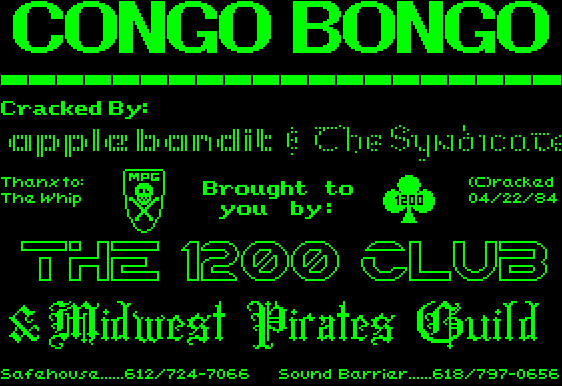
In much the same way that a lot of troublemakers and brigands from the past take on an almost nostalgic haze with the passage of time, so it personally seems to me with these software pirates of old. Groups like the Midwest Pirates’ Guild (MPG), 1200 Club, Digital Gang, and many others would take commercial software, remove the copy protection on the floppy diskette the game came from, and distribute the now-easy-to-copy software to waiting hands and drives across the country. They started a tradition which has continued to the present day, of acting less like criminals bent on smash and grab crimes, but more like flamboyant masterminds, able to take the time to leave distinct calling cards on their work before sending their “wares” along to the world.

These calling cards manifested themselves in elaborate “Crack Screens”, which branded the now-cracked software into a work at the mercy of the crackers, ready to do the bidding of whoever copied them. The race to get their hands on a piece of software, crack it, and distribute it made for some intense battles in those now-gone days.

I collected many dozens of these “Crack Screens” on textfiles.com at this location: http://artscene.textfiles.com/intros/APPLEII/

Krakowicz’ handle shows up on a large collection of “warez” from the period, and certainly has some amount of fame (or infamy) for that alone. But beyond that particular trait, he also did something very few other crackers did: He gave away all his secrets of how he was accomplishing it.

These manifested themselves in Krakowicz’ Kraking Korner, a collection of files written and distributed on Apple II floppies which provided hints, tips, and instructions on the sort of work Krakowicz was doing to accomplish his craft. They are both witty and accurate, and they leave the reader feeling smarter, far beyond the ability to make an arcade game copyable, but knowing some of the core concepts of programming itself. They are, in a word, a treasure.

I had stated publically that Krakowicz was one of my great unknowns, one of the few figures from my youth who I had either not contacted or heard from, who I would love, given the opportunity, to meet or have a conversation. In late 2004, that wish came true.

Krakowicz contacted me through a double-blind anonymous account, and after
some sharing back and forth of information, we confirmed each other’s authenticity, so to speak. What follows is a question and answer e-mail interview conducted in February, 2005, where I’ve asked Krakowicz a number of questions about his craft, the world that he lived in when kraking was his hobby, and what he thinks of some of the modern day.

For the record, he himself pronounces his handle “Crack-oh-vitch”.

THE INTERVIEW

Do you remember the time or the time period where you came to realize that it was possible to make a game function as a copy-able program instead of a
monolithic, protected disk? That is, was it an outside inspiration or something
you devised?

It was probably when I first came across a kraked game disk that was
previously uncopyable, and thought: “I could do that!”. I was introduced
to “shared” programs by teenagers in the local Apple user’s group.

What do you think are the most forgotten aspects of the Apple II period
(1977 – ~1988) that really should be remembered and understood?

For me, it was the extraordinary fellowship of Apple owners, the way they loved
to work with computers hands-on, and the joy of sharing experiences and knowledge
about it. Also, the incredible genius of Woz in creating the Apple hardware (as
well as integer Basic), and the unbelievable efficiency of the disk drive
interface card. Third, very few people remember that a fledgling Microsoft
corporation wrote Applesoft, the floating-point Basic that was put in ROM for
the Apple ][+.

The most forgotten program is likely “Cattlecar Galactica.” Bruce Tognazzini
(who wrote “The great probability machine” that everyone got on tape with an
early Apple, and which was possibly the greatest achievement ever in low-res
graphics) put together a hilarious, comprehensive disk that took command-line
inputs and corrupted them in very funny and clever ways. If you typed in “HGR,”
the response was “RCH,” the acronym for the smallest known measurement in the
English language. The original disk was copyable, but when you tried to load it,
it switched back and forth between two disk modes, and just went “swish-swish”
endlessly in the drive. You had to sector-read it and fix the intentional
error to play the game–in other words, you had to be an Apple cognoscenti
in order to appreciate his humor and genius. One instruction would give the
plaintive response “Free the Milpitas 8!”

Fittingly, he’s now a sage, sooth-sayer and user-interface consultant, still in
California’s Bay Area (http://www.asktog.com/).

Among your kraking solutions was to do actual hardware modification to the
Apple so that it could turn on the programs and then take out memory snaphots.
The Freeze [another Apple II cracker] told me of actually having a custom
setup where it could act like a regular apple until the program was loaded,
and then he would flip a switch and it would go to the modified chip. Do you
remember the process of coming to use hardware solutions to deal with this
problem?

Yes–this and other hardware modifications came from my first personal
computer experience in the late 60’s–a Linc-8 system in a hospital
laboratory moonlighting job I had in college. The Linc-8 was a DEC PDP-8
implementation of the Laboratory Instrument Computer developed at
Washington University in St. Louis. It was way ahead of its time; had dual
DECTape drives, a CRT with a character generator, a 12-bit multiplexed A
to D converter, sense switches for program branching, and a teletype for
programming I/O. With the sense switches, you could make a program do
different things by changing the switch position, and I extended that to
the Apple ][.

The other thing I loved to use on the Linc-8 for program debugging was a
variable clock (you could run at 1 Hz up to 1 MHz, or single-step, just
like the system I implemented for the Apple in the “bus rider.”) There
was also a pair of pre-set address registers (“E-stop” and “F-stop”)
that would halt the computer when a given location was Fetched or Executed,
allowing you to examine the stack, flags, or memory location contents.

Because the 6502 had an “NMI” (non-maskable interrput) line, it was
possible to halt the machine and examine its contents under different times
and levels of a game. That was an irresistible early hardware mod, as was
the custom F8 EPROM. I had just enough electrical engineering training to
know and describe how to implement the debouncer circuit so it would work
correctly (I started as an electronic hobbyist by building a radio out of
Popular Electronics magazine when I was about 10).

Was there ever a program, disk, or other project for the Apple II that you
looked at and ultimately felt, for whatever reason, that even though you COULD
crack it, you wouldn’t do it?

No–this was not a punitive or commercial activity, it was a learning
experience. I think part of it was to teach the software publishers that they
were irritatiing their customers as well as wasting a lot of their money
coming up with protection schemes. The other part was to better understand
the apple, its hardware and operating system, and to inspire others to learn
what I had learned.

I actually owned or copied very few programs, and probably played fewer of
them than most pirates. However, I always considered Beagle Brothers software
to be inviolate–they had great humor in their work, and really clever programs
(and they were smart enough not to protect their programs). I always thought
those traits should be rewarded.

What inspired you to make the Kraking Korner guides?

There were several driving forces. Realizing how much I had learned about the Apple and its software from The Blue Manual, The Red Book, Beneath Apple DOS,
and other sources, I felt that it could be a conduit for instructing others in
the engineering skills, as well as the creativity, that was inspired by the
hidden phrases in protected programs like “Bet you can’t crack this one!” I
thought that as long as there was an inspirational driving force (free game
software) that caused bright young minds to look more deeply into technology, it
could add knowledge and insight as well as hours of fun.

Also, although I didn’t intend or realize it at the time, the series became
excellent training and practice in effective written technical communication.
When I look back at those articles, I see the seeds of a writing style that
served me well as I progressed to more significant positions in industry over
the decades.

Do you have any thoughts on the art of programming and working in machine
language?

I’m not a programmer; not even an engineer, but since the first assembly language
program I wrote, I found particular challenge (and later satisfaction) because
you had total control over what the computer did, AND, it had to be exactly
right! Now, even if you can’t spell, Google will forgive and correct your
inadequacies. The 6502 was fun (even with its page-boundary bug that I once saw
exploited for protection), and the memory-mapped I/O structure allowed simple
interaction with the Apple hardware.

Was there ever a time you met someone who had created a game you had cracked? Or,
conversely, were you contacted by anyone whose game you had cracked, positively
or negatively?

I never met any of the authors of the games, and they never contacted me. If you
still have the description I sent of the Arcade Machine incident, I felt that was
one of the most ironic episodes in the entire experience–a manufacturer makes a
protected program, sells it to kids for generating other game programs which it
intends to distribute, then unwittingly ends up distibuting a game developed on
a cracked version of its generation software. I called their offices to tell them
how stupid they’d been, and the person who answered said “Can I place you on hold
for a minute or two, while I find the right person for you to talk to?” They
really thought I might hold while they traced the call!

[The description of the incident that Krakowicz speaks of follows]

My all-time favorite story of this era, however, concerns Arcade Machine. If you
don’t recall, it was a game creator to make left-right shoot-em-ups of your
own design, which the publisher (I think it was Broderbund) would then
re-distribute if they were good enough (to run the games made with it, you
were supposed to have the original disk of the program, but I also removed that
requirement so the games would auto-run without the presence of the program
master). The program inserted a hidden splash page so the publisher could tell
if your game was indeed made using their software. After I kracked it(and it
was quickly distributed by the usual suspects), people started using the
pirated version of it to produce games, some of which were subsequently
distributed by Broderbund. Apparently, not all the people knew about the
hidden screen (and the publisher didn’t bother to check) to see if it was
intact. It wasn’t. I altered it to reflect the unprotection, then stuffed
it back where the original had been. When the publisher sent out one of
the games, it had actually been written using the kracked version, then
sent in for publication. Cursory examination of the commercial game showed the
“unprotection” screen. I wrote a press release entitled “Publisher Pirates
Publisher,” and mailed Broderbund a copy. The press release made it to quite
a few bulletin boards, but I don’t know if it survived the ages.

Were there any other crackers or cracking groups you looked up to or admired?
Were there any specific qualities about them that particularly appealed to you?

There was one game (whose name has passed from memory) that was kracked by
someone who went by “The unknown kracker,” and drew a picture of a brown bag
with cut-out eyes using ASCII screen characters as part of his logo. The game was
a tour de force of protection, and used almost every single scheme ever devised
to protect it. The problem was that you had to be good enough at playing it to
get to each level to find out that there were yet more protection schemes, and
then go about removing them. I think he found and removed them all, while I had
to give up because I wasn’t adept enough at playing the game.

I greatly admired the author of the boot-tracing techniques, but I’m no longer
sure who that was. I seem to recall that Mr. Xerox took credit for it, but I’m
not sure he was the originator.

Was there a particularly difficult, involved, or brain-crashing crack you still
remember to the present day? One where the software company laid an unusually
involved technique or process in your way to cracking the game?

I kind of answered that earlier (they told us to read the entire test paper
before ansering the first question, but I was always impulsive), but the system
that was most challenging to me was SSI’s RDOS. They had very cleverly disguised
the boot-up (it was called “qwerty” so you might think it related to keyboards
only), and the routines to read, write, move the head, etc., were very arcane.
Deciphering all the code, and making sense of it so I could explain it to others,
was probably the hardest task I encountered while kracking.

Was there an uncrackable game, one where you finally turned away from it,
considering it too much time lost to finally and totally crack it?

Other than the one I was unable to play well enough to complete (cracked by
“The Unknown Kracker”), I don’t recall one that was too hard, or took too long.
The more complicated the protection, the greater the challenge it provided, and
the more fun it ws to krack. Besides, as Neitzche said, anything that doesn’t
kill you makes you stronger, and each technique mastered made the next one easier.

Were there any particularly clever software protection methods you still hold
admiration for?

Sometimes the journey is the destination. As each new technique was developed,
it was a real trip to find it, figure out what was being done, and eliminate it.
The first time I saw code that was set up to deliberately corrupt the Monitor’s
disassembler, I relly loved it! I’m an inveterate namer, and my favorite
expression of all the techniqes used was the “window shade” technique. A
sensitive piece of code was hidden by exclusive-or ing it with a garbage byte.
When it was needed, the routine was “rolled down” by exclusive-or ing it with
the correct byte, and immediately afterward, it was “rolled back up” with the
same cloaking technique. After the first few, you learned to look for the hex
value of the XOR opcode (it was rarely used for legitimate purposes in gaming),
so the protectors began to hide that instruction with other techniques.

What struck me most about the basics of kracking series was how you laid it all
out, did your best to bring people into an understanding of not just the
process, but the thinking behind cracking. Did you get feedback about this?
Did you hear from people who were cracking and getting their start thanks to
the series?

This was before the days of effective email, so most of what was said was through
posting on BBS’s. I saw a number of posts that indicated people had enjoyed the
series, or learned from it, but there were probably just as many posts telling
me to stop quoting soppy poems or Ricky Skaggs songs, and just get on with it.
I didn’t visit many BBS’s, so I don’t have a good feel for true sense of the chatter.

I think there were over a dozen episodes of the Kracking Korner, but I haven’t
been able to find them all, even searching various textfile archives. Most were
written with a primitive 40-column word processor, and contained embedded ASCII
graphics, so re-formatting has lost some of the material. I was touched when,
many years later, my son sent the link to your description of my original work.

Cracking groups continue to this day. Do you have any thoughts about them, or
do you pay attention to that world at all anymore?

I have to say I’m completely ignorant of current activities. The level of
sophistication of software has increased dramatically, and so much of what is
done now is in high-level languages, that it passed me by, technically, about 20
years ago.

Are there any social groups or projects that you see today on the Internet or
modern computer world that give you a similar feeling to the Apple II Cracking
days?

Certainly, today’s open source projects operate under the same egalitarian
perspective as the kracking community of those days. Also, the people who test
corporate and network security systems, whether gainfully employed doing it or
just having fun, as long as their motives are to protect rather than to steal
other people’s property or to create worms and viruses.

Is there any sort of message or thought you want the world to know from Krakowicz?

OK–you asked for philosophy, so here it is.

Sometimes, in base pursuits (getting free games, for instance), unintended but
nobler consequences result. Challenge, knowledge, training, experience and growth
were all a result of the pursuit of Apple software unprotection, and the
simultaneous technological development of bulletin board software (very much
the forerunner of the internet for most of us) allowed the sharing of those
desirable outcomes with others. If they learned, developed, figured things out
and grew in any positive way as a result, we are all the better for it. If not,
we sure had a lot of fun and comeraderie as we explored the ways in which the
earliest (and for many of us, the best) personal computer enriched our lives.

Krakowicz


An Unusual Feature —

The BBS documentary DVDs may have something which hasn’t been tried before. I have subtitles in English (and in some places, Spanish as well), but I have a third subtitle set called “Non-Technical”. Basically, when people throw out terms that are completely from left field (“8-bit”, “Acoustic Coupler”, “8080”), the “Non-Technical” subtitles define them, at least in a way that makes it all a little more clear.

None of these non-technical subtitles will win any awards for depth; I define “Arpanet” as “An early version of the Internet.” Effective for the purposes of something showing up at the bottom of the screen, but I wouldn’t go in front of class with my book report and give that. I found the first 40 minute episode got 52 explanatory subtitles, including my favorite, “Don’t get hung up on all the details here.”

I have no idea if this feature is useful or wanted. It might be really annoying to have this occasional spate of text at the bottom of the screen explain something you already know. But maybe, if you’re watching these episodes with friends, it might help explain something you’re having trouble getting across.

Anyway, it’s in there. Adding them is reminding me how much I know these episodes by heart.


The Wrapups —

MAKE IT PAY is now done.

All of the episodes need a final run-through and re-render, mostly for extremely, extremely minor things, like a fade going a second too long or a spelling error in a title card. All of these are just one-off tweaks before final render.

Last night, I sent mail to the 15 main interviewees of the MAKE IT PAY episode, explaining to them the different parts of the story as I portray it, along with any controversial aspects or accusations that are included. I am not fond of blindsiding people, and I want people who are mentioned in varying light to know what’s going to be on the production.

Personally, I don’t think anybody takes a big hit, and what I do put in, I include a couple of points of view to, but I didn’t do this whole project to ‘get’ people, and so I don’t want someone who opened their home and time to me to feel surprised and hurt.

A lot of the remaining work is reactive and simple: chapter divisions (unbelievably simple in DVD Workshop), commentary recording, subtitle placement (they’re already typed), and so on.


Home Stretch —

MAKE IT PAY is basically done.

I need a few more shots of the inside of ONE BBSCON to make what people are saying about it more illustrative, but otherwise, the thing is pretty much nailed. This is the last of the episodes, and brings to a close “new” content, that is, episodes or footage not already rendered out and being analyzed by The Eye and myself.

What’s left is mostly mundanity: shoring up the subtitles (it’ll be in either 2 or 3 languages, depending on the footage, and depending on who was available to translate), testing the menus, adding chapters (I have chapters work, but I don’t do those silly “one hundred billion little video windows you scroll through” menus), and then testing, testing, testing.

I refuse to make predictions of any major amount, but if this thing isn’t out the door to the printers in the next week or two, someone should come by and hit me with a sack of potatoes. I hope to have everything out by end of month, but I had hoped it would be done by the end of November 2004, too. I am not good at predicting the full weight of the rock I am carrying.

MAKE IT PAY, as an episode, is somewhat taxing on the editing side, because what we have are two sides to the story, which are simply at odds with each other. On one side, you have people who built BBSes for the fun of it, as one might tinker with a car or collect comic books, or host parties for your friends. On the other side, there were a small army of folks who saw personal or general financial gain in this amazing new technology, where they could create software for sale, or charge to use their BBS, or otherwise eke a living out of this unchartered territory. As you might imagine, these two outlooks didn’t co-exist entirely well.

Subsequently, we have these multiple great figures, and I mean “great” in the larger-than-life sense, who were well on their way to sculpting out an online industry from the foundations of the BBS, and then we also have a chorus of voices saying “what are they DOING? Why are they going to RUIN IT?” I was, as a person, very pleased to have gotten all these great interviews with people who were figures from my memory, people who ran the companies that made software I used daily. But I also had to include the voices that felt trampled or used by these same figures (or at least, the industry they represent). So it goes back and forth.

I suspect that to some people I will have barely scratched the surface of the story, but a part of that is because it’s one hell of a story, and needs a book, just like the Fidonet story (and for that matter, many other stories I do not tell in the scope of this episode set). I may only scratch the surface, but it was a very unscratched surface.

I will update with some general technical and wrap-up information next, after this, talking about what’s on the DVD set. Which is a ton.


All of the Podcasts —

This is a story about how I ended up downloading every podcast. But it’s actually a little more than that.

I have a reputation/name as a historian now, and that’s nice, but I’m primarily a collector. I have an innate need to put things with other things like it and end up with a large set of like things. I do it everywhere and in a whole range of ways, and have done it since I was very young. I don’t really discriminate too much about what I like to collect, although I suppose it leans in the direction of information or unusual subcultures. What happened and continues to happen is that in pulling together these collections, I discover patterns and themes that reveals things far beyond the mere collection itself, and I draw on those themes to write or speak about. It’s like enjoying bike-riding and you bike-ride so much you discover how towns are laid out and roads are planned, simply from the mass of places you’ve ridden your bike. A tangental, but important and ultimately vital set of learning.

When putting together a collection of any sort, there is a vital but most-unrewarding portion of the process in the beginning. You start putting like things together, begin assembling them in a rough fashion or order, and are spending some significant amount of time doing so. Depending on the nature of the collecting, you might find that you lose a day or days to it, at the end of which you’ve only increased your collection minimally. Additionally, there’s very little difference between a beginning collection and a trash pile. A lot of people have trash piles that could be collections if they cared about them, but the trash pile is the cast-off shell to them, not the fruit. It is also very difficult to explain to people why you think something needs to be collected in the first place, and so you have the worst of all worlds: a small, non-comprehensive collection of something that you know others have done better and which will never have “it all”, which is taking a lot of your time to put together. This is where most people move on, and put stuff into the electronic or physical trash can, delighted their worthless proto-collection has been set aside to make space for more important things in their world. This once expressed itself in things like piles of magazines, sets of carefully arranged postal stamps, or small piles of rocks representing various minerals and non-precious gems. Now it expresses itself in piles of printouts, files, manuals and hard drives.

About once a month I get a tragic, sad letter from someone who threw away their BBS lives a year or multiple years ago, who regret it heavily now that they see my collection and the gaps they could have filled. These are not enjoyable letters to get. But it’s quite understandable why they did so. There was a definite physical heft to the collection, but no value as they saw it.

(For the record, if you have a collection of BBS material, whether it be printouts, old parts, or archives of files, I will take it, no questions asked.)

So one day I looked at Podcasts. I liked some aspects of them, so I am downloading all of them. Every one. I am going back and swiping older ones as I can find them, but I’m still in the process of getting every single one, so it’s taking some time. I have them in languages I’ve never spoken, and I have listened to less than one tenth of one percent of them. At last count I’m at 75 gigabytes of podcasts which works out to roughly 7,500 individual files. I suspect there are doubles and many missed files, but we’ll see if that comes with time.

I’ll take a moment to describe how I am doing this. Obviously, I need some space to store all these podcasts, but space, these days, is very cheap. I watch sites that provide specials for hardware, and can purchase a 250 gigabyte hard drive for $100. It’s a drive type that is prone to failure, so I buy two. At home, I run these drives on USB2 enclosures, on two separate machines, and I use a program called rsync to keep them synchronized. I download podcasts using a program called doppler, which has several advantages to its approach that are useful for archiving. I have the podcasts on a network drive, so I am not beholden to a specific machine to download the podcasts. I found very quickly that Doppler Radio didn’t check to see if you had pointed it to multiple copies of the same feeds (it assumes you’re using such a small amount of feeds, that you would always notice the doubles yourself), so I wrote a perl script that yanked out doubles. This has held up for the time being, and while I don’t have firm numbers on how much disk space per day this process is taking, I’m not too worried about it.

While I’m here, I’ll give my own thoughts on the general medium of podcasting. I think the name is incredibly dumb. It sounds like the thing only works with iPods, which it does not. It sounds like you’re doing some sort of radio show and nothing else, when in fact it’s just a container for any data you choose to send along. And it sounds new and revolutionary, when it is anything but.

Podcasting certainly has its roots in zine culture, home-brew tapes, BBSes, carbon-copy SF fanzines, and telegraph. If that’s too high-minded and artsy-historian, then I could point to the direct event of the fad of “Push Technology” that infected a number of companies in 1998 through to 1999. Microsoft and Netscape both claimed that Push technology would change everything, and Pointcast tried to build a business on it. Really, it was all a fine idea, but the order of the day was to claim that not only was a good idea good, but it would actually turn dog poop into solid gold, so the actuality had issues with the (stock-driven) promises.

“What is this Blog thing?” my father asked me on the phone just a few days ago. Dad doesn’t buy into much, because life has taught him that everything’s one big massive scam with collusion by government and industry adding to the mess. Describing it to my dad, as I’ve learned over the years, requires about two paragraphs at most before it’s obvious I’m just being long-winded. So I basically said this (and I did, actually, say this; I am not playing semantic or dramatic games):

“Every once in a while, a group of people with a lot of free time who talk too much band together and take over an already-existing hobby, task or medium. In doing so, they invent a whole set of language to describe the already-existent thing they do, so it sounds like it’s really new and neat. They tend to ignore what’s before them, which is bad, but they also cause this critical mass where they force money and interest in the thing, which is good. The thing becomes easier and better put together to help these people get what they want out of it, which is to be really cool or make a lot of money.”

“So blogs are diaries that are online, where people talk about themselves and other people can read them and tell them how cool or uncool they are.”

Obviously the medium of blogs has a depth or meaning far beyond this, but I think that nails a lot of it, for the purposes of a quick explanation to my father when in fact he was wondering when my documentary was going to be finished. (The answer is, I’m working very hard on it.)

For the record, I am not very fond of the word “blog” at all, but the online and offline worlds are littered and choked with etymolgical abortions that grate and dismay, so there’s no sense in crying about it or trying to turn the tide. I’ll stick with “Audio Diaries” in ten years after it all dies down.

So again. Why am I collecting tens of gigabytes of podcasts, when I don’t seem to have an overreaching awe and admiration of them? Because life has taught me several facts about history and the nature of collecting which tell my gut instincts to go after all of them anyway. I gave a speech about this in 2004 called “Saving Digital History: A Quick and Dirty Guide”, but I’ll summarize quickly.

The hardest single part of analyzing history is to be at the historical event when it happens. You could be very good at knowing everything about Lincoln’s assassination, but the best information all flows from being at the event when it happened in the theatre, not reading second or third-hand accounts, or finding cribbed trial notes or anything else. But obviously, it is most difficult to travel back in time and be there.

Similarly, it is very hard to tell what in the present day will have historical significance. There’s some easy, large targets like major political events or spectacular trials, but sometimes it’s just dumb luck, having a camera or a good memory for facts, and being at the right place at the right time. Sometimes, there’s actually no historical significance but the artistry around recounting the event gives it historical significance. (The Woodstock concert/Aquarian Exposition of 1969 comes to mind.) And sometimes it’s merely a case that, looking back, you find that something has an entire other meaning than anybody associated with it could ever have imagined.

Such I think it will be with Podcasts. They are, essentially, a few people (not more than 1500 at any given time) who are recording their voices or music collections into compressed music files and then making them available for distribution. The fact that the clients for getting these music files are geared towards use-and-discard broadcasting models is irrelevant to me. What, instead, that I focus on is that there are entire swaths of life being recorded by these folks: their accents, their way of phrasing things, their lives, pieces of the world around them, who they know and knew, and how seminal events cut across all these geographic and personal boundaries.

The example I like to give (and I’ve done it a lot, just not in writing) is a hypothetical Letter to Home. Imagine a Civil-War era soldier writing home to his wife to tell her how things are. He might tell her how they’re very cold and unhappy but that the war might be over soon, and that he misses her very much and they should think about getting some more cows. Pretty straightforward stuff, and likely, to someone of the time, to be a rather boring or at least unremarkable letter.

Time changes its value. Obviously Civil War-era letters gain some amount of value by merely being over 100 years old, but beyond that the letter itself could reveal facts or insight that were never thought of at the time when the letter was collected. For example, the soldier might mention being in a specific field which will tell when the armies reached a certain point in a battle, different than previously thought. Maybe that soldier used a word or term that was coming into vogue at the time and helps language specialists trace the spread of that term through the US.

Or maybe, just maybe, that letter contains a watermark showing that it was manufactured by a company that claimed it never sold provisions to the “other side” during the war.

The point is, you can’t know. There’s so much information in the nature of the spoken voice and what the spoken voice is speaking of at the time, that it has contextual meanings that might come out months or years down the line. When combined with the times that they were recorded or the location of the speaker, you end up with a whole host of insight that comes up from your collection.

There are a number of other factors which will also assist me in collecting, most of which I pull from my experience collecting other such from-the-ground works. First of all, the number of day-to-day, consistently outputting podcasts will be very low. Like any interesting medium with a barrier to entry involving time or effort, the novelty wears off and the person stops doing the project. This turns it from an ongoing concern into an exhibit, and exhibits are very easy to collect. Another point is that the whole nature of this particular medium is that people are doing all the hard work themselves, that is, generating the content and ensuring its distribution through directories and clients. That means that I just have to keep setting my clients to the widest swath possible, open up every filter, and make sure the disk drives work, and 95 percent of my effort is automatic. When I have time, I might find more contextual information about each feed, but otherwise, even just having it all in one place is good for now. Obviously I have a lot of other things on my plate, but in a given day, I do basically zero work towards collecting, so it’s not a strain.

Where will this go? I don’t know. I don’t see there being a podcasts.textfiles.com and I’m certainly not looking to start a business as a podcast respository. But libraries and collections out there, some of them really amazing, were started because someone said “Why throw that out? I’ll put it away with the others.” and so it began.

So it begins.


BBS Documentary Update: The Dog That Roared —

The FIDONET episode is ready for the Eye of Doom.

Folks, we’re getting close. What’s basically remaining, aside from some basic refining and icing, is the last part of the MAKE IT PAY episode. I’ll talk about that episode when I finish it, which I hope is very, very soon.

FIDONET was a bear of an episode to edit, and represents months of work all on its own. There are several factors that caused this amount of effort to be expended, but the primary one is simply the subject.

The Fidonet was an ad-hoc network composed completely of volunteers that connected bulletin board systems all over the world, via a very complicated routing setup. It continues to this day, although the gravity well of activity has moved away from the United States where it was created. At the center of this was a figure, Tom Jennings, who achieved a mythic personality simply by the size of the whole project (at one point there were tens of thousands of BBSes connected) and his own unique character.

Along with Tom Jennings are many other giants, all of them with names that ring true for the people who were associated with Fidonet directly or indirectly: Ken Kaplan, Ben Baker, Thom Henderson, Bob Hartman…. and dozens of others.

It’s a nightmare for a person trying to tell “The story”. The Fidonet story is FRACTAL. The more you research, the MORE YOU FIND, until eventually you realize the whole thing is nearly untellable. It’s like trying to tell the story of “Computers”. It goes down in so many ways and so many levels. I wasn’t paralyzed, but I was certainly intimidated.

Luckily, the efforts of a number of good people, notably Bob Hartman and Tim Pozar, got me in touch with a nice percentage of the “big names”, or at least, enough names that would allow me to broach the Fidonet story with some level of authority. There are some people who I was unable to interview and a small amount who didn’t want to be on camera, but nearly all of them helped me with information and pointers to research.

I consider all of my episodes to be “foundations” in telling the BBS story. You have a rapidly downswinging trend when doing a technical story, where you have to balance the technical discussion with the number of people who will be able to understand and parse the information you’re pouring at them. You have to be careful to summarize without corrupting, and you have to be cognizant of not taking things to such an accurate level that only the people who the subject is about could understand them. I feel I struck a good balance with this episode, but I know already that there’s a 1,000 page book beyond it in things that happened that I am NOT covering. I hope that I can facilitate further research and work on this subject, with my documentary inspiring folks to dig even deeper than I have. I hope so, anyway.

I can also say that this episode gave me one of my most harrowing situations of the entire production: last year, I showed a beta version of the episode at the Vintage Computer Festival (vintage.org), along with a good number of the rest. And knowing that I was showing this episode, Sellam, the organizer of the festival, arranged for Tom Jennings to come see it.

It is a singularly stressful situation to be showing a film in which a person figures majorly into the story, and to have that person seated one row behind you watching it. On several occasions, Tom let out a “WHAT?” when people said things that were speculation but not actually true, or laughed loudly when people recounted their thoughts on Fidonet from a perspective he himself didn’t have on it. I talked with him several times at the festival, and he was OK with the episode, a major deal to me.

Realize that for every event I show in the Fidonet episode, there will be a number of people who go “that’s not how it was”. This is, as far as I can tell, endemic to Fidonet. NOBODY agrees on ANYTHING most of the time. It was called “Fight-o-Net” for a reason. I am fine with this, and will host rebuttals or clarifications if there’s major contentions (I’m doing this for all the episodes, in fact). But I think, at the end, I captured a real sense of what this Fidonet thing was.

I want to take this time to thank everyone who bought this DVD set back in October, who are still waiting for their DVDs to arrive. Please be aware that the delay is for the best of reasons: quality. This fidonet episode is a joy for me to watch, to see this magical subject I couldn’t explain to anyone who wasn’t there, now readily packaged and able to show to my family or friends or everyone else and have them go “Oh! I get it now.”

It’s all coming together.


Fahrenheit 300/1200/2400 —

I had an excellent phone conversation tonight, discussing the approach I took to making the documentary and some of the changes in myself and the process that occurred over the four years. My counterpart mentioned, as an aside, a conversation he himself had had with another person who responded to my name in a less-than-positive manner.

The salient phrase here is “Jason Scott is a Michael Moore.”

I have a few moments during this render of the Fidonet episode, so let me just make a quick statement, a blanket one, about this sort of thing, because I expect it to grow as an actual documentary hits the world.

During the time that I’ve been working on this project, Michael Moore has put out two documentaries, one an Oscar winner, both representing the top two documentaries (in terms of box office) in history. In making them, he has brought to bear a lot of attention, ink, and discussion about the subjects he covers, and of course the way he covers them. He has also brought in a lot of criticism and commentary on the documentary genre as a whole.

His name has also been consistently fashioned as a shorthand cultural term for a number of complex concepts: the range of truth in documentary, the nature of political agenda, the role of filmmaker in political life, and so on. A lot of it is generally used negatively or at least the most memorable writing is.

When you make a film of any sort, truth or fiction, you are taking reality, some sort of lived life or representation of it, and cleaving it towards an intended timeline, one of the length of this film. It’s why they had to make cards that said “two years later….” or add narration to the beginning of a movie so you knew what was going on. This is normally quite expected and understood, unless you personally have an investment in the subject matter or the building blocks of the production. Then things take on a different shape.

In making this documentary, I have chosen a relatively obscure subject: BBSes. I have approached it in a rather overreaching manner, where I interviewed an awful lot of people, collected a very large amount of data and artifacts, and spoke to literally thousands about it. It is, therefore, a pretty friggin’ huge thing.

I am, at the end of the day, a single person, driven with his own goals, his own approaches, and his own talents applied to the project. If another person did this, they would have done it differently. Not many folks would drive one thousand miles in a single day to interview a creator of PC-Board. Very few would track down over 700 BBS program histories, just to get a sense of them. And I don’t know how many would have considered conducting over 200 interviews about the subject.

Maybe their film would be better, more focused. Or maybe it would be so short and light that there would be nothing of note for anyone. I don’t know.

When you put your line in the sand, and say “I’m going to cover this subject, because nobody else has in this way”, some people are going to go “finally”, some people are going to go “whatever”, and some people are going to go “the hell you are”. There’s a lot more people in the middle than in the two ends.

Make no mistake, I have gotten hate mail for this project. I have certainly recieved criticism, threats, slanderous implications, and all the glory that the world can shove in my door, telephone and e-mail account.

This is not unfair, not below talking about, not surprising: it’s the cost of living in the world, of creating something that claims to tell a story or be in any way based on factual information. It’s just what happens. It tells me the subject holds passion for people, that they care how their story gets told, and by whom. I would be surprised if I didn’t get any over time.

Some criticisms are valid. Some are not. But they come from an honest place.

I get fan mail. I get a lot of fan mail. I get several a day, praising some aspect of this work or the work I’m doing. If I want to reach out into the world and get validation for what this is all about, I have it, sometimes every hour on the hour. I enjoy getting it, I enjoy reading it, and it’s also a part of putting your line in the sand.

This project is self-created and basically self-funded (I was sent no-strings-attached money from several folks “just for doing this”, including one very generous multi-thousand dollar donation from a gentleman named Frank Segler). I did not do it on spec, I did not do it as my job, and I certainly didn’t do it in a way that someone told me to or where I didn’t have final say on all aspects of the production. The project is mine, fully mine. At the end of the road, I will be able to point to this DVD set and say that the way it soars or the way it flops is the result of my actions. I will have no-one else to blame (but plenty of folks to praise).

I will stand behind it 100 percent, I will gladly discuss my choices made in editing, subject matter, approach, interviewees and worthiness. Some of my answers will suck, talking about scheduling, missing opportunities, or broken appointments. But I will be talking for myself, knowing it all rests on me. And I will do so. Freely, often, and everywhere people corner me, either on a forum, at a bar in a convention hotel, or in a phone call. And I will be proud to do so.

So let’s get this show on the road.