ASCII by Jason Scott

Jason Scott's Weblog

A Little Bit of Nostalgia —

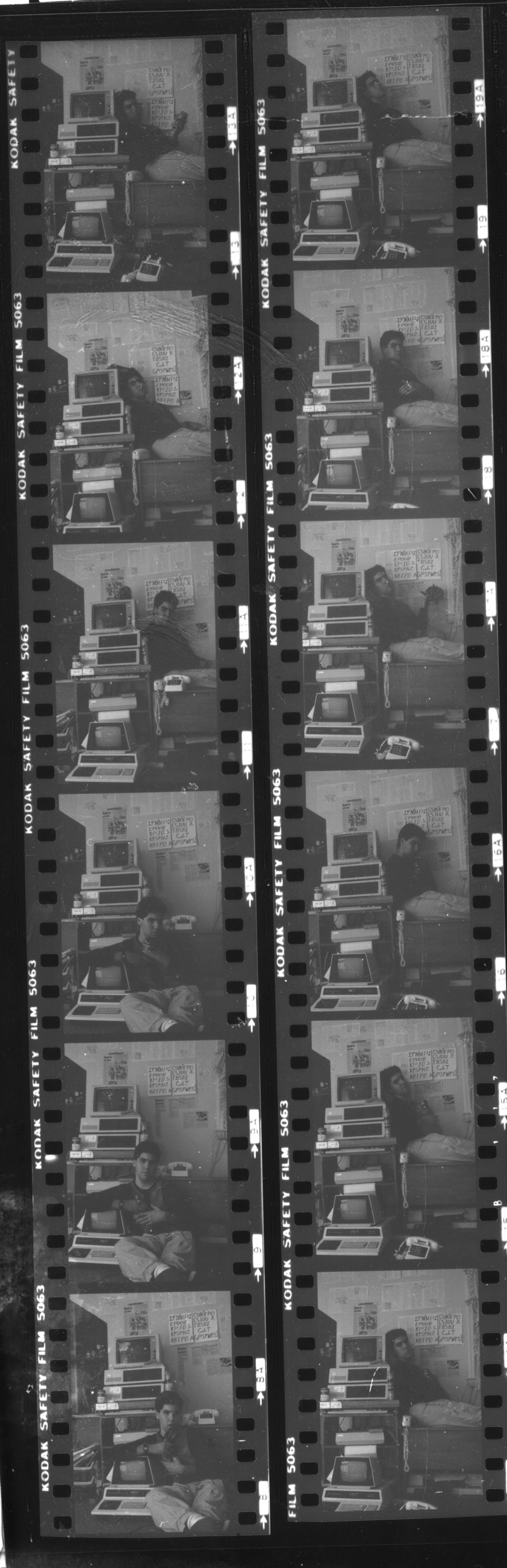
When I was 17 and a senior in high school, we had to pose for yearbook pictures. Horace Greeley High School, where I attended, had a nice policy about the pictures, which was that the students could basically choose their backgrounds, poses, and the rest. Since I spent most of my time in my house, that’s where I had my photos taken, and beyond that, I had the photos taken in my computer room. A student named Rachel Lovinger was assigned my photo, and we took a bunch.

I lived a happy life for my years in Chappaqua, NY. I lived with my father in a 4 bedroom house, and I had run of the top floor, which became a kind of weird geek paradise, one I tried to live up to later when I bought my own home. I do remember, at the time, being very happy with the world I’d set up for myself. My bedroom had two parts to it, a computer lab and a bedroom/media area (the pictures you see here are from the computer lab) and I even had a remote monitor coming out of the computer into my media area, so I could watch the goings-on on my BBS while also watching TV or playing music. I have nothing but the fondest memories of my late teens, sans a small incident where I was thrown out of the house.


Unlike a lot of the “person in front of swirly background” photos that populate yearbooks, photos like the ones I had taken also document my room, and my earlier computer life before I went to college or ran textfiles.com or anything else. Of the 20 or so photos taken, we obviously only used one, but I was able to get a contact sheet from Rachel, which I kept, and which these photos came from. Obviously, they weren’t really meant for final publication, and look a lot worse than they could, but the information is there.


Obviously the second one is posed, with a Commodore PET computer lodged in front of my main system where it normally wouldn’t be. The rest of it is pretty accurate.

There’s so many little reminders in these photographs, I don’t know where to begin. That’s an IBM PC with an expansion chassis, making it look like a two-level monster. I ran The Works BBS on that for two years before leaving for college. It’s impossible to see in the photograph, but the Works BBS login screen is up. I can see business cards from BBSes that I used to call, taped on the desk. There’s a dot matrix printer there, which I printed out many messages and files from, which I kept (and still have) and which I’ve been slowly re-digitizing BACK into text. And the walls are completely covered in computer and BBS articles that I would pull from Microfiche at school, photocopy, and then tape up.

(Naturally, since all yearbook photos should have semi-secret messages, there’s those two pieces of paper with letters on them, with the simplest of one-letter shift ciphers on them, for others to find: “HELLO: DONNA, JOHN R., JEREMY, JASON B., BRANDON, BRITT W., SARAH – B.I.S. FOREVER!” By doing this in the photo, I didn’t have to put it into the paragraph in the yearbook. The B.I.S. did in fact end up being forever, since that’s the name of the production company for the documentaries.

If you’re a die-hard fan (I apparently have a few), you can feel free to download the entire contact sheet (700k) from the BBS Documentary site. I like the last one from the bottom, left side.

I’ve had a number of people send me photos like these posed near or using their computers, often taken by family members going “Here he is in his natural habitat, always in front of that computer.”

My advice is that if your family member does something all the time, take photos of them doing it, they’ll thank you years later, because everyone wants at least a little memory of the times before, and stuff they may not have thought about for decades will come rushing back. I know this because I get many dozens of letters a month telling me that’s what textfiles.com does. And thank goodness for that.


ONE. MILLION. DOLLARS! —

Date: Fri, 10 Feb 2006 18:56:37 +0200
From: Chevron System LLC
To: textfiles.com
Subject: Regarding textfiles.com

Hello,

I’m interested in purchasing your domain “textfiles.com”. I’m seriously
interested in buying textfiles.com. We use the services of Escrow.com
which is a US government licensed escrow. If you are interested please
contact me with your asking price.Thanks for your time.

Best Regards,

Chevron System LLC

I get a request to buy one of my domains about once every few months. At this point, I just ask for an incredible amount of money, and leave it at that. I’ve had domains for 10 years now, domains like cow.net and someone comes along hoping to buy it for two thousand dollars. Goodnight!

I wouldn’t let textfiles.com go for less than seven figures now. And why would I let it go at all? Because at seven figures, I could use that money to further the goals that textfiles.com stands for and the work it does. And why wouldn’t I let it go for less? Because it’s a part of me, like my name or my voice.


Speaking in Princeton —

I know I always hate it when someone tells me where they’ll be speaking…. TOMORROW. But there you go.

I’ll be speaking/presenting at the Princeton Library in Princeton, NJ tomorrow (February 7th) at roughly 7pm. You get to see some of the documentary, hear me babble, and then, if you’re feeling frisky, buy a few copies.

See you there, assuming about 100 details about your life that I shouldn’t.


Adventurers’ Club (Last Followup) —

I finally removed the Paypal link from the Adventurers’ Club page, as well as the part where I beg people to join. Instead, it’s now a description of what the club is and who the members are.

There are 50 members in the club (not all are listed, at their request).

This is five thousand dollars.

It’s nice to have one of the high points of the production occur before filming begins. That’s just amazing to me, fifty people sending in $100, wanting the film to be made and to show their support.

Since I promised each person 3 copies of the film, that’s 150 copies that go right off the top into the world. Pretty neat!

Filming, by the way, starts this month. Don’t ever hesitate to mail me with suggestions and requests about the production.


“I can’t imagine they would enjoy such a conversation.” —

I had a call waiting for me on my voicemail, from a Jennifer Pew (her phone number was 206-903-3915) of a law firm called Dorsey and Whitney LLP, who specialize in IP law. She asked me to call her back, in association with an MGM vs. Grokster case.

Now, there’s always that interesting swimming feeling when a law firm calls you. I’ve been through the legal colon enough times to know you give up nothing, discuss not much, bother less. Doesn’t hurt to call back.

Talking with Jennifer for a while, she asked me about a file available on Kazaa, with my name on it and BBS and so on. The track, which she couldn’t pronounce, didn’t sound like something I’d written, but there are a lot of songs on the BBS Documentary soundtrack, and as we all know, most peer-to-peer programs keep the titles and artist names with near-talmudic precision. So with names like Sleepy Rabbit, Manolo Camp, and Treewave, who knows what they could be called now.

I asked, “Wasn’t the Grokster vs. MGM case settled?” She said this was a new one. What the hellafuck. I was wondering if she was from the good guys, the EFF or whatnot. I mean, if I get to testify WITH those guys, hey, free trip to California and maybe I get to give Larry Lessig a hug.

So we’re dancing around simply because I’m wondering who she represents. At some point in my sleepy mind, the “plantiff” vs. “defendant” thing clears up, I remember she said Plaintiff, and I ask who she’s a part of. She explained it was a consortium of firms, including media companies.

At this point, my tone turned what would best be described as “vaguely hostile”.

I hate this shit. I really do. I was kind of curious to figure out what song it was they were associating with me, and how they decided it was me, and how they got the phone number, and all that. But after a while, I realize I’m talking to a paralegal. Paralegals do not consider themselves evil. Paralegals are, in my experience, torturers who have not been allowed to use the forge yet to make the hot coals, but they’re waiting and hoping. I consider them part and parcel of the law profession, very little of which I personally like. (I do like a little of it.)

She offered to put me in touch with an uberlawyer to hear the song that supposedly Jason Scott made or otherwise has his name on, but I said, ultimately, “I can’t imagine they would enjoy such a conversation.” Who needs it, it’s Friday.

I explained that all the music in my documentary was licensed under Creative Commons. Later she verified it by saying “so you provide it under a public license.” I said no, CREATIVE COMMONS.

The salient phrases from me, which basically ended the transaction, were:

“I do not want to be associated with whatever you are doing in any way, and if my name shows up in any legal document from your firm I will be very angry. If people are distributing music with my name associated with it, I hope they are giving it to schoolchildren. For free. Forever.

Anyway, so if you make or otherwise involve yourself in musical production, maybe you too will be “called on down ” by Jennifer or her other zombie paralegal compatriots to ask if you authorized your music to be made available on Kazaa. Be sure to top my reaction, if you so choose.


Dit dit dit hey wait —

With absolutely no fanfare or warning, Western Union ceased its telegram service on January 27, 2006. They notified employees internally in mid-January, and then abruptly closed off the service.

The full message for saying goodbye to 155 years of telegraph service was:

“Effective January 27, 2006, Western Union will discontinue all Telegram and Commercial Messaging services. We regret any inconvenience this may cause you, and we thank you for your loyal patronage. If you have any questions or concerns, please contact a customer service representative.”

The first official message (that is, part of a demonstration for a built prototype line from Washington to Baltimore, was sent on May 24, 1844. It read, “What hath God Wrought?”

In fact, you can actually look at a photo of the actual tape that was sent. Badass, those historical archivists can be.

I am not a big fan of the standard weblog “this event happened, now I will comment off-the-cuff-with-no-research for the next 3 paragraphs and look at you dumbly” approach to journalism/event notification, but I do have to say, this was handled quite poorly.

Understand that Western Union has gone bankrupt and then been bought out a number of times, and that the vast vast vast vast majority of its funding comes from money transfers (started in 1871) and not telegrams. I’ll be willing to make a reasonable guess that the telegram revenues were almost in the range of a rounding error. But that’s more of that off-the-cuff stuff I was talking about.

Instead of giving you a massive rant and historical essay, may I instead recommend a book that I had recommended to me by the author/speaker Richard Thieme: “The Victorian Internet”, by Tom Standage. Were that I could compose a book so effective, so perfect in presenting its facts of history and event, and linking them to today.

Regardless, I left a foamer in their customer service box at the Western Union site, and I would send out this call: Send out one last telegram, this day or on the anniversary of the telegraph on May 24th, and give this incredible technology the sendoff it deserves.


Hardcoded —

35 might not seem like a very old age to some, but in many ways, it’s a good time for me to really decide what projects of mine are going to “happen”, which will not, and what, if any, new projects I should be taking on while I still have the energy and age of the 30s. As a result of this, I started work on about 3 movies and a bunch of other things (GET LAMP is the absolute forefront, of course) and I’ve been dumping off a lot of other stuff that was in the planning or consideration stages.

One of these was a TV show I’ve pushed around my plate like a bit of unwanted vegetables for about 3 years. It’s time to get rid of that one. So what better way to get rid of it than throwing it out on a public website?

For all my ranting about television in previous entries, it might be surprising to know I was considering doing a television show. But part of that was that when I say “television show”, I mean “videotaped show”, which means it could have been distributed online, sold as a DVD, or what have you. Maybe even on a cable channel or one of the other many channels out there for new works. I wasn’t going crazy on that side of things.

So here we go; here’s the “pitch”, as it were, and why I am dropping the whole idea.

First, you need that kind of short-form pitch that either makes people interested or makes them cut bait. So the short form: “Junkyard Wars…. for programmers. Have people hack computers and make programs, for money, in a marathon coding session. Prizes, tie-ins… hey, you gonna do that whole line?”

Now, a little more meat. The title/name was “Hardcoded”, and the basic premise is this: set up in a warehouse with a two level structure, you have four teams of programmers, perhaps an artist or other unusual creative person thrown in, and each gets a corner of this structure on the first floor. On the second floor, two hosts (I wanted two chatty but engaging males, kind of the smart nerd type) talk to their on-the-floor person (an engaging female) about what the teams are up to.

The game goes on for two days (enabling weekend shoots). The teams can be assembled from software companies or other firms, or maybe are all from around the country and thrown together. The teams assemble on the first day to be given the task they’ve got to have finished at around 2pm on Sunday. For my example/pilot, the game would be “Pac-Man”, and we’d have a Pac-Man machine in the center of the place. It’d be plugged on, under a sheet, and lifted up for people to see. Obviously, it’d be playable throughout the event.

The four teams would be given the art of Pac-Man and the sounds, but that would be it, and they’d have to hack something together after that. A point-scale would be there based on creativity, skills… And every 4 hours or so, the teams would be given other “code challenges” they could take on at the same time, and the question would be, do we go for that code challenge and risk failing to “ship”, or do they just jam through?

Like a software project, there would be stages for “alpha”, “beta” and “final”. In the Pac-Man example, having the ability to move around would be a “alpha”, having the game playable would be a “beta”, and then the final bits would need to be there, like fruit and the like, for “final”. If this sounds rough, it is. I wasn’t exactly staying up late at night concerned about how the scoring scale would work.

The question that might come to mind is “how could this at all be compelling”? Well, several answers to that. First of all, you’d have quite a bit of post-production in place, doing things like explaining (in high-level form) how the programmers were coding, how they were working together, and so on. The hosts would be engaging in their own way, but we’d also have sequences about, say, Pac-Man and the videogame industry that could be used if segments were missing some level of interest, until we got to the “beta” stage or so on.

Obviously, all the screens of all the programmers would be recorded, as well as webcams showing their expressions and other cameras showing events within the space. Most shows/events of this sort have what’s best called a “safe room” where the contestants are allowed to go outside of cameras (specifically, to sleep and use bathrooms) but there’s a contractual obligation they sign where they don’t discuss strategy or have conversations except with producers if there’s an issue.

Now, either you buy into this idea or you don’t. And that’s fine if you don’t, I liked the challenge of making programming interesting and doing cool post-production and assigning teams of different people to interact, and so on. That’s part of what made the idea fun and worth mulling over.

There are two main problems with this whole idea, in terms of stopping me from going forward. I don’t mean cash or equipment issues, either, which are a different level; certainly tie-ins for prizes (win stuff from Thinkgeek! win stuff from sony or panasonic or apple!) and branded computer systems (Alienware!) would go a ways towards helping the cost. That’s just money.

The first problem is the fact that most of these shows are fake.

Now, I don’t mean fake in terms of actually pre-determining who will win and then crippling the other team until they can’t win, ever (like the quiz show scandals of the 1950s). I mean more along the lines that the most important thing, the driving force in putting together each show, is to make it compelling. And the fastest way to create compelling footage is to ensure, hell or high water, that there is as much conflict and neck-and-neck competition every step of the way.

This sounds logical, but to me if you’ve designed the show right, the compelling aspects will come out of it. If you’re of the state of mind that says that unless someone is yelling nothing is happening, that’s a different type of show. And with the type of shows that Hardcoded takes its cue from (Monster House, Monster Garage, Panic Mechanics, Junkyard Wars and so on), any multi-episode observation of how they flow show off several “tricks” being engaged.

A number of the shows sabotage. They fail to deliver what was asked for, they undo work the team has completed, and they modify the rules (occasionally drastically) to suit keeping everyone neck and neck. While nobody likes to see an absolute pulverisation of the losing team or the deadline, it’s mildly creepy to see weights piled on a team like Harrison Bergeron just to keep them from overly succeeding. And that’s the stuff we can see through the edits; that’s not even the stuff we never get to see.

Another trick is to force conflict; in cases where teams are assembled, say, Monster House, you will see a team assembled where you have 4 or 5 relatively together individuals, and then one absolutely insane fuck-up of a person. Someone who may or may not have skills, but are certainly not used to working with a team, or who don’t normally work under a short short deadline, and are brought in essentially to grit the wheels and get some nice sparks flying. Conflict arises in all things, to me; and you have compelling footage from that, but just intentionally hothousing a situation panders to the worst aspects of television and I couldn’t see myself being a party to that, to achieve the level of success these shows had.

In fact, that’s where the second part came in; I remembered what it’s like to work on a production like this, having been involved in such stuff in my past; the crew fights, the gossip, the little lies, the big ones, and all the pieces of you that this sort of project rips away from a person, until they’re only a small bit of what they used to be (although, hopefully at least, richer).

That’s kind of the reason I’ve grown to enjoy shooting leisurely (or at least lacking insane deadline pressure), generally alone, generally one-on-one. I like talking with people, getting to know them, not depending on their crying or breaking down or screaming to know compelling footage exists in them. I like the burden being on me to bring out the interesting part of a person, not just piling on bullshit over a person’s head until they squeak out protests and I film it 3 inches away from their face. I can live with it.

So into the shitcan goes Hardcoded. It would have been fun to watch. It probably wouldn’t have been as much fun to make.


Loose Film Ends —

None of the following concepts/ideas/paragraphs grew in my mind enough to warrant a decent weblog entry, so I’m grouping them together, like a lost hiking party, clinging to each other for warmth and hoping you’ll read them before the ice weasels come.

There were a number of planned ideas at the beginning of BBS: The Documentary that I had on deck but which, for various reasons, did not ultimately happen or were morphed into other aspects of the work. A few that come to mind are:

  • An episode that was going to focus on just one “bbs scene”, start to finish, to show how the BBS could influence a community across decades, and to get a deeper feeling for what it was in the context of a location. I chose Worcester, Massachusetts because it was geographically close and because I thought it was just big enough to be interesting but not so big that the anonymity/population would be overwhelming. Too many people had left Worcester or were uninterested in being interviewed to make it realistic; one was semi-violent about the prospect.
  • An episode was going to focus on just those tiny/fringe voices that found a place on BBSes: UFOs, alternate science, sexuality, religion, based around small businesses, and even neo-nazi. The idea was to give some insight into how the BBS gave people a voice they didn’t otherwise have. This got absorbed into SYSOPS AND USERS, because it felt like I was just trying to do a freakshow, which I was personally against being a party to.
  • An episode that was going to talk about everything from Amiga MODs to Demo groups to ATASCII creators, you name it, to show the massive spectrum of art and artists that were able to express themselves over BBSes. I ended up just doing ANSI art, and American ANSI art at that (this became ARTSCENE) because just getting a grip on that story filled an hour.
  • An episode about computer and communications hardware, to show the history related to the equipment, modems, and other stuff associated with a BBS. It didn’t take me long to figure out that it was much more interesting and relevant to talk about the people themselves instead of their hardware.
  • An introductory short film with me (on camera) welcoming you to the world of the BBS Documentary and describing what they were. This got as far as narration and music before I shot it in the head, because while I want to think otherwise, I ain’t camera talent.

This is the nature of a project, especially a documentary, which I described recently as “a film where you shoot the footage and then find out what the plot is”. If there’s one thing I’d want people to know who were taking an interest in the process, it’s this: you have to be flexible. Just because in your mind the most important shot is a crying baby, if you don’t get your crying baby, suck it up and keep shooting and you’ll probably find something even more compelling than the crying baby. You can’t just go ripping stuff apart because the reality you’re filming doesn’t conform to your vague mental shooting script. You keep going and make the best of it; this happened to me all the time. It’s a shame some of these ideas never saw the light, but many more ideas saw the light that I never even fathomed would show up during filming.

Let’s switch gears. Far and away, the most complaints I get about the BBS Documentary series, in terms of content, is ARTSCENE. I get some nice accolades for it too, but I have gotten nearly a year of rips and insults for that specific episode.

The reason for this is because it is so highly focused, and so intensely US-centric in content. I get a lot of petulant “I guess [my thing] wasn’t good enough for you” and “too bad you didn’t tell the real story”, and a bunch of stuff along those lines. It brings up an interesting perception, which both interests and confounds me: a lot of folks are pretty convinced I’m it, in terms of documentary exploration of this subject. That is, if the BBS Documentary didn’t cover it, we’re screwed, it’s over, it won’t be covered, dust in the wind, all we are is dust in the wind. I appreciate the unwarranted belief that I’m the canonical arbiter of history and permanence, but in point of fact that’s pretty much crap. I’m just the most recent attempt to tell online history and the story of computers from a specific position. In my case, I’m going to flood the market with dozens of hours of interviews about the subject, but that’s not the final word either. There is nothing stopping anyone from doing another film with a different core country in the center of the story; and in fact, there are documentaries that I have seen myself that take place in other countries and tell stories of “scenes” and computer-based social groups. Some are really good. Some are not really good. But they exist and are being made. No need to park the waaah-mbulance in front of my door.

Switching gears again, I am asked by people if I will be doing a documentary on X, where X is some relatively recent concept or social group. Here’s some of the suggestions I can remember off the top of my head:

  • Viruses/Virus Writers/Virus Companies
  • IRC
  • Warez Groups (Modern Version)
  • Wardriving
  • Hacker Conventions
  • Hacking/”The Underground”
  • “The Internet” (Modern Version)

I don’t mind dropping all those ideas on you, because I have no plans to do anything with them. The fundamental reasons are pretty much the same: modern “scenes” don’t trust guys like me. I am asked why the BBS documentary doesn’t go too much into “the current scene” in the context of the present. And besides my focus being on what was because of the danger of it disappearing, another trivia fact was that with very few exceptions (thank you Rob Swindell, thank you Leif Bloomquist), most people doing anything relatively in the “present” treated me like a litterbox.

People don’t trust someone who says “I’m going to come in an quantify your life on video”. They trust it even less if we’re talking about their current life, and not something 10-20 years ago that they can reflect upon or consider with some distance. Trust me, I got the message: stay out of the present, stick with what happened. I don’t need the pain.

Additionally, and I don’t know why this shouldn’t be obvious, the number of people willing to speak on camera about ongoing quasi-legal acts are few and far between, and mostly consist of you (the filmmaker/journalist) being the latest con or challenge. This is part of why HPAC is not HPVAC in the series: people who wrote or who did anything with viruses assume (and it’s a good assumption) that going on camera saying “Yeah, I write/wrote viruses” is a one-way ticket to sucksville. So there you go.

(Like I said, these are all half-developed ideas, huddled together for warmth. I’m sure if people need greater context, they can catch me at notacon in a few months. Bring Pocky.)

Finally, some commentary on length/breadth. I get two main complaints about the current size of the BBS Documentary DVD set:

  • It is way too long and burdensome.
  • It is way too short and fluffy.

The second one is easy to answer: imagine me holding the box in front of my face and me yelling “IT’S FIVE AND A HALF FUCKIN’ HOURS!!!!!”

I found, ultimately, that lengthening the work (and make no mistake, I would have made it 10 hours long if it made sense) just found me kind of telling the same story in slightly different ground. For example, FIDONET, which covers that network pretty well, does not discuss Alternet and about a thousand other networks that used Fidonet or Fidonet-like technology to communicate in groups and lines that might never intersect with the larger Fidonet. I got ribbing about this from some of the groups or people who motivated the networks, but cinematically, how do you say “And also, there was something almost entirely like Fidonet but not quite like Fidonet but with many of the same issues and situations we’ve just discussed” and not be clunky? I couldn’t find a way in the editing room. Same for a lot of stuff which people have criticized me for not including. Like I said, for a lot of people, I didn’t go into the subject enough. While I understand this in a vague sense, the harsh reality of the concept stuns me. “You mean it should have been longer!!?

As for “It’s too damn long” or “it goes into crap I couldn’t care less about”, this I can understand more. I certainly didn’t create the film in a way that really lets you watch 15 minutes and “get the point” while you go out to the bathroom until minute 30 and catch up immediately again. This stuff is deep, wide, and all over the place. It’s like one of those 1,200 page books the author spent years on, and you’re just staring at it, stunned, going ‘Well, I’ll bet it covers the story of Robert Moses pretty damn well.” But that’s not what you specifically wanted.

And on that note, I’ll say: I’d rather have people who loved the subject/film so much they wanted it twice as long, or people who so completely didn’t relate to the film that they couldn’t hack 10 minutes of it, than a million people who could watch my film for the purpose of having something on the TV while they fix the numbers in their cell phone memory. I didn’t make it to be a background, or a screen saver, or another piece of crap flying down the pipe. I made it what it was to the best extent I could. This cuts down the potential audience greatly, but the audience it’s cut down to tends to be very happy indeed.

Oh, crap! Ice weasels! See you!


Pud —

Philip J. Kaplan, “Pud” of Fuckedcompany.com (and a bunch of other sites) was interviewed for the BBS Documentary in 2002. I’ve now finally put his total interview up, and it’s definitely one of the more entertaining and hilarious ones, all the way through:

http://www.archive.org/details/20020302-bbs-kaplan

It’s about 43 minutes, and you can tell in the first 15 seconds how it’s all going to go.

Here’s the description from the notes for that interview:

Pud was a complete drop out of the dark for me. As a reader of fuckedcompany.com throughout the late 1990’s, I’d always enjoyed his wry sense of humor and quick jabs at some of the foolish companies that took so much money from everyone in the name of pies in the skies. So it was very surprising when he contacted me, directly, out of the blue and said that he was interested in being interviewed.

It turned out that Philip Kaplan (“Pud” on his site) had run a pirate BBS in earlier times, before he’d joined the world wide web. And not only that, he really wanted to talk about it. This was big news, because in the amount of talking I’d done with anyone who’d touched pirated software or BBSes, the general reaction was a complete disinterest in talking about those days. A few mentioned the Statute of Limitations and their current positions in society as reasons; obviously Kaplan did not really care what other people thought. And really, it came out in his interview that he was no insane big player in the pirating of software; just another kid with a BBS who offered a few games for download that weren’t his.

The interview was to be done at his offices in New York City, and when I arrived a half-hour before the appointed time, I decided to stick it out in the lobby of the thin, strange building in downtown until the right moment. I got into the clanky elevator about five minutes before the appointment, not wanting to show up too early but not cruise in late, either. Imagine my surprise when I got to the floor, went into the hallway, and found all the doors locked and all the lights off.

I waited around for an hour and a half, figuring I’d messed up in some way, double checking the time, calling Pud’s phone number from the interview sheet, and trying to determine what to do next. It was apparent at that time that for whatever reason, Pud was not going to be available for an interview.

Outside, with my equipment, I decided that I really needed to make up for the 200 miles I’d driven in some fashion, so I called an old friend of mine from the BBS days whose number I had on my cell phone. He used to call my BBS in the 1980’s and ran a rival BBS for a while before his family moved away, and we’d connected again in the 1990’s after he came to work in NYC. I figured I could spend the day with him, and maybe even interview him, so I’d have some footage to show for the day.

As it turned out, my friend was not available for a visit or interview, as he had a bunch of other things to do that day. But in a level of synchronicity I still cannot believe, he said “Wait… pud? He hosts with the company I work for. Let me get his cell phone.”

Let’s just focus on that again. I was in New York City, home of millions, and I was unable to reach someone, and I called one number of one friend who lived there, and he knew how to reach that person.

Pud called me 10 minutes later and apologized profusely. It turned out he was rehearsing with his band late the previous night and had just fallen asleep at the rehearsal studio. He gave me directions to where the studio was and told me to call upstairs to be let in.

I decided to just bite the bullet and take a (expensive) cab ride the many blocks to the studio. It was a nondescript building, certainly nothing that looked like you’d go there to do music or anything else. I always have a slight amount of nervousness walking around in a city laden with an obvious pile of expensive audiovisual equipment, and the look of the place didn’t help all that much, but after some effort, I got inside and Pud came down to get me.

The building was basically all rehearsal studios, lots of rooms with black walls and tons of flyers and info sheets on hopeful bands trying to get a break. In Pud’s space, he had a massive drum set, a bunch of keyboards and drum machines, a few guitars and lots of other similar stuff you’d expect to see. He also had some intense stage lights set up, I guess so he could get used to doing his work while distracting lights blazed all around in his face.

Pud had a bandmate who was somewhat disinterested in the whole endeavor as I set up. Pud didn’t seem to have an interest in sitting anywhere besides his drum set, so I simply aimed the camera that way. I had a back light to shine at him from one side, but the weird lights on the ceiling provided more than enough brightness, although of course they killed anything resembling color balance.

Pud told me that this was the same rehearsal building where Madonna used to practice in her early Like a Virgin days. In the meantime, of course, hundreds of bands had been through this place, and many of them were playing that very moment.

In fact, they were playing around the room we were in, to the point that it was difficult to hear Pud from across the room. This was a sound nightmare. I couldn’t very well tell the other bands they had to stop playing, and so was resigned to the idea that none of this interview would be usable.

Since the interview was being conducted with a massive drum kit in the shot, I had a weird idea; maybe if I took the boom microphone I used and put it right in front of Pud’s face, inches from his mouth, I could get enough of his voice in there to drown out some of the background sound. I figured that with so much obvious music equipment in the shot, nobody would really think a boom mike out of place, especially if I aimed it as if it was always supposed to be there.

This worked; when I got the tape at my friend Delchi’s apartment later that day, I found that the sound on Pud was really, really good and everything he said came out clearly. You could hear the bands if you listened, but it was fuzzy background, not the in-your-face din that it was at the interview. In fact, it was so loud at the interview that I had to shout the questions at him for him to hear me some of the time. So really, all things considered, between the random call that got me in contact with Pud to the luck-out with the sound, the whole interview is a miracle.

The interview lasted about an hour before Pud got bored. While I was setting up, he played a bunch of drum solos and flipped his drumsticks around a bunch of times, so that’s on tape too. His cowboy hat and willingness to answer every question candidly adds a real spice to the whole interview, so it’s one of my favorites for that reason. We talked about running his pirate BBS, how he used his skills with BBSes to make fuckedcompany.com’s web boards move smoothly, and we talked a lot about how the internet changed the face of BBSes forever.

After the interview, I got a cab ride down to where I’d parked the car, and headed over to Queens, where Delchi (another interviewee) had an apartment, and where I hung out before driving home. It was a great time.

By the way, as I said before… since I go through these interviews one more time, then I have to upload a 2 gigabyte MPEG file (and some additional other files) and then edit in all the relevant information into archive.org, the whole process is taking a significant amount of time to do. But it is being done.


The Best BBS Movie Ever Made —

The best dramatic movie about BBSes was created not in the 1980s, but last year, 2005. And it wasn’t a movie, it was a TV series. And it wasn’t made in the United States – it was made in Japan.

It’s called Densha Otoko (Train Man), and in my opinion it is the best dramatization of using a BBS, ever, in a visual medium.

The story itself is pretty simple: an otaku (fan boy), who lives an OK life with his figurines, movies, idol worship, and anime, sees a girl being accosted by a drunk on the subway, and stands up to protest. This gets the attention of others in the subway car and the drunk is wrestled away, saving the girl from an assault. The girl is not wearing her contacts, and doesn’t notice what an intense nerd the otaku is, and asks for his address to send him a thank-you. From this, a friendship/romance blooms, and with the expected ups and downs that come across the next 11 episodes.

Since he has absolutely no experience with women who aren’t untouchable idols or figurines, the otaku turns to the only place he has to get advice: a web-based forum, where dozens of posters get together to help him learn on his feet about life, love, and where to get a haircut.

The genre is called J-Drama (Japanese Drama), and has its own conventions that might seem weird or annoying to american viewers used to the raising-eyebrow-smirking school of american dramatic films, but one thing can’t be misunderstood: this thing was a hit.

It was based off of a book with the same name, which simply printed all the web forum messages in order, so you would read it and over time you’d get the same story, without it being played out visually. So all the different personality types and interactions of a BBS came out in this book, as you read along. And the book was supposedly based on a true story (not that I have any way to check on that), and sold many, many copies. A project to translate this book into English is here.

That was in 2004. In 2005, the television adaptation came, and it’s incredible.

First of all, the creators did a very smart thing; they cast dozens of people to play the web forum posters. They recorded hours of each of them, surrounded with their various environments and props, just reacting. No words, no saying things out loud, just reacting. Then, when editing these scenes into the show, you could get a montage of reactions, one after another, flooding the screen. It’s overpowering; people all reacting one after another, all staring into screens, adding their bit to the conversation; it’s what I was shooting for in my film and they do it so much better (since, obviously, it’s a dramatic piece).

Second of all, the BBS is not just a cheap device like someone being able to fly or grant wishes; over time, Densha’s story causes other people in the BBS to change their own lives, inspired to take that extra step, pick up the phone, or look at life differently. And as an extra cute step, some of the people’s lives intersect directly into Densha’s life (as others find out about the BBS and his postings on it).

I was first told about this series from RaD Man, who himself first heard about the series because one of the characters is an ASCII artist and posts text-based artwork on the site throughout the series (and even has his own sub-plot). He kept wanting me to see the “ASCII movie” but of course it’s actually a BBS movie, a fantastic one.

At this point, you either want to see this thing or you want to run far, far away. I can say that it’s pretty easy to find this thing to download, and get subtitles for, and all the rest. And I can also say that the television series is absolutely rife, overrun, with fan references and commentary, nailing a lot of what I like about the Otaku ideal. It is a very well-done series, and, again, the best BBS movie ever made.

By the way: From the success of the TV series, there was an actual movie made, but it’s not that good. It was shot, edited, and released in about 60 days, and it completely shows. Also, the main character starts out shy instead of ugly and shy, along with a host of other flaws. Ignore it. The TV show, with its dozen hours of opportunity for exposition, is the way to go.