ASCII by Jason Scott

Jason Scott's Weblog

Warning! Amateur Night! —

From lauralevine.com:

All photographs, text and html coding appearing in the Laura Levine site are the exclusive intellectual property of Laura Levine and are protected under United States and international copyright laws. The intellectual property MAY NOT BE DOWNLOADED except by normal viewing process of the browser. The intellectual property may not be copied to another computer, transmitted , published, reproduced, stored, manipulated, projected, or altered in any way, including without limitation any digitalization or synthesizing of the images, alone or with any other material, by use of computer or other electronic means or any other method or means now or hereafter known, without the written permission of Laura Levine and payment of a fee or arrangement thereof. No images are within Public Domain. Use of any image as the basis for another photographic concept or illustration is a violation of copyright.

From livestrong.org:

This Website, its design (including HTML code) and layout, and all text, web pages, graphics, pictures, documents, button icons, images, audio clips, video, information, testimonials, letters, articles, other written materials, and other content found on this Website (collectively, “Website Content”) is protected by U.S. copyright laws and may not be downloaded, reproduced, republished, sold, displayed, copied, transmitted, distributed, or otherwise used or exploited except as provided below without the prior, written consent of the Lance Armstrong Foundation (“LAF”). All photos, images, videos, and personal testimonies and stories on this Website are not subject to the license granted herein and may not be downloaded, reproduced, republished, sold, displayed, copied, transmitted, distributed, or otherwise used or exploited without express, written permission of LAF.

From mcachicago.org:

Except where noted, images and texts on the MCA Media website may be downloaded and reproduced only by members of the media for the sole purpose of timely reporting in newspapers, magazines, television, radio, web publications and other media. Use of media images and texts for any other reason and at any time after the close of the exhibition or program may be subject to additional permission requirements. Media materials may not be downloaded or reproduced by commercial stock houses or archives or by members of the general public.

From nem5.com:

While it is impossible to stop any real thief from right-clicking and stealing the work off websites, part of the purpose of the statement guidelines of use on this site is to help new-comers to the internet who may not understand that what they do when they take images, literature or other work on a website without permission of the author/artist is considered theft and is punishable by fines and imprisonment. Any site that has permission to use the work on Nem5 will have a link to the site that has permission listed on nem5.com. Any site using the work without a link to nem5.com does so illegally. Any person/website using any work from this website without permission agrees to pay $500.00 for each individual work (ie: 1 image or 1 poem or 1 short story) to Maggi Norris plus $500.00 to the original artist/author of the work, if not Maggi Norris, plus any fees recognized as the fine for copyright infringement. If the work is changed in any way the user agrees to pay $5,000.00 to Maggi Norris plus $5,000.00 to the original artist/author of the work plus any fees recognized as the fine for copyright infringement per individual work taken from this website per instance of change to the work. This payment does not grant any rights of the copyright to the person who took the work without permission. Stated payment will be considered compensation for the illegal temporary use of the copyrighted work. If an agreement for future use is not agreed upon by Maggi Norris/Nem5, the original author/artist of the work and the person who took the work, the time for use ends upon discovery of its unauthorized use. On the date of discovery a notice will be sent to the contact email of the site using/showing the unauthorized Nem5 work. Any use after that date shows agreement to pay charges of $500.00 plus $500.00 to each individual owner of work Nem5 does not hold copyright to per week for each individual work plus any and all fees incurred due to prosecution or other methods of stopping unauthorized use including any and all legal fees and/or court costs incurred due to improper use.

People like the internet. They like the ease of communication, the simple markup language that creates what used to be a thousand-dollar brochure for pennies, and the world-wide reach granted each and every entity within it. This is fantastic! They can finally sell their shit to people they don’t have to corner at parties and harangue for 20 minutes.

But they don’t really like the internet. They hate the ease of downloading, the copy/paste keyboard commands so many machines come with, the speed at which that special photograph of a bee can be repurposed, remixed, redone and put up elsewhere without their knowledge or consent. In fact, it’s possible it could be done dozens of times and they’d never even know it or could even recognize their own stuff if they found it.

So they do the natural thing: they go psychotic. They put their stuff up, and then add a contract to their website that you implicitly sign onto when you browse them. They don’t hold you back from viewing it until you explicitly agree. That’s hard! Also less people would browse, and more people browsing is good. So basically, they kind of make up this sort of mirror-world law that they think they have.

I get letters occasionally; people explaining to me how the world works inside their heads and what amazing forces they have at their disposal to stop me from doing what they think I shouldn’t do, with regards to my various websites. Occasionally they’re right and hurt feelings are repaired, but other people would be much more interesting to me if they threatened me with some sort of dragon-lion mix that they claimed was going to come through my window. That has zest.

We truly live now in the age of the true amateur; the amateur scholar, the amateur lawyer, and the amateur law enforcer. I can say one thing about amateur night: it’s pretty damned entertaining.

These flexible curtains of text, like the ones I pasted from above, are draped all over the place online right now; they’re hastily nailed-up NO TRESPASSING signs with no ability to enforce the demands behind them. Not to diminish the honest concerns behind the people who use them, but I can vouch that my immediate and instant reaction is to hit the ‘Download All’ button.

…so if you lose your website, give me call; I’ll give you my backup.


Notacon and Blockparty: Deadlines Approach —

If you were on the fence about attending my demoparty being held at Notacon at the end of the month, this is the time to jump over to the light. The hotel is filling, the preparations are being made, and it becomes easier for everyone to know how many folks are showing up.

Naturally, you can wait until the last moment (assuming the event doesn’t sell out and you can still get in when you show up), but it’ll make for better planning if you pre-register now.

I’ve really gone crazy-go-nuts trying to assemble a great set of speakers (this in addition to the already-great lineup that Notacon put together), and I’ll be running a few events, and I’ll even be punching Wikpedia in the face live on the stage! Who could ask for more?

Towards the last week of April, things heat up for me as I’ll be putting the final touches on various projects and then driving to Cleveland from Massachusetts for the event. I’m sure I’ll have pictures galore, but I’d rather you be in them than browse them.

See you there.


Fruit Flavored Power —

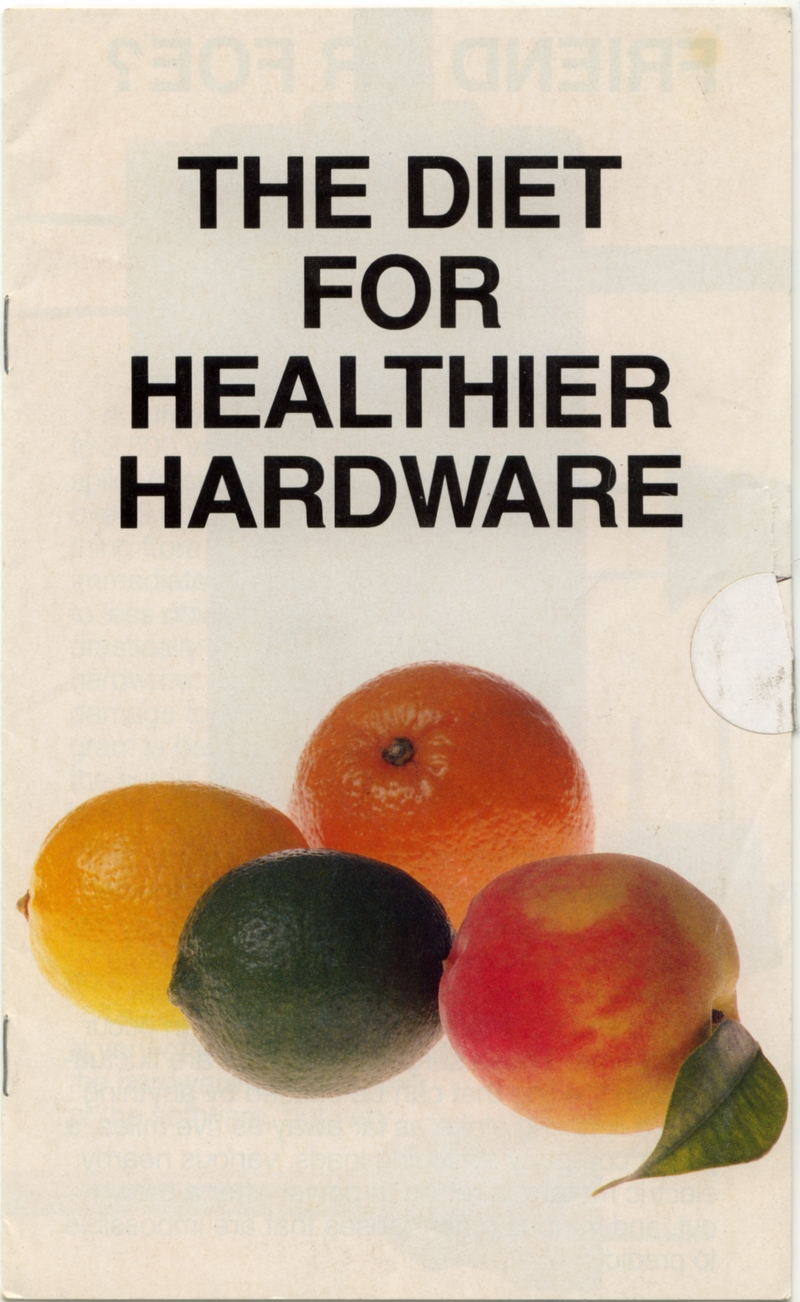
Within digitize.textfiles.com there’s a chipper little sales catalog for a line of fruit-themed power connectors. Really!


The name of the company was Electronic Protection Devices, Inc. They produced power cables, power splitters, and power monitors during the early 1980s. As part of my endless writing away for catalogs and “more information” from computer magazines, I got a hold of their 1983 mailing and put it up for the benefit of the world.

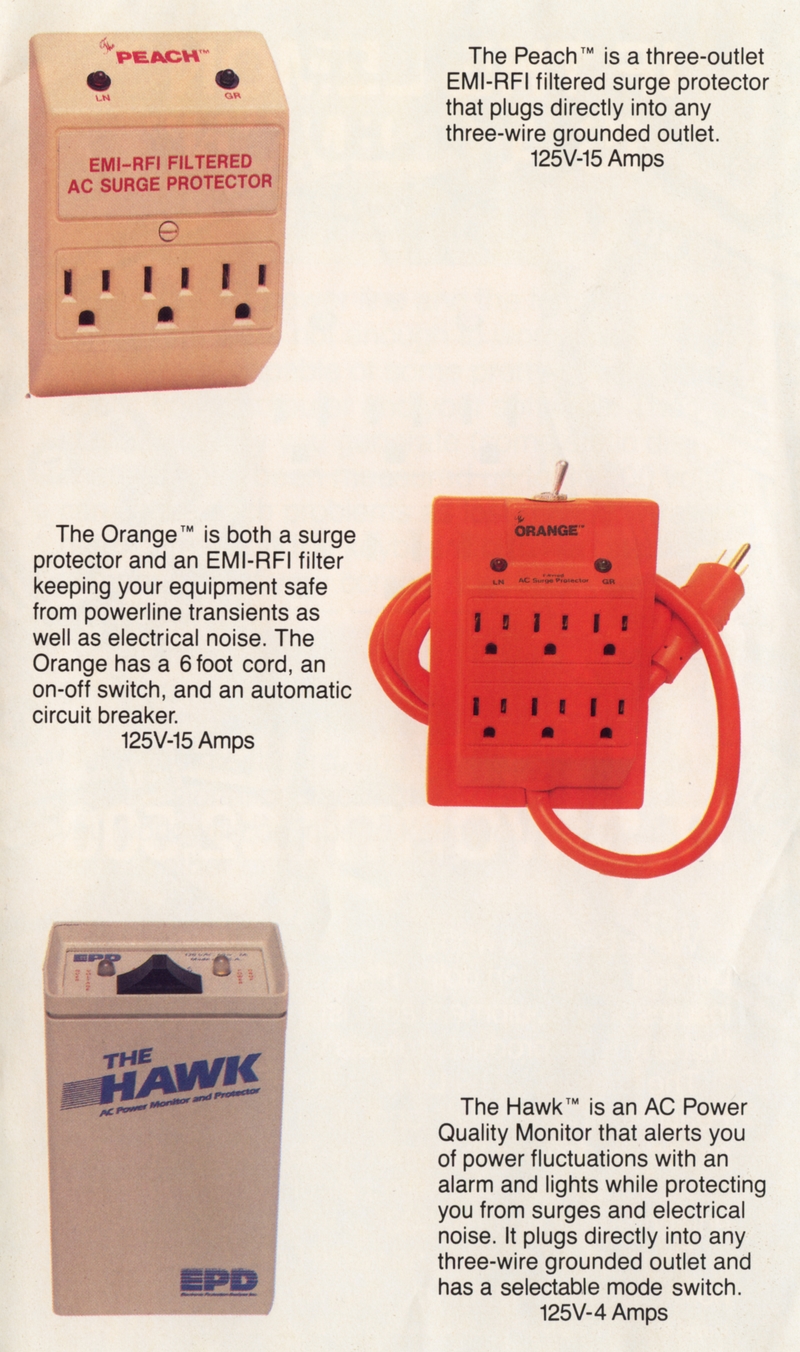
It’s the fruit theme that makes this collection of power equipment stand out: The “Lemon” (a six-outlet surge protector), the “Lime” (the “Lemon” with a switch and a 6-foot power cord), the “Peach” (a three-outlet version of The “Lemon” with EMI-RFI filtering), and the “Orange” (a six outlet verson of the ‘Peach”.

Jeez, now I’m hungry.

Of the 12 pages of the catalog (not counting separate price list), roughly seven of them would fall under the now-well-known advertising approach of “Fear, Uncertainty and Doubt”. You’re warned of the terrifying fluctuating electric world we live in, where surges and spikes snack upon your precious hardware like a plague of locusts. Nobody is safe; lightning appears across a page, forks of death driving themselves into the roast beef of your power grid. Only the well-researched, top-quality EPD protection line of surge protectors will save you!

There were two other items available, the “Grizzly” (a UPS) and the “Hawk” (a power line monitor with alarm!), but since they’re not fruit-themed, I assume this was the result of some internal naming battle where the marketing guru said “It’s just not going to reassure them if we call it ‘The Watermelon'”. As the fruit liberates, so shall it imprison.

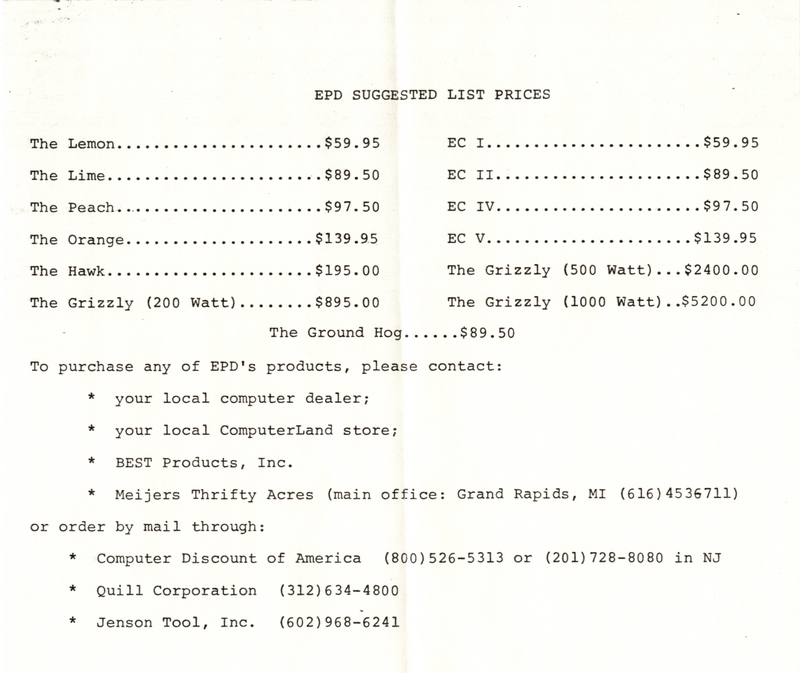
And how much did this collection of power nirvana cost you? Quite a bit, comparatively. The least expensive item, The Lemon, would set you back $60. “The Grizzly” started out at $895 for the 200 Watt version and skyrocketed up to $5200 for the 1000 Watt version! I’ll bet you could hear a little cheer raise up at 5 Central Avenue when one of those showed up on the order queue.

Since 5 Central Avenue in Waltham is near where I live, I drove by and took a look. Electronic Protection Devices is long gone, no indication left that there was anything like that inhabiting that building. It’s just another non-descript structure in a forest of them, buildings designed to house stuff inside but not impress the passer-by. The fact that the address was listed as a PO Box indicates a mail forwarding company, or possibly an advertising tracking method (although it would be silly to use a P.O. Box instead of a “Department”). I’ll go with mail forwarding, although the building was big enough to house the manufacturing arm if they had so chosen. I’ve always had a fascination with the cruel contrast between how a company appears inside my head and how the actual company looks in real life. Both myself and many others have made “pilgrimages” to these firms only to get quite the shock. Maybe it’s a kid thing; you want to go to the magical land where things come from, but there are not that many true magical lands.

Naturally, a dedicated power supply company would have scant chance of living through the outsourcing of the technology sector to the point of the $5 surge protectors we see today; even the UPS market has optimized to such a degree that you can buy one with a USB connector, many more plugs and an ability to tell the computers hooked to it to start shutting down. For whatever time they had, EPD’s days were always numbered.

It looks like they started life in 1981, and I find evidence they got at least up to 1993 before expiring. Interestingly, it looks like they ran a 1-800 BBS for a number of years for technical support. After further research, I find messages in 1996 begging for assistance in finding EPD’s current location to get a “Grizzy” replaced. So for at least a dozen years, this fruit basket stayed ripe, even though like all things it ultimately went sour.

Damn, I’m still hungry.


The Little Trojan Horse —

A number of these cameras have been slowly showing up, but my eye is pretty well caught by a camera called the Canon HV10. This might get a tad technical, so I’m going to put lots of explanations into parenthesis. Using HDV compression (a semi-crappy compression scheme that has the advantage of using last generation’s recording media to record the next-generation’s video resolution), it basically can shoot 1080i (1920×1080 resolution instead of regular TV’s 720×540) and stick it onto a Mini-DV tape (the tape I shot the BBS Documentary onto), meaning a $3 tape can get you an hour of HDTV recorded. (It used to cost $120 to shoot and develop film, and old videotape couldn’t do anything like Mini-DV and it sure wasn’t digital)


This all gets my interest on several levels.

First of all, this camera can shoot resolution qualities (although with a few limitations) comparable to what I’m shooting with my $6,000 camera. Not better or the same, but comparable. And the camera is retailing for $1,000. I’m starting to see the more charlatan camera places offering this camera for $700, which means the bargain rate is probably around $900, and the camera’s only been out a short time.

Second of all, this thing is tiny. It is just a little bigger than a couple packs of cigarettes. But it shoots in high definition.

Third of all, the camera companies are all trying to out-do each other in this area, so this is not likely to be the last we see of these tiny-footprint, HD-shooting cameras, along with probably one or two better features than this one.

Here’s the thing. The disarming aspect of this camera is how tiny it is. It’s so small, you can easily forget it’s there. When I shoot interviews for my stuff, people know full well there’s a camera there; it’s that crazy huge thing next to my head, taking down every word. When the camera looks like a walkie-talkie strapped to a watch, it’s many times more disarming than a regular video camera, yet it takes a perfectly great image. The quality of interviews is likely to go way up as a result.

Also, it packs light, meaning you can go more places and travel quicker, and carry it into odd situations and be a little less worried about being separated from “the action”. Stuff you capture will be something like HD quality, enough for the vast majority of people. The moments captured, when they’re captured this way, will be that much more definitive and that much more intense.

I think we’re going to see some pretty darn good student films out of this, and some pretty amazing documentaries, and maybe even some cool fiction movies as well. I’m in a big way about people not having to beg through a pile of gatekeepers to shoot what they want and how they want, and this is going to help that in a major way.

There will be this special, cool time for the next couple of years when people will not realize that cameras this tiny and unassuming are actually creating footage better than anything in the history of television before HDTV. We’re going to see some interesting situations because of it. I can’t wait.

I am co-producing a documentary starting next year, it looks like. I suspect it’ll be shot on this camera or an equivalent, for all these reasons. Hooray for progress!


Snake Oil —

A little side-track on the weekend; a friend of mine didn’t believe me when I said this product was being sold in the checkout line of my supermarket, so I bought a bottle to prove it, and since that’s $13 (!!) wasted, the least I can do is amortize the ha-ha by sharing it with my weblog audience.

There’s this sleep aid product called “Rescue Sleep” that’s sold, as I said, in supermarket check-out lines, in that impulse rack that has gum, candy bars, Archie comics and small booklets telling you how to predict the future. I occasionally look for new sleep aids because I am a very poor sleeper. It comes in a little spray, which looks normal enough:


Good enough, and maybe you might even convince yourself that $13 is a fantastic price for such a trusted name in such sleep aids, until you actually take the time to read the ingredients list:


This stuff is hooch!

On one hand I’m somewhat horrified, but on the other hand I’m delighted that even in the modern day and age, the world hasn’t yet grown so sophisticated to completely and utterly reject the idea that alcohol in a sleep aid is an “inactive ingredient”. I was recently reading a book that mentioned this very situation, except it was talking about 1897, not 2007. Such opportunities still exist for grifters, snake oil salesmen, and confidence tricksters, even if they’ve replaced a slick suit and a crooked smile for a hiptop and caps. The more things change, the more we still get ripped off.


That Time that I Cared —

The hardest part of my “job” is neither the collecting of artifacts and information, nor the by-its-very-nature obsolesence of the things I surround my life with. It’s not even the lawyer threats or the endless arranging of my time such that I can do the work of 387 meth addicts.

The hardest part, by far, is remembering when I cared.

And by cared, I mean absolutely lived for these things, these textfiles, these software programs, all these printouts and parts of computer history long gone. It has been to my dismay as I travel through my no-dress-rehearsal life to realize how absolutely talented our minds are to dull and dismiss anything we keep close to ourselves for too long. I really really care about this stuff, but it is a different sort of caring than I once had. Whereas in some ways these late-night collection runs and warez trading still bring the smile and memories to my face, I am not “in the moment” anymore.

As a youth, I would watch download progress bars like a jeweler working on the Hope Diamond. I would wait, breathlessly, for someone to respond to my sub-board posting on a BBS that probably had 200 people to its name and a single line for them to share. I would read, intensely, the textfiles I downloaded and printed out, studying them in school or on a bus or walking along the highway to and from the local diner that had arcade games. This was an entirely different form of living and in that way I was very much alive but a different sort of alive than now.

The human mind’s ability to sort through its world and experiences and produce a shopping list of not-accurate-but-will-do-for-now rules to follow from them has given us some pretty amazing triumphs, as well as the occasional terrifying disaster. It is what we do, and as we get older, we change so that things we’ve encountered before have a warm but distant glow to them, demarcating that we can avoid the whole intense study phase and move right to the decision phase. But a warm and distant glow is nothing compared to an intense burn.

Discoveries delight; rebuttals sting. Anger flares. Secrets smolder. Like a deflated balloon looking up at a ceiling it used to knock against, I can recall a great many events in my young life that cut lines of indelible ink across previously open sheets of paper. The thrill of newness, of realizing I’d stumbled into a whole new place for myself, and the seemingly-endless chain of connected miniature revelations that these breakthroughs would drag into my life. I can see these things, but I don’t quite feel them the same way, even recalling them and being the very person who experienced them.

The challenge, therefore, is for my work to reflect in itself a sense of excitement, of caring, of non-dismissive regard for the great and wonderful things that have come and will come again, refashioned. I am capable, as any readers of this weblog or patrons from nearby restaurant tables can attest, of a nuclear level of cynicism. If I don’t concentrate, and this is a good percentage of the time, I can receive the gift of a fan or admirer at an event or in my e-mail and return it with a useless self-deprecating kooshball of quasi-acknowledgement that does me no favors and the other party even less.

This is wrong, as wrong as a person can be.

Yes, there are salesmen and jerks and all the hazards of human interaction, but there are, so many more times, that person for whom your own old hats are glittering new headgear, expanding their minds. I get letters all the time with this tone, of a kid who just wants to talk, chat, engage me for a while. Entertainingly, the eggs of their questions usually come wrapped in a nest of complimentary platitudes that sound exactly like someone who is sweating over every word to avoid offending me in any way.

At conferences and parties, I’ve caused that jolt of recognition as someone figures out I’m that textfiles guy. They’re not putting on an act, they’re not cynically regarding me as a point of ridicule; they’re honestly surprised and happy to see me. After the first few times, it becomes difficult to give each new person that same smiling and open-faced regard. But that’s what makes it difficult: I must.

GET LAMP is as much a story about the excitement of the text adventure genre as it is about “history” in the sense of “a connected series of events”. I’ve shown the occasional bit of film to people, and the opinions range. One thing that’s obvious to me is that it won’t be anything like the BBS Documentary was, and will approach the subject matter with a lot of talking heads but with a ton of artistic insert shots too. (These are embryonic plans and could change, of course.)

But here’s the germ of the idea: for the young, the first time they sat down at a text adventure, even one of Scott Adams’ two-word-parser “Grand Adventures”, I’ve found that people were overcome, literally washed away, with the sense that they could do absolutely anything with these games. For those who program or who programmed in environments prevalent back then, the potential horizon was a lot shorter than the player thought… but that’s the skill needed with any linerar/semi-linear tale: making the reader/player feel they’re in control, can step away at a moment’s notice from the “plot” and change things however they wish. That feeling, which I simply cannot feel like I once did, has to show up in the film and hopefully make everyone feel washed over with a sense of possibility. If done right, that will be a wonder to behold.

I realize my good fortune in having this be the “worst aspect” of the life I live. But like any shortcoming, you can ignore it as unimportant and do so at the peril of waking up one day to find yourself not growing up but dying down.


Landscapes by the Country Gardener —

I have a little brother, and his name is Brandon. He’s 19 months younger than me, and where I went into film school and computer administration, he went into landscape design, snowplowing and construction. He works with landscapes like I work with textfiles, if that’s any endorsement. He’s really, really good at it. He’s been at it for something like 10 years, and has worked both for large landscaping firms, and for himself. Currently, his company, Landscapes by the Country Gardener, is serving the lower New York State counties.

Why do I mention this? Mostly with regards to the way my dad has been trying to leverage his two sons’ talents to help them both out. Since I’m the “Web Guy”, there’s been a project for years to get my little brother’s company up on the web, available to anyone who even thinks about having landscaping done in his surrounding area, and ensure him great success. The thing is, this whole “search engine placement” situation is overloaded with way too many folks investing an awful lot of time and money into getting the attention of the endless waves of web-browsing cattle. “All I need is a few days” they say, and they steroid-pump their websites with “keywords”, hidden phrases, searchbot-detecting assault scripts, and a dazzling array of this-side-of-spam techniques to make people like to them. They call themselves “Search Engine Optimizers”.

The fact that right now, there are guys who get up, drive to work, sit down in an office, and have the words “Search Engine Optimizer” on their business cards makes me want to run out to my car with a wi-fi antenna, a list of IP addresses, and a baseball bat. But, looking back, it’s hard to believe that someone got paid to write “Lemonade Stand” too. I’m glad the world found a place for all those people who were making $50,000 a year “coding” HTML around last century.

For my own websites, I’m not overly concerned with getting specific people (or even getting a high search ranking). Folks stumble in, stumble out, stick around, disappear forever. I’m appreciative of the letters, but I don’t sit and watch the access logs and hope for just a few more folks. My place is in just collecting stuff and working on my projects, and sharing what I’m up to. I guess, ultimately, I have a product, too, but that’s not why I do what I do; it’s just a nice 3-DVD side effect.

Brandon’s business is different. He builds walls, flattens hills, arranges landscapes, plants trees, makes sidewalks. And trust me, he’s really friggin’ good at it. He sits down with this pad of paper and sketches out his ideas with his customers, and they’re like little intense blueprints. And then he sticks to the blueprints. Kid knows his shit, is what I’m saying. But he only needs a few dozen people to hire him in a year, and those people are very geographically special and specific. (Well, unless someone flies him somewhere to do his work, which would be weird but very welcome.)

He’s mostly forced to use methods that are almost paleolithic compared to what others think should be done: he advertises in the local papers, puts up posters in the local supermarket bulletin boards, and he’s even tried his hand at the yellow pages, which have continued to hold their death-grip on ludicrous charges for an ad. A few jabs have been tried for the modern internet age, including his website and a couple postings on craigslist, but that’s weird to him; he’d rather be out doing stuff.

As a result, the Landscapes by the Country Gardener site got 250 unique visitors in March. I got 500,000.

“Do something”, Dad says. “I’ll try”, I say.

What’s interesting is how different two brothers can be, and how the two of us, with our skills, have built up an outlook at the world that are completely offset from each other. I love my little brother, and I’d do anything for him.

Maybe even become a Search Engine Optimizer.


It Is Pitch Dark —

Principal shooting finished up last night for a side-project: a music video in support of a song on MC Frontalot’s new album, Secrets From the Future. For some segment of the population, the idea of the director of the BBS Documentary doing a music video with the head of the nerdcore hip-hip movement for a song about text adventures may actually blow some sort of gasket.

Yes, text adventures. On Secrets from the Future (which you can order here), there is a song called “It is Pitch Dark”, and it was written in support of the GET LAMP documentary. It is absolutely loaded over with reference to Infocom games, home computers, parsers, you name it. And it rocks.

I had two sets of friends help me with the production; one set of three (Charlie, Robin, Matt) came over on Monday and cleared out space in my basement. Charlie also made some great set suggestions that I implemented. On Tuesday, another set of three (Nick, Oliver and Fred) were crew and set photographers while I shot the video with Frontalot.

Shooting a music video, especially if you choose to do one with no on-set sound, is either wonderfully easy or stupidly difficult depending on how complicated you want things to be. From watching, oh, 69,105 music videos throughout my youth and later life, I’ve come up with several philosophies about what makes one good:

  • Music videos should play to the strength of the performer. You should highlight what makes them compelling and unique, and study their history to know strengths they might not have.
  • If the performer has no strengths and is not compelling, then you should instead surround them with compelling and unique stuff. Sometimes, you might not even want the performer in there at all.
  • If you have a compelling and unique performer AND can also surround them with a compelling and unique environment or event chain, even better.
  • Music Videos tend to make very bad “Film Shorts”.
  • The most compelling moments are often the most obviously unexpected, improvised, or bloopered.
  • No video is for everyone; don’t make it for everyone, or you’ve made something meaningful to no-one.
  • Once you go in a direction, really go in that direction. Don’t half-ass things.
  • If your video is less compelling than Duran Duran’s video for Rio, you have failed.

So, in my case, I sought out MC Frontalot’s performing strengths and worked out these strengths into a video. We shot for about three hours in the basement of my home in a set that will seem familiar to some folks who know me, although it was majorly tarted up for the video. Of course, we shot in high definition as well.

The set itself had lots of space for dancing, gesticulations, and odd angles. We did roughly 8 setups (moving and readjusting of cameras and lights), although in some cases I did major zoom so that it might as well have been another setup. We ran through the song with him lip-synching roughly 12 times. We ran through the song with no lipsynching probably another 6. I shot 70 minutes of footage.

There had been plans for a second night of shooting, but I canceled it. Frontalot’s performance is, to me, so extremely geeky and intense that I think shifting in a second-unit set of shots would just have diluted things. There was concern by some of the crew about this choice, but I think the choice is a good one, and Frontalot and I worked out another potential set of dates to shoot more footage if I turn out to be wrong.

The set is geeky; there’s so much equipment jammed into each shot that people will spend hours combing through them trying to determine what is what. Frontalot’s act includes lots of technical references, and the inclusion of such items as Apple Lisas, a 14.4k modem, a KOZMO.COM dropbox and a pile of 1982 IBM-PC manuals will hopefully do his first video proud.

I don’t know a release date for this yet, and there’s a lot of work for me to do in post-production, but I had a great time. Thanks to everyone who helped, and look for this in the future (and on the GET LAMP DVD, where it’ll be a bonus feature).

Oh, and I’d like to mention definitively: MC Frontalot is a really, really nice guy.


Homecoming —

I was chatting with one of my oldest friends, and while going over a few things, he said “TIM needs a new home”.

“What?” I said.

“Let me forward you the e-mail trail,” he said.

When I was 19, living for the first time in my own apartment with multiple roommates, I’d started to get into this whole phenomenon called MUDs, or Multi-User Dungeons. I was introduced to them by my friend John, who had been traipsing throughout the Internet for a while before me up at his (far-away) college. We’d been buddies in high school and kept in close touch, and while I was generally using BBSes at this time, I’d been able to get into the Internet at large via the “Terminus” system at MIT (an 8-line dialup they had with semi-flexible open access). These MUD things, which felt an awful lot like text adventures you could share with others, were fascinating. I didn’t take much interest in the standards of role-playing and building, but I really did like the real-time communication and the ability to walk around in “spaces” and build my own attachments to these “spaces”. That ruled!

Within a short time, John and I, who had founded a humor magazine together back in high school, found enough in these games to warrant a parody. So, in March of 1990, we used Richard M. Stallman’s AI lab account (which he freely shared with people) and put up a MUD. Many games used a program called ‘TinyMUD” that resulted in names like “TinyHELL”, so we naturally called ours “TinyTIM”.

Within an ever shorter bit of time, we were fighting with the other users of the GNU.AI machine to keep TinyTIM (TIM) up. We moved to another hosted machine thanks to a very kind user at the Supercollider in Texas, then he and I had a falling out. We in fact moved many times, had many adventures, and all of this is way too much to go into in a single entry. There’s a history at the TinyTIM home page.

Anyway, I would say that for many years, my home and space was on TIM. There’s a lot of people who know me that way, as Sketch the Art Cow of TinyTIM. It’s a major part of me, and who I am. I probably spent 15 hours a day on it, every day, for years. Some day I will mine these stories for you.

This is also why there will be a MUD presence during GET LAMP; I’ve interviewed Richard Bartle, creator of MUDs, and will hopefully round out with a few others as well.

Around 10 years in, the unthinkable happened; I started to live a very different life from wanting to run TIM. Textfiles.com had taken off; I was starting to get my face into some very global/high profile places, and knocking myself out over a place that would max out at 200 attendees when I had a site getting 100,000 visitors a month was starting to be less appealing. In one of those ugly situations and cascading set of events that always seems to happen, the “Sketch Retires from TIM” got about as ugly as it could and I was both jumping and pushed. This, also, is worth mining.

From that time, people who were truly my friends and not just holding friendships of convenience have stayed in touch, and one of them is R’nice, the battery that drove TIM. A programmer, genius, and amazing fellow, he’s one of my most closest friends, and my leaving TIM broke his heart. It was he who told me that the machine had lost its current (generous) hosting location and needed a new home.

So what else could I say? I took it in.

The machine arrived today, packed in a huge crate; a backup form of it is currently up and running at the old site, and this one will replace it. There’s some adjustments to be made, some hardware upgrading to do, and so on. But here, seven years after I quit, the place I co-founded will be running in my basement.

How do I feel about this? Well, I never disliked the place; I just outgrew it. I had (and still have) management opinions, but I’m a different person now, with different goals and things to do. I want to make sure the old clubhouse doesn’t get torn down; I’m not interested in being Lead Moose at the Lodge.

This is TIM’s seventeenth year; may it have many more.