ASCII by Jason Scott

Jason Scott's Weblog

Does the BBS Guy Run a BBS? —

It’s natural to ask if I myself run some example of this very thing I collect so much information on. You’d be suspicious of a critic that doesn’t “like” movies or a music historian who never at least tried to pick up an instrument.

When I was 12 and first getting into modems and collecting textfiles, I dreamed, like most kids dream of owning a car, of running my own BBS. I knew that I would name it after a prototype computer graphics film being done at the New York Institute of Technology (NYIT) called “The Works”. Even by the time I’d heard of it, the project had been languishing and eventually collapsed, but there was something about the small amount of information I’d seen on it and the captivating images of strange robotic bugs that made me decide this was what my dream BBS would be named.

I was so sure that the BBS would be named “The Works” that I started pre-labelling my floppy disks that held textfiles with “The Works Disk #10” and so on. This went on for years, until 1986, when my BBS finally got its own phone line and joined the somewhat exclusive club of 914 BBSes. I tried running every bit of software I could, from Colossus to Fidonet to PC-Board, and more. Eventually, however, I decided that there was no better choice than “Waffle“. Only problem was, Waffle BBS was written for the Apple II and I owned an IBM PC. So, I started writing my own version, which I called Ferret BBS, or FBBS.

Like any piece of software written by a sixteen-year-old, Ferret BBS was a mish-mash of weird ideas and bizzare implementations. If you typed “Control-V”, it removed all the vowels in the line. When people logged in and it sat at the password prompt, it would play the “Jeopardy” theme… but only for me.

I ran the BBS from 1986 to 1988, when the move to college and a massive phone bill took The Works down. But while in college, I was contacted by a young sprite named Dave, who offered to bring the BBS back up at his house. I wasn’t sure he’d do it, but he did, and from 1989 to about 1994, Dave ran the BBS during its most popular period. He messed up the Ferret BBS code really badly, but he also got it to be a Cult of the Dead Cow node and earned it a reputation as one of the places to go to for textfiles. Keeping my principles, the BBS continued to be “Textfiles Only”. He also had the opportunity I never had, to run Waffle as written by the original author. When he asked if we should turn our back on years of our own code, I said “We were trying to duplicate Waffle, and here it is! Put it up!”

After Dave went off to College and himself lost track of the BBS, it was taken over by Grendel/Iskra, a user of the original Works and the later Dave Works. He ran it on and off for a good number of years, insisting that the Works be online for its 10th anniversary.

The Works, believe it or not, lives on, and is a fully connectable ssh-only BBS. Just ssh over to “works.org” and log in as “waffle”. It’s now run by a nice kid named Owen (Autojack) who holds his mantle as the Fourth Works Sysop with pride.

The thing is, there’s all sorts of stories like this for the many thousands of BBSes that rose and fell in the last 25 years. Many of them are lost forever, but others are taking up the torch and are writing their stories down. I’ve collected some of them but others are spread throughout webpages out there.

In case anyone’s wondering, the documentary will have a affiliated BBS, but if the way of recent message boards are any example (here and elsewhere), I am not overflowing with anticipation as to what it will end up like. But this is the way of things now, no sense hiding from them.
The Race To Digitize Everything Ever —

One of the nice side-effects of an online life (and for some of us, childhood) is that almost all of the output of your efforts and experiences are digital, ready and waiting to be brought back in full binary clarity. With textfiles.com, this is especially the case, since people can go and find the exact file, with exactly the same formatting and phrasing, that they remember from a decade or more before. This is probably the biggest “jolt” that folks get from the site (and similar ones) because the stuff seems “pristine”.

There are a few people who I would call “of my ilk” who have this insatiable need to save everything, anything, whatever they can get their hands on. Of all the like-minded folks I have heard of or dealt with, only one of us has an enormous amount of money, and that would be Brewster Kahle.

In case anyone cares, other equivalent spirits that I’ve interacted with, met, or otherwise know of are Paul Southworth, Michael Hart, Jim Leonard (Trixter), Christian Wirth (RaD Man), Curt Vendel, and a host of some whose names escape me this Saturday afternoon.

Some of the collections of these associates and friends are huge indeed, but Brewster’s archive.org (which is, I hasten to add, not just run by Brewster alone) is incredibly friggin’ huge. So big, that when I’ve occasionally gotten my urge to “back up” a site, attacking archive.org is like trying to use the Moon as a jawbreaker. Kahle’s site is breathtakingly massive: just browse for a couple seconds in the
movies section and you realize how much data they have, in so many easy-to-grab formats. These people are barrelling down on a petabyte of stuff. For you. For free.

Obviously, at this point, a massive amount of volunteers and paid members are doing this project, and they’re sending it into wider and deeper waters. They also have enabled it to do some amazing projects that a lot of us single-person websites simply can’t do. The Internet Bookmobile is a personal favorite, just for its “you have no idea how far we’ve come” demonstration ability. A van pulls up and just starts handing out books, any book you need from a million texts. Amazing.

Except for the occasional whack-ass who doesn’t get it, people are generally amazed and delighted at these collections, because it puts everything that once was right there in a way you can immediately copy for yourself and yet still leave. There is, by its nature, no need for an “original” in the most common sense, and the “duplicates” are just as good.

Here’s some examples I think show how neat this can be: The Beagle Brothers Online Museum, the Atari Coin-Op Specification Stash, the Youth International Party Line, and of course, the one my tax dollars pay for (and it’s money well spent), American Memory.

Of course, beyond all these basically legal and above-board digitizations are the hundreds, likely thousands of people who are digitizing anything they can find, be it comic books, movies, recordings, flyers, photographs…. compiling them into archives, and trading them on Peer to Peer networks as if they were some sort of ‘Ware’. Which, I suppose, they are, but it’s pretty shocking to see “Every Spiderman Comic” or “The entire run of Red Dwarf” or “20,000 Science Fiction Books” being traded where once there was “Choplifter”. It strikes me how people are doing this, bringing all this stuff online, and some of them are doing it with all the care and process of art restorers. Where this is going, I don’t know, but I’m making my best effort to collect the artifacts.


Through a Carrier, Darkly —

I’ve spent many nights answering e-mails to people who tell me about their memories with BBSes as they experienced them. In fact, it was the hundreds of responses that I originally got from posting the world’s largest BBS list that told me there were some serious holes in most computer history.

Of course, the easiest story to tell is that of hacking into computers and occasionally BBSes would be mentioned as “electronic meeting places” but kind of drop off the map. So they’re kind of there and not there, one of those things where people say “Yeah, I remember hearing on my local BBS about (event)” but they don’t go into too much detail about the BBS they were on themselves.

Which is why so much of this “blogging” “phenomenon” holds interest to me, since it is to BBSes what the X Games are to Dynamite Magazine and skateboarding in pools. However, when I’m put in the position of having to explain them to BBS types who don’t see the draw, I say “Think of them as BBSes where the only topic is the Sysop”. But of course it’s much more than that to people as they’re experiencing it, and they will be in the same position as “BBS people” are, 20 years from now, when they try to explain to teenagers what the draw in constant, unending discussion about a world-wide influx of occasionally profound but often minimal events and actions was.

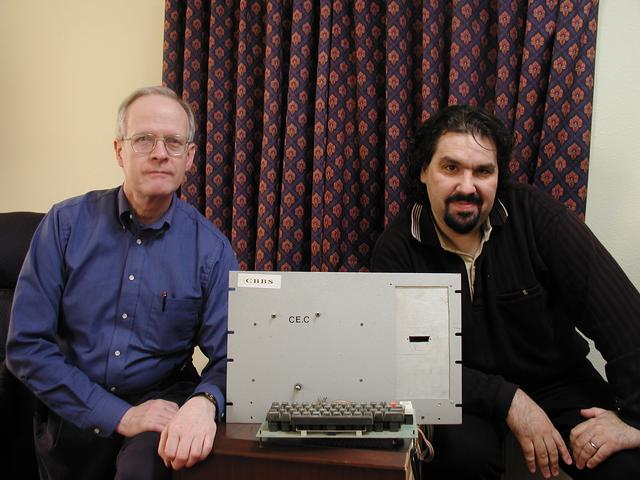
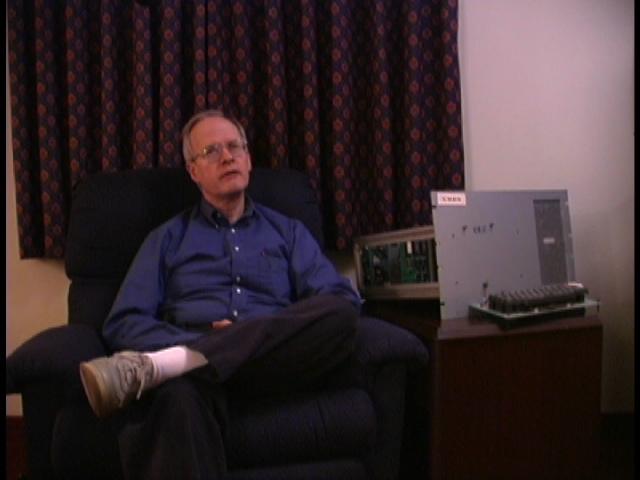
So I decided this was a cool thing, to go ahead and film a documentary where I would track down those names that were like stars to me, to get them on video talking about this subject that formed so much of my childhood. And, generally, that’s come very true. I’ll mention some of the folks in future postings, but on a pure holy-crap-I-can’t-believe-it level would have to be Ward Christensen, who essentially invents what we consider to be the canonical dial-up Bulletin Board System, and even XMODEM to boot. Not a bad set of accomplishments. Ward and I have spent no small time on the phone and we filmed five hours of footage of him, where he goes off on wonderful, insightful tangents about his programming, his life, and of course CBBS, the Computerized Bulletin Board System. When you’re doing a documentary, the holy grail is to get time with the guy who invents the thing you’re doing the documentary on.

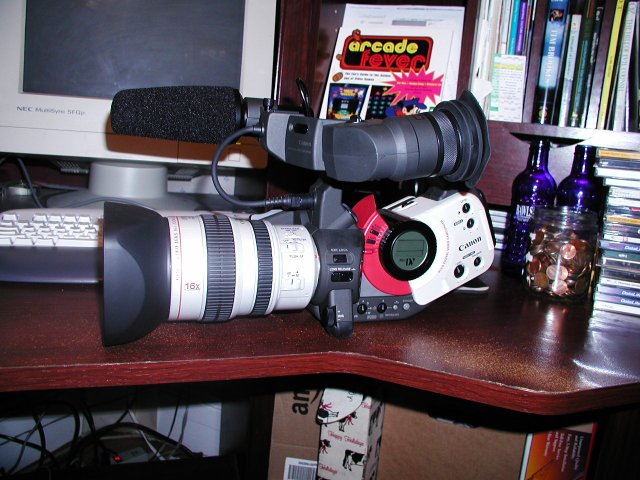
Just that, those moments spent with a man whose work so profoundly touched my own life, is worth more than any sort of payment or profit from the final product. I have to encourage you, before your eyes shift to other parts of other websites, to think that all I did was buy a camera (Canon XL-1), a lighting kit, a couple suitcases, and then started doing it. Maybe there’s some subject that you wonder about as to why no one’s done a film on it… maybe that subject is waiting for you to do it.