ASCII by Jason Scott

Jason Scott's Weblog

Why Is There No Advertising on Textfiles.com? —

I wrote this article a little more than a year ago, after entering into an argument with someone trying to get me to sell his product on my site, wherein he told me I was being obtuse and out of touch after I refused. I’ve reprinted it here because you are technically a different/new audience, and also to show that not all my writings are uplifting rainbows and sunshine.

I thought I’d write a little bit about the idea of advertising on the Internet, since the subject has been coming up more and more wherever I happen to browse (i.e. “The End of Free”, “The Free Ride is Over”, “Pop-ups Now Rule the Web”, etc.) and I figure there’s no harm in giving my opinion. If you’re the kind of person who doesn’t really want to hear the opinion of the person running a site like this, I entirely understand and you can stop reading with no guilt whatsoever.

I essentially abandoned BBSes for the Internet around 1989, still using a few local boards but spending the vast majority of my time on the (relatively) small number of attractions on the Internet. I know this is hard to believe now, but the Internet offered an amazingly educated audience and set of users who could be depended on to post some really thought-provoking writing and otherwise communicate in a forward fashion. Jerks and haymakers were, even within their own contexts, amusing and complicated figures in themselves; Compare Batman’s “The Riddler” to, say, a teenager with a pistol.

Advertising in these early days was pretty much forbidden; as the Internet was primarily the province of non-commercial entities (schools, government) any attempts to put commercials or otherwise inject advertising into the Internet could get you quite a bit of wrath and in some cases actual phone calls to the entity providing you your connection, ending in a quick cut-off.

Like everyone else, I was very excited when I brought up a Mosaic Browser in 1993 and saw this “all-in-one” experience we now call the World Wide Web WWW). It seemed the logical conclusion for similar technologies that had been appearing before (Gopher, WAIS, telnet) and I’m happy to say that along with a few friends, I helped bring a really nice website up and running in 1993 (http://www.tim.org).

What I’m saying is, I’ve been at this a very long time. I have the history to pull from, and I have the experiences that I remember from over a decade ago to compare to what we have now. I’m not coming into the whole goulash within the past few years and suddenly making major pronouncements. So here goes.

It took a while, I’ll grant that, but using the Internet (and by that I mean web-browsing) has become a fairly combative experience. Your websites are choked (and in some cases overrun) with advertising. Your mail accounts are filled to the brim with unsolicted offers of sex and mortgages and hundreds of consumer goods. You are sometimes misled by search engines directly into porno sites that sieze your browser and change your bookmarks. Pop-up ads are now filled with sound and graphics and demand your acknowledgement before you can make a single move on a website.

Essentially, you are no longer a valued part of the entire exchange: You are a Click Monkey, a mindless automaton attempting to retrieve content that may not even exist, like a toy robot running into a staircase and pitifully whirring against the first step.

While most webmasters will not admit this to your face, many of them have dangerously bought into the Lexicon of Marketing, where you measure the success of your website by the number of people who connect and stare at your ads, bringing in pennies with every click-through. In this backwards world the content is besides the point except as a means to keep you on the site, and the meaning of the site is pushed ever backwards to get the audience to walk further down the aisles past screeching banners and demanding buttons. Marketing turns a website into a platform for an ever-rotating cachet of uncaring Masters, each only interested in shoving their carefully-crafted “purchase” message down your throat.

Marketing’s allure is itself very attractive; this is why otherwise bright and intelligent teenagers choose to major in it and learn how to laser-focus their abilities to make a populace want something it previously didn’t know about. Why they go into such a dismal landscape of subtle treachery and misdirection is kind of hard to understand from the outside; at a stretch one could convince yourself that the messages that you will drill into the minds of children an the inattentive will make the world better… but this is almost never the case. Instead, you will use a paintbox of fear, uncertainty, doubt, and sexual tension to bring your client’s message to the forefront of the minds of potential customers the world over. There are barely words to descibe how low you are.

It was inevitable that Marketers would come to the Internet after it opened to commercial interests; only Marketers promise revenue based on lack of effort. That is, all you have to do is candy-coat your website with a number of alluring banners and the money will come to you, pulling you out of your own personal financial swamp. Wealth or at least a humble self-sustaining income will be yours for the mere cost of a few inches of your website. This is a very, very powerful message, if you don’t notice the Pimp behind it.

At this point, I’ll mention what you’ve already figured out: textfiles.com doesn’t have advertising. It doesn’t use banners, it doesn’t use pop-ups, it doesn’t harvest your e-mail address and spam you, and it certainly doesn’t make you click though a number of “read this” pages to get to the content. It’s all there, quite freely available, easy to download and get to. I wish I could say that this site was the norm, and it’s rapidly becoming obvious that it is not.

None of my mirrors (bless them) contain advertising on their textfiles.com sites either; once they do, they’re not listed as mirrors anymore. On several occasions I have been offered a mirror site, if I just allow them to cake their fetid banners all over the content. When I say no, that’s just not going to happen, I get back the one thing that truly angers me: The Indignation.

I understand disappointment that this potential new “revenue stream” will not be available to exploit. I expect a sort of dumbfounded silence at why I am literally throwing away all this glorious green money. But I do not understand that segment of the population who think that the slathering of advertising is doing anyone a favor, and who come back at me with righteous jabs at my luddite-esque reluctance to turn textfiles.com into an advertisement for low-cost server hosting or a pointer to an endless landscape of vaginas. In some cases, I have recieved insulting, critical paragraphs from people who I’ve turned down, telling me to “get with it” and join the “real world”.

Indignation, to me, betrays a complete lack of understanding of the reason that websites were created in the first place: to provide content. These are the same minds that put billboards over urinals and in hospital waiting rooms, who coat subway cars and school hallways with posters, who see no issues with DVD discs that force you to watch a logo every time they’re inserted or with “non-commercial” public radio that begin every show with five minutes of who the show was brought to you by. They look at every spare moment of life as a potential to sell you a product. Every square inch of unused space is a place where an ad should be. Every last bit of meaning in the world should be “presented by” a corporate entity.

Advertising does nobody a favor. They turn everything into a sales pitch, they present glossed-over facts and figures to convince you their goals are the logical conclusion, and they will always sacrifice unpopular ideas and uncomfortable truths if it increases accessibility. All-ages blandness will always triumph over messy introspection and the questioning of meaning, in their book. It is a sad, colorless world they prefer, with the only color coming from their latest campaign. I hate everything they stand for.

Textfiles.com is free: free of cost, free of restrictions, and free of any advertising. I am not paid by anyone to say anything. I am not in the employ of some firm using me to get “clickthoughs” or “sticky eyeballs” or whatever the term is this week. I am here to give you the history of the BBS and to take the site in whatever directions branch from that. I am having a glorious time doing it, too.

The site costs me hundreds of dollars a month to run. I consider it the best spent money in my entire life.

– Jason Scott
August 21, 2002


An Increasingly Misnamed But Still Interesting Site —

Some time after textfiles.com started to gain popularity, I found more and more examples of files that post-dated the BBS era, but which were pretty much in the same “spirit” as the files on the site. The problem with just dropping them into the mix was that I was encountering issues where files about “How to Hack AOL” were showing up next to 1983-era Apple II soft documentation. After a while, you wouldn’t be able to find what you might be looking for.

So, after agonizing over the issue, I created web.textfiles.com, which contains textfiles created in or after 1995. I started dumping hundreds of text files into that site, and luckily (or unluckily?) the number of people creating actual files using ASCII text and not HTML and derivatives is rather small.

Where did 1995 come from? Mostly a somewhat arbitrary decision that 1995 was when the Internet went from being a pretty neat communications medium to a must-have for the computer-oriented and then just the computer-owning. While there’s been a lot to dislike about the resultant entity, there has been a lot to like, too. That’s probably worth another entry some time. But regardless, 1995 has been a pretty good choice, looking at the content on the two sites. In some cases, I’ll see something so entirely historical or important to the BBS era that was written post-1995 and which shows up on the original site, but this is pretty rare. The new batch cares about AOL and getting free accounts on geocities and never ever ever using a mere 80 columns. Or, for that matter, line breaks.

The site has taken off nicely and has a few thousand files, now. When I find new ones, I throw them in handily, and I don’t worry about the original site becoming unnavigable.

The success of this site has encouraged me to create more. As a result, there have been a number of textfiles.com sub-sites, including audio.textfiles.com (the mp3s and .wavs of history) and BBSlist.textfiles.com (the world’s largest BBS list).

So I suppose it was inevitable that as of last night I have loosed PDF.textfiles.com upon the world, which will include many files in the Portable Document Format created by Adobe. For better or worse, it is pretty soundly established as a de-facto standard for document layout and transfer, so there are some very fascinating and involved writings and posters coming out in it. Like any metalanguage that has descriptions of the things inside it, a lot of the quality of PDF comes as a direct result of the person creating it. If you just scan a bunch of documents as bitmaps into your PDF and send it out into the world, it’s going to be a horrible bloated mess. However, if you take a little time and knock together some of the standard methods of shrinking a PDF including the use of postscript and vector graphics, you end up with a small, slick, fast-moving document.

I must rush to state that Adobe has some aspects of being an evil company, specifically in the realm of the Dmitry Sklyarov case, which I won’t belabor here. To balance my seeming acceptance of their document standard with a need to sleep at night, I think we can see a number of anti-Adobe documents making an appearance on the new site. Think of the irony of having anti-Adobe creations in their own document format!

Additionally, a glance through the PDF site will reveal a lot of my personal interests and biases: refurbished Atari 2600 programming manuals, unusual academic papers on such subjects as the economies of online multi-player games, and infamous documents that have some amount of controversy associated with them. The two current examples are the paper on Microsoft’s effect on security in the industry that lead to Dan Geer’s dismissal, and the MIT Guide to Lockpicking, which MIT long ago disavowed and goes crazy when someone mentions them in association with it. It being “The MIT Guide to Lockpicking”. You know. MIT. Lockpicking.

As time permits, I will add additional files to the site, and you can see how fast I grab up everything everywhere. That’s what I’m into, bringing information into a central place, and just letting people have their fun. Eventually, I hope, historical context will come with the content, but that can’t happen if the content can’t be found.

And by the way, there’ll be an html.textfiles.com about a week after a pile of printouts falls over and crushes me.


README.TXT —

Hello, and, in some cases, welcome back.

This is the official beginning of my own dedicated weblog, covering everything from essays I write about subjects I need to work out, to information about advances across my historical websites, to the occasional BBS Documentary gossip and discussion. While a number of locations have existed for this information before, I finally decided that I might as well try this out for the time being, and see if the interface is compatible with my writing and working style.

I should state for the record that Weblogs, and their counterparts in livejournals, deadjournals, bloggers, userland and what-have-you slipped quite happily under my radar; My attention was focused elsewhere, and the nature of the whole process seemed somewhat un-new to me. When describing them to people, I tended to call them “BBSes where the only message topic is the Sysop”. This is generally true for a mass of them, but not all.

I found that a lot of weblogs lack, in any meaningful fashion, content; they are simply an additional layer of gatekeeper, pulling data from various sources which you have equivalent access to, and then adding a short pithy comment and pasted paragraph before sending you on your way. It didn’t seem worth it to have to slog through a couple dozen of the things every single day in the hope that they would reveal some interesting nugget of linkage I might have stumbled into my own way. And I certainly didn’t want to be yet another voice shouting over the cacaphony.

Things have achieved a better sort of clarity now that I understand RSS and News Aggregators and so on; then the whole paradigm shifts and we have a number of folks providing content channels that my little feedreader program can slog through and pick out the newest entries. Essentially, websites become Usenet again, but the mid 1980s Usenet, which was quite the little intellectual parlor for a while.

My intention with this weblog, then, is to add content; to create information, to add my thoughts and embryonic ideas into a discernable web-based location, allowing syndication and feedback. I am not interested in starting a community at the moment so I will not add comment links to the essays. I welcome e-mail, of course, and will do my best to respond intelligently to them and bring particularly helpful/insightful missives to the log itself.

Expect extremely spotty posting, as little as once every two or three months, but who knows, maybe I’ll surprise everyone and become a daily poster.

Weblogs, more than most writing mediums, reflect the flaws and advantages of their owners; I hope you enjoy the latter and live with the former. And thank you for browsing.


Hey, I Was Here First —

Advances in technology, software or hardware or whatever, come from a lot of locations. More importantly, the version of the advance that becomes the most well known is both lauded as that person or group’s accomplishment, and criticized as a lightweight rehash of a previous technology that existed before it. This happens over and over; we use the web but forget Gopher, we use XBOX Live and forget Starpath, we laud photoblogging and forget Pixelvision. Yet none of those earlier technologies are really even the same as their antecedents; they just have that eerie sense of coming from the same place in our collective brains.

Invention mostly comes of interest in Patents and awards. Being the first in and of itself is not generally profitable, but could potentially be in the right hands, with the right marketing and shark-like attempts to quash anything similar. It also, along the way, has a lot of pride with having made those first baby steps into something bigger than the person who created it. This pride can turn into anger and shock when someone after you announces that they themselves have discovered what’s only an incremental change from your discovery.

I’m all about history, so let’s use some recent history.

In the 1980’s Mark Herring created .QWK Packets. This is one of those “of course” discoveries that changed the face of BBSes forever. Not everyone partook of them, and the need for them went away with the Internet (sort of), but they stand as a real example of going about a problem and “fixing” it. If you want a self-contained lesson in advance of an experience, this is it.

The problem with single-line BBSes is that very thing, the single line. When someone is online with the BBS, nobody else can be on. If that person is sitting at the prompt, they are by some standards taking away time from other people. On a BBS that is particularly popular, time that someone isn’t logged on could be measured in minutes out of a day. So, if you want to respond to messages, check your mail, consider it, and reply, you’re suddenly running up against things like imposed time limits, and your own typing speed. This is a problem, and it needs fixing. And Mark Herring fixed it.

Basically, he created a format and a client that would take all the messages that were unread on a BBS, and all the private messages/mail that came addressed to you, and enable you to download them as one big clump. This format, .QWK, would send down these changes to your client. Then, you could immediately disconnect from the BBS (you’d only be on for a few minutes), read all your new messages, read all your mail, and then compose your answers, right there, in a nice text editor, with instantaneous response (instead of the subtle but noticeable delay through a modem). Having composed these messages to your complete satisfaction, it was simply a matter of auto-dialing the BBS again until you connected, and all your responses and replies were uploaded to the system along the same .QWK packets and sprayed across all the message boards.

This changed everything; now BBSes could stop being mostly single-point terminals with folks waiting a person to conduct their business before everyone tried to get on again. Now they were drop-off centers, with people able to connect and drop off their “pack” and pick up another “pack” and disconnect. This fundamental change of the BBS experience can’t be discounted; and once this technology was added, nobody who used it really wanted to go back.

Mark told me of one unintended artifact of .QWK: People who were unable to type with their hands, (for example paraplegics with sip-and-puff typing software) could write out long and intense messages and responses with nary a care about the BBS time limit and other users waiting; they could come across exactly the same as everyone else on the BBS, since their messages would look exactly the same as if they could type at 100 words per minute. He was very proud he wrote something that would facilitate that, as he should be.

I interviewed Mark for the Documentary, so I spent some time learning how the packets worked, including the fact that saved .QWK packets on floppies and old hard drives are inadvertent archives of BBSes. So they were pretty fresh in my mind when I started paying attention VERY recently to RSS feeds.

Sorry that I’m so late to the RSS party; I hope there’s some cake left. I got my hands on feedreader, started looking for the secret handshake on all these weblogs and news sites I’d been browsing rather fervently, and finally figured out how all you maniacs can keep track of 100+ weblog sites at once with actual time left for eating and sleeping. It also solves the problem of getting to someone’s site to pick out the newest information from stuff you’ve already read, and trying to remember which site had an essay you wanted to read (thanks to the search function). I was delighted when I finally understood what was going on.

But did Mark discover this “first”? Is he the father of the concept of News Aggregators? And did what Mark create rate as the “first”? What about Usenet? Does a newsreader count as more of a “first” than Mark’s first, even though they weren’t used for BBSes? And what happens when you figure out who was “first”? Do they get a prize? (Well, they get interviews by a guy like me, but you can ask them if they think this is a prize). This is what I’ve come to call “The Game of Firsts”, where people lay claim to a discovery or a creation and then someone comes along and argues that another technology, lacking some features but having others, was “first” before them.

This expresses itself BBS-wise with, in time order, Ward Christensen’s CBBS, Community Memory, PLATO, and Telegraph Operators. Each one can lay claim to being the “first” BBS, but you have to play some games with what comprises that term. Do computers need to be involved? There goes Telegraph Operators. Is the dialing of a phone line vital to the experience? There goes PLATO. Is it important that anyone in the country be able to dial in? There goes Community Memory. My documentary will only glance upon the first few of these “proto-BBSes” before settling on Ward, simply because I had to declare an arbitrary point of the story. But in doing so, I am setting myself up for quite the fight. There’s nothing I can easily do about that, other than make sure that I don’t dismiss these earlier technologies as feeble or irrelevant to the story.

It is the most unavoidable and yet most wasteful of debates; which technology came first, which was better, which one “should” have won. I understand advocacy as an expression of joy and of spreading information, but not as a tool of harassment and jingoism. It’s been around so long (Apple vs. IBM vs. Commodore vs. Atari, or even Ford vs. Chevy) that I guess it’s part of being human. But that doesn’t mean I have to like it.


The Parties I Missed and the Parties I Didn’t —

It’s hard not to browse over the attendee list for Foo Camp and not feel sad that I couldn’t dip in and out of crowds of those folks. Some of them I heavily disagree with, some of them I worship from afar, but there’s no question that a goulash of them in a non-commercialized space is likely a wonder to behold. What great ideas might be reverberating from that event as we speak!

It reminds me a lot of another great party I wasn’t invited to, the Apple II Reunion hosted by John Romero in October of 1998. Information about this party is mostly buried away, but the attendees included Chuckles, The Fat Man, Lord British, Jordan Mechner, Bill Budge, Dan Gorlin, and The Woz. Just knowing these folks got to spend an evening together makes me happy indeed, on principle.

These sorts of events happen a lot, actually, depending on who you look up to and what floats your nostalgic/cutting-edge boat. For example, anyone who has ever lost a weekend with an Atari Joystick or hit their head against a particularly difficult puzzle in an adventure game would likely be in heaven at the Classic Gaming Expo. The Vintage Computer Festivals bring along their share of luminaries and infamy, as do the myriad hacker conventions that pepper the landscape. I’ll leave the debate about the purpose and concept behind “hacker conventions” for some other time, but I can say that I happen to enjoy attending (and speaking at) them very much. Here’s a hint: treat them like parties instead of paradigm-changing resume-boosters.

What really confuses me is the perception that people who own computers or at least delve into them intensively eschew parties, meetings or other social gatherings for the percieved safety and distance of online. Even the most extreme cases want a place where they belong and where they can ask things rapid-fire of a group of others like themselves, so any announced gathering interests them. And those extreme cases are just that: extreme. You can’t discount the importance of reality to the inhabitants of the online world, and shoving people into some sort of freak box does nobody a favor, including yourself.

Having an event be invitation-only and then not getting invited is always a downer. It’s probably not you; it’s just that invitations depend by nature on the right webs of knowledge and trust, and if you’re not in the one that drives the event, then you’re not getting in no matter how much you might deserve to. The solution is simple: Build your own massive web of trust, and then wait for the cross-links to make your world a richer place.

I was lucky enough to get over to NAID (North American International Demoparty) in 1996, but missed Pilgrimage in 2003. Demoparties, those insane gatherings of computer people and what-have-you over a weekend are rather rare in the United States, mostly owing to insurance concerns. They’re not invitation-only, but that’s not important; the goal is that anyone with some talent, knowledge or ability throws their hat into the ring, maybe they compete at something, and otherwise make a name for themselves. I am hoping that with BBS Documentary DVDs in hand and knapsack, I will make my way across a bunch of them in the coming year or two and meet a lot of people and see a lot of wonderous things.

Many times, when you’re at an event, you don’t really feel like it’s anything special other than a good time (or a not so good time). It’s only with the addition of years that you start to look back and get that perspective to realize that the folks who were starting out at those get-togethers have gone on to great things. You never know where the next mad geniuses and media-gravitating superstars will come from; that’s the magic of it. Maybe you’ll be with friends or your children years from now, mentioning you sat at a bar next to the guy who made the next big thing. In other words, don’t despair at your position on the arbitrary totem pole of now; if you truly care about such things (knowing you’re friends with the best and brightest, as opposed to the most visible) then energy expended meeting people and communicating with them will come back ten-fold.

People, after all, are what make the whole thing memorable. Machines are machines, but it’s the people who turn a LAN into a LAN Party.


All Hail Gunderloy —

BoingBoing, as a print magazine, was a part of a universe of small-press publications, hatched in apartments and off-hours and tons of sneaking around being able to afford the next issue. There were lots of names for this sort of creation, but the closest is “the zine movement“, which essentially came into a golden period when the cost of printing or at least photocopying dropped to affordable levels. With this came a massive influx of leaflets, booklets, rants, and other such creations on actual, from-an-unsuspecting-tree paper.

This may sound like it’s not all that related to computer history, but in many ways it is, because the same type of fertile minds that seized the (to them) obvious opportunity of zines did the same with websites, and many of those creative forces blast across the Internet in the present day, using the same excitement and skills they had to make the web a very interesting place indeed.

There were so many figures I remember from that part of my life, the people whose creations I sent money or stamps or my own art to get a copy of, most of which I still have, packed away in actual space here in my home just like I keep so much online history packed on my hard drives. There were so many of them….

And then there was Gunderloy.

Gunderloy is my often-forgotten creative mentor, one forgotten by me because his star shone so brightly and so intensively and then disappeared. My memories of him and others are casualties of my aging and moving on; sometimes I forget how many people contributed to what I am, and it’s efforts like my web projects that help me to bring them back.

Most people who know anything of Mike Gunderloy know his creation even better: Factsheet Five held for a number of years the uncontested crown in keeping track of “small-press” publications, and by small press I mean a guy stealing time on the office copier. This isn’t to say Mike didn’t take non-independent materials; it just worked out that among the hundreds of individual creations and writings that Mike reviewed, it wasn’t the latest bestseller or even the accepted “alternative” book that was sold in the same chain stores as the “mainstream” ones. This was the stuff in the pile next to the magazine section in your small record store, the stuff with the black and white cover with the hand-drawn date and issue number, the one where you opened it up and you could just tell, looking at the lettering, that they didn’t use QuarkXpress or Print Shop, they used some tape and glue and hoped it would all hold together down at the library when they ran it through for 20 copies.

Factsheet Five produced an issue about once every two months, the central repository of reviews about zines, records, and other creations firing out of homes and apartments all over the country. Throughout the issue were neat little cartoons, tons of writing, and about every crank advertisement for every bizarro publication and project you might want to find. I even remember the many ads from Boing-Boing, featuring a little character I thought of as “The Ornament Girl” (Sorry, couldn’t find an image of her online).

I discovered Factsheet Five during my first days of college in Boston. It was on the magazine shelf at Tower Records of all places, with a cover by Gaither, which caught my eye immediately. It was issue #27, so I was definitely a late-comer to the party.
What struck me was how many zines were listed, all of them having come out in just the last couple of months, and only later, after many bathroom and subway reads, did I come to realize that most of these reviews, these quick little paragraphs summarizing the content of these hundreds of zines, were written by one person.

If nothing else comes out of your reading this entry, let it be this: for years, a 100-200 page magazine showed up six times a year featuring hundreds of thoughtful reviews written by a single individual. He had to do 90 hour weeks to do it, and he crashed against the rocks when it ultimately caught up to his life, but he did it. And if someone can accomplish such a thing, you can accomplish anything. The pure herculean aspects of this astounds me, even now; he had to get a zine, indicate what type of printing was used to make it, say how many pages there were, list the subscription information, read it through, and then create a review. And then do it again. Hundreds of times. To produce one issue. And then he’d put that issue to bed and start on the next one.

Now, I rush to clarify that Mike wasn’t the sole individual involved with the magazine and its sole staff member. Many dozens of people assisted, wrote columns, helped get Factsheet Five out, contributed artwork, and wrote many, many reviews themselves. But it can’t be discounted how central to the whole experience and endeavor Mike was, and how, even glancing through the pages of these issues today (I kept them; they’re all treasures) you see how he stands out from nearly every page, a strong influence and voice that doesn’t crush the personality of the people he works with or whose work he reviews, ending the paragraph with a little (MG) to let you know who had read it. There’s so much to learn from him in these pages.
They age wonderfully; and they still inspire.

I only actually met Mike on two occasions. Once during a party held in his home, and the other in New York City, when he spoke at a small political meeting. Both are memorable for entirely different reasons.

I went to the New York City meeting simply because Mike mentioned in Factsheet Five that he would speak there. I had no interest in the politics or anything else. I was happy to be there, although at the time I had a very terrifying phobia of NYC and it says how much I wanted to see him in person, because the entire experience was like someone afraid of heights getting dinner in a revolving restaurant. I bought up some issues of Factsheet Five, got Mike to autograph them, acquired some weird pamphlets and stickers, and quickly ran home to the suburbs, thinking I’d not get to see him again.

However, the second time came to be when Mike announced a small Factsheet Five party being held at his home in Rensselaer, NY, just outside Albany. I immediately resolved to go, although I didn’t know how to drive at the time. I’m sort of fuzzy on who I conned to drive me all the way up there, to drop me off in front of Mike’s house and let me hang out for hours… whoever you are, thanks again.

I remember another attendee looking like I did over Mike’s massive wall of books, pamphlets, stories and volumes along his living room wall, and saying “This… this is the most amazing collection of alternative thinking and revolutionary thought I’ve ever seen.” I felt the same way; Mike didn’t just acquire, he collected and cared about what he was reading. The house had cats, strange mailed-in items, stacks of paper, and was a real amazing collection of the power of the written word overpowering nearly everything else. I had a fantastic time.

Like all things, Mike’s time with Factsheet Five hit a major wall when the amount of himself that he had been pouring years into finally caught up with him, and he took the whole magazine down. He donated his zine collection to a library, closed up shop, and basically disappeared. Myself and other lifetime subscribers got a small, tiny tiny “zine” from Mike that he put out some months later, more like a “get it finally out of my system” project than anything else, and then he was gone.

Factsheet Five went on for a while without him, and it’s more sad to me than anything else, although the people who worked on them sweat just as hard as any normal editor in trying to put together the magazine. But computers were becoming a bigger part of the process and they got to do a ground-up reboot of the production, and so I myself drifted away after a few issues. I don’t diminish their work; they just weren’t the heroic figure I saw in Mike, burning himself to the bone to bring us so many fascinating works.

Imagine my delight when a couple years ago, I discovered Mike Gunderloy’s websites. He runs a number of them from Lark Farm, raising his family, working on his current computer-related projects and living a good life. To be honest, his writings show a guy comfortable with his world, loving his wife and children, and living out where the air is fresh. It’s like a little slice of heaven, and if anyone deserves heaven on earth, it’s Mike Gunderloy.


The Place Has Really Gone Downhill —

People occasionally ask why I don’t run my own blog or my own BBS or message bases on textfiles.com. My answer, in a basic sense, is I don’t have the time to run things correctly, as I think it should be. To ask me what my definition of “should be” is gets to the heart of the matter.

The online environment suffers from the same problems a lot of communities suffer from: power issues, political infighting, and a wavering sense of the sanctity and baselessness of the entire endeavor. These issues are human, not electronic; they happen in spelling bees, book adaptation efforts, and quilting. Trying to solve human problems with electronic solutions is hit or miss at best, but shouldn’t be considered a huge surprise if it fails to do so.

About all I can do to contribute something helpful to this discussion is point out two rules I’ve encountered in studying this history. Community breeds controversy, and communication breeds contempt.

Descending even further into theoretics, and summarizing what some people fill their college careers studying, the core goals of most communication technologies are not to foster conversation, but to prevent controversy and conflict. Phones are designed for end-to-end communication over the same wires as millions of other calls without a conflict. Phone conferencing, an incremental change in the experience from a person-to-person call, requires a heap of added features to allow the “conference operator” to function and maintain order. Ethernet, I probably don’t have to go into much detail about, but the same issues apply: avoid conflicts, avoid things interrupting other things.

From the first moment a “Sysop” decides what’s going to be discussed or what the name of their BBS or blog is going to be, there’s a steady set of restrictions, rules, goals and mores that get placed upon the forum. And with all of that imposed order, the natural process of decay begins. I’d compare it, in some way, to swimming; you land in the water and begin paddling. Paddle (maintain) at the same rate, and you’ll stay afloat. Stop pouring energy in, and you sink. Pour too much energy in and you end up with an out-of-control splashing maniac. It is that ability to balance and to be a part of things while not overdominating them that’s so difficult to keep around.

And again, it’s not the controversy-of-the-moment that causes the problem. From about five feet away or further, many of the controversies are distinctly entertaining, but they’re far from it for the people involved. That’s because the controversy is besides the point; it’s the group mind-set that’s being fought for, the way things will be for the group at large. If you truly believe there’s a “there” there, then you’ve got to buy into every aspect of it, leaving you in some amazing positions to defend.

The unspoken words are the ones that define a place, even an electronic one, but they’re never clearly stated: we are all alike of a way, we are all huddled against the darkness, we are here for this moment but that moment may end in an instant. That’s what keeps us coming back, and if we find those feelings betrayed, based on whatever internal scale we measure them by, then we feel the place is “lost”.

Throughout the interviews I’ve had with people about their experiences with BBSes and related discussion groups, I’ve gotten a very wide spectrum of thoughts on the art of online conversation. Some ruled their boards with an iron fist, while others remember logging onto a BBS where the sysop hadn’t logged on in years. (There are still a handful of BBSes out there, still up, still having their phone bills paid, just running alone, on autopilot. Bless them.) And in many cases, the BBS software itself (or the blog software or the discussion software) contributes or hinders the style of order that the community will express. The reason that I have over 700 BBS programs listed on the documentary site is not just because there were so many platforms to program them, but because the balance of the software and the hardware against the very root of humanity’s nature is a problem, a difficulty, far deeper and greater than any specific issues of the moment.

The cycle is often stated as “birth, flourish, death” for a community, but it’s almost always “birth, flourish, change, change, change (…) death”. With each change comes nostalgia for how things were and comparison between now and then, when perhaps the best thing to do is consider how things are now compared to how they’ll eventually be.


Five Things Worth Looking Into —

Instead of filling up this bar with some very long, very intensive descriptions of events and things that not everyone would have an interest in, let me quickly give you a handful of informational tokens, flush with links and left as an exercise to learn about if it interests you.

PLATO. It doesn’t stand for anything, although they tried to back-tack some acronyms on it. To some, it’s the first BBS. At the very least, it’s an impressive technological feat, allowing a thousand users to connect to the same computer space, starting back in the late 1960’s. You can trace Lotus Notes, Castle Wolfenstein, Tradewars, Hack, and a bunch of other concepts to this system. Brian Dear has absolutely, unequivocably risen as the Mack Daddy of PLATO knowledge, and is working on what will probably be the best book that will ever be written on the subject. Update: Brian Dear wrote in that in fact it has always stood for “Programmed Logic for Automatic Teaching Operations” and did from the very beginning. The “Tacked-on” myth is just that. Schooled!

Infocom. From its inception to well into its existence, Infocom was the best game company in all of history. They produced a world-class product from day one, ensured it could be released instantaneously on over a dozen platforms (with no change in the quality of the experience), and brought to the world a cascade of worlds and memories that are still shared by many, many thousands. If Floyd still makes you cry and darkness makes you think of Grues, you’re in the club. If not, it’s pretty easy to join.

New Old School Hackery. It’s understandable if there’s a lot of interest in the video game systems of yore, and that the original games might find themselves copied from cartridges to transferrable images, but when you first find out that people are absolutely knocking themselves silly shoehorning games into these very old platforms, you just have to marvel. People have ripped the technical specifications as far as they can possibly go and that doesn’t slow them a bit. Right now, you can buy new Atari 2600 game cartridges. How cool is that?

The Technological Assistance Party (TAP). Before 2600 Magazine and definitely before Phrack magazine, TAP magazine rose from the Youth International Party and for well over a decade gave you some of the most subversive, strange, and hackerish information around. Maybe it all seems quaint now or maybe even irrelevant, but that magazine had everything going for it before the editor’s apartment was firebombed. To be honest, a good solid website will accomplish the same goals of the original magazine, but if you don’t learn how it was done back then it’s much harder to avoid the same mistakes now. And wave to Abbie Hoffman as you go by.

Steven K. Roberts, The All-Time Classic Journeyman Hacker. So let’s get this straight. Steven Roberts sold all his stuff, built a recumbent bicycle loaded over with the best gear he could get at the time, went out on the road, and started to send out missive after missive to Compuserve from all over the country. He travelled thousands of miles, wrote about all his experiences as they happened, and lived a dream that many have had, and lived it well. Yes, he’s real. Yes, it happened, and he wrote a book about it, a book floating around the top space in my collection. Steven K. Roberts, I hope everyone learns your story.


Have you met Curt Vendel today? —

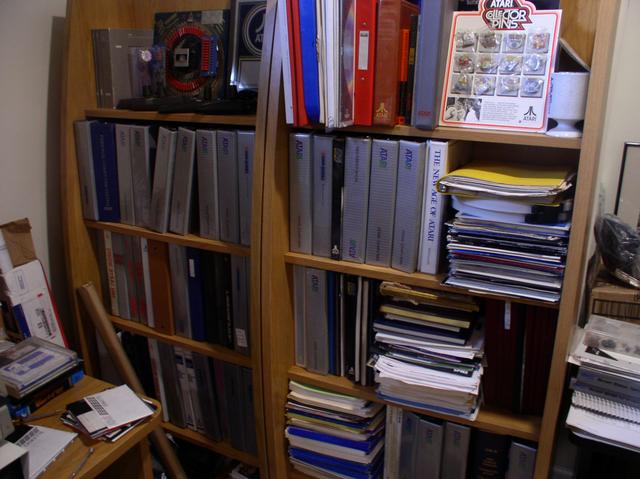
There’s the usual layer of nostalgia: you played an Atari game or two or perhaps owned a 2600 and some cartridges. Then there’s the layer below: you check on ebay for cartridges and collect them, maybe even pick up the occasional full-sized game to burn through some ready cash. And there’s a layer beyond that, where you pick up old vintage Atari posters or a t-shirt or maybe even the occasional obscure artifact like an Atari Asteroids Halloween costume.

Even there, you’d have nothing on Curt Vendel.

One of the things I do once I get my hands on a new subject to research is working my best to exhaust all the available data sources, then going after more obscure indirect sources that might reveal more: knocking up shareware CDs for sale on ebay to get additional versions of a BBS program, for example. Or finding a website that posts information that isn’t related to the subject, but mentions it indirectly, which gives me some vital name or event which I can search for and find even more interesting. Once I get into one of these runs it takes me pretty far, pretty fast. Naturally, this would occasionally put me into contact with Atari, which has not only a long history (Williams/Midway and Gottlieb do as well) but had such interesting amounts of employee and idea churn over its decades that people correlate all over the history of computer games and computers at large. And the thing is, wherever I went, Curt got there first.

I’d find what I thought were golden, obscure internal Atari VAX message postings, and Curt had been involved in the project. I’d find some neat old articles on bulletin boards and it was Curt had the original magazines. And it was Curt who had access to the golden stuff, the neatest of the items, the ones I thought didn’t exist. If the term “Atari 1450 XLD” has any meaning for you, Curt’s Ownership of one should come as a bit of a surprise. In fact, Curt has what seems on all fronts to be the largest private collection of Atari Memorabilia, information and documents in the world.

I interviewed Curt for my documentary because I wanted people representing as many of the major platforms of the early 1980’s as possible. (Atari, Commodore, Tandy, IBM, Texas Instruments, and so on.) Who better to discuss the draw of Atari than someone with so many examples of it?

(The interview went very well, by the way.)

It turns out that in fact I’d met Curt at the Vintage Computer Festival East, where he had a number of Atari artifacts I’d never seen or heard of, including oddly colored joysticks and a light pen. We talked a bit then, but the documentary wasn’t full in my mind then, just an idea being kicked around, and I was a pure tourist, someone delighted that so many interesting items were around so close to my home.

Curt is not just a mere warehouser of Atari; he is truly a curator. His website, Atarimuseum.com, is completely packed with information, pictures and documents covering pretty much all aspects of Atari. Curt understands more than most the magic this company built up in marketing, engineering, and all-around approach to the concept of “computing for the masses”. That’s a very etherial thing to grasp onto enough to present to folks, and I think he’s captured it.

So here’s what I’m getting at. Having collected nearly everything there is to find about Atari (although I’m sure Curt personally feels he hasn’t), having amassed a collection reaching into the thousands of individual items, Curt’s natural and distinct goal is to digitize and present as much of it for the public’s consumption as possible. To give it historical meaning, to get it saved for posterity, and, through his attendance of computer festivals and conventions, give people who grew up so influenced by Atari the chance to see how many incredible things this company had to offer. Instead of locking it away to covet on his personal time or show to a few arbitrary individuals, he’s opened it to the most folks he can on a physical level and provided (through his website) the opportunity for anyone who didn’t know until five seconds ago they needed to see it, the chance to see all of it.

I can’t think how it gets better than that.


The Art of the Crack —

By request, I’m going to write a little bit about the concept of “Cracking”.

Like any good computer-related term, it has gone through many different meanings, all of them hotly fought over in certain tiny corners. Many of these uses are correct, as long as you take into consideration the time being spoken of. In my case, let’s go back again to those late 1970’s and early 1980’s.

One of the lost qualities of the online experience is the pure factor of time, where the amount of minutes required to download just one side of a floppy disk (between 100k and 300k) could be excruciating. While in today’s world of 800-1000 megabyte bittorrent collections might seem similar, at least you can do other things with your machine at the same time; play a video game, read your e-mail, even be downloading via other methods at the same time. With an Apple II or Commodore 64 or Atari 800, that was it; you just got yourself a plastic-cased Floppy Disk Transfer Machine that could do nothing else.

While this would normally be a small nod to the potential for exercise, in fact it was one of the factors towards the goal of “cracking” a program, to remove the copy protection and potentially shrink the amount of data by turning an entire disk side into a singular file. This file would be much smaller than the original, and could be transferred in a fraction of the time.

The piracy of today often involves the use of .ISO or similarly-named and formed images; basically exact copies of the entire data range of a CD or DVD, compressed with today’s much-faster compression routines like .ZIP or .RAR or .ACE, and then sent along its merry way while the game companies curse your name. Outside of the fundamental issue of acquiring the pirateable data before anyone else and having access to a method of distribution, this is not a challenging or intellectually stimulating endeavor. You are generally not changing one whit of the data and you are, essentially, a glorified photocopier.

Not so in the days of the Crackers, when a program contained incredible tricks and traps to make sure that it was on an honest-to-goodness floppy disk and hadn’t had some sort of unauthorized duplication set upon it. To be able to wrest it into a file, you had to step through the actual assembly language of the programs, decipher what was trying to be accomplished, and remember that in many cases the program was trying to fool you. You had to really know your stuff to be one of this tier of software pirate; Cat Burglars where others were smash-and-grab thugs. As a result, talented and quick crackers were few and far between and prized by the groups that had them.

Ah, groups. In a phenomenon that exists to the present day, those involved in the duplication of items have often decided to give themselves handles, and refer to their set of friends or acquaintances as a team, or pirate group. Even from the beginning the names were colorful: Black Bag, 202 Alliance, 6502 Crew, Apple Mafia, West Coast Pirates’ Exchange… and a few dozen others. All of them battling to crack the protection, get the ware out, and keep the glory.

I can tell you with very strong belief that the term WAREZ arises out of “Wares”, itself a shortened version of “Softwares”. I have message bases caught by my own computer from 1984, so I know that the term definitely stretches back that far. Going through those message bases, I see terms that are very hard to pick up on their face. Terms like “Catsend”, “G-Sections”, “AE Line”. While I think a lot of these files are vital history, I am very concerned that the terms will have no meaning by the time others come to them for any learning.

Concerned about this, I created a very large, very thorough file called The Annotated Pirate’s Guide, an exhaustive research of terms and meanings from Apple Pirate days, based off the original file, called The Real Pirate’s Guide by Rabid Rasta. You could lose an afternoon on that file, so beware.

We wouldn’t have any idea of the involved processes of cracking where it not for a select group of crackers who chose not only to crack games but write informative guides about how to do it. The most prominent of these is Krakowicz, who wrote “The Kraking Korner” in the early 1980’s and lays out the whole process with a talent for writing and a sense of the magic in the process. Krakowicz is also officially my Last Great Unfound Hacker, so if you’re Krakowicz, please write in. Other guides by Buckaroo Banzai and The Red Pirate are also excellent insights into the Cracking life.

But if the actual nuts and bolts of the Crackers doesn’t interest you, perhaps the crack screens will. For not only were Crackers able to turn a disk into a file for easy transfer, but they would often modify that file so that the title screen would have a special little shout-out from the cracking group, letting you know who did the work. This sense of pride coupled with ability enabled groups to get their name out to people who were copying the disks as fast as they could. After a while, you knew you were seeing a Black Bag release or another disk from the Apple Mafia. And after a while, these crack screens grew more and more elaborate, including animation, sound (and music on platforms like the Atari and Commodore 64 computers), and multi-screen thank-yous and membership lists.

After a while, these opening screens became so elaborate that separate divisions of pirate groups had to be formed just to program them. And after a while, these programmers said “why do I need to be associated with a pirate group to make really great-looking programs?”

And they went by themselves, into the darkness.

And so were born demos.

As it stands, I recently did some work taking the Crack Screens of over 350 Apple II programs and putting them online. If you’re feeling like giving your machine a workout, try looking at the thumbnail gallery. If you were brought up looking at pirated Apple II programs, like I was, it’s like someone grabbed the Memories Hose and turned it full blast upon you. Wear a raincoat.