ASCII by Jason Scott

Jason Scott's Weblog

Vintage Computers, Vintage Film —

I had a great time at the Vintage Computer Festival. My photographs of the event are here. You don’t know old-school until you’re playing a copy of Spacewar on a vintage PDP-1.. against the creator of Spacewar. Meeting Steven Wozniak again was also great.

Actually, there’s so many great memories, I’ll have to go into them over time. Needless to say, it was a wonderful way to spend a weekend.

Talking with Count Nibble at the festival, I suddenly was struck with how I was dragging my feet on another project… REALLY dragging my feet.

Spike Lee has The Messenger. Terry Gilliam has La Mancha. And I have Blessed are the Filmmakers.

At Emerson College, you had to propose your final film for it to get accepted by the faculty and be given a semester to make it, for credit. Only some students were accepted. I was not accepted. So, I went ahead and shot it anyway. I’m like that.

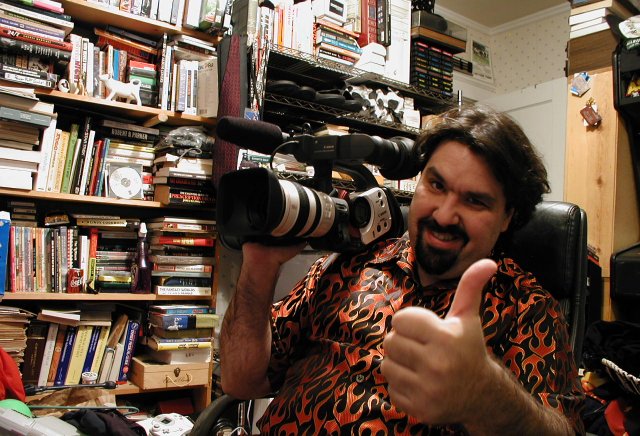
Of course, without it being part of credit and having not much funding, I shot it on video, with a somewhat large cast and some portions shot on 16mm film. I was the director, but my producer, Scott Rosann, was also a critical driving force. (Scott looks like this these days). I also had a director of cinematography who was fantastic, but I have forgotten his name (I hope the credits show his name).

14 years ago, I made this film, and it is so rich with ironies it sounds like I’m making it up.

If I had to come up with the genre, I would say it’s a supernatural comedy. It tells the story of a film student, Andrew, who has not graduated from film school because he hasn’t finished his final project. And he hasn’t finished his final project because he hates it. Told by a school committee that it couldn’t have a happy ending, he filmed the couple in it breaking up at the end, but he can’t bear to edit it that way. In fact, while he sits at his editing bench trying to cut the film and finish it, he gets into arguments with his characters about what they should be doing.

And they argue back.

In fact, he ends up talking to a few other student films, whose characters respond with why they were made and what their directors wanted.

Meanwhile, he is assaulted on all sides by his friends, who want him to finish the film, and from the school, that expects him to finish it.

So many of my friends are in it, I’m sure it’ll be a shock seeing them all, between 20 and 23, walking around with smiles and happiness, nearly a decade and a half ago.

Is it good? I actually don’t know. The reason I didn’t finish the film was simply money; it cost so much to edit video, that I couldn’t afford the hourly costs. Well, obviously now I can. So let’s get that thing done.

I’m either going to love it or hate it. But I am going to finish it. And I am going to release it. For free.

I believe it’ll come in under 20 minutes, so hopefully this won’t be a killer to put together. And maybe, with the BBS Documentary under my belt, it’ll come out better than it would have so long ago.

Here’s hoping.


One From the Mailbag —

Date: Mon, 7 Nov 2005 04:10:41 -0800 (PST)
To: jason@textfiles.com
Subject: Concerning storis on your textfiles website

Jason,

I am the author of several stories on your textfiles
website, probably a good 13 stories. Maybe it’s just
meaningless text to you but it was a lot of hard work
on my part. I notice that there are no author credits
on my stories and I am very interested in hearing why
you removed author information. I find it offensive
but I’d like to hear your side of the story instead of
just assuming.

Date: Mon, 7 Nov 2005 10:34:16 -0500 (EST)
From: Jason Scott
Subject: Re: Concerning storis on your textfiles website

I never removed a single author credit on a single story. In fact, I
never edit a file, unless I wrote it, or I retrieved it from a dead
medium, like off a printout (indicating that I transcribed it so
people know what the source was).

These files have come to me from archives, CD-ROMs, old floppies, and
printouts. I do not edit anything. Your accusations are insulting;
you say you want to hear my side and won’t assume, but then you do
coming out of the gate.

People might remove author credits and then put them on their BBS, up
on a site, or on compilations. I get them from there; the corruption
happened elsewhere. Feel free to send me your original works and I
will happily host them.

Speaking of insulting, I run a site called textfiles.com and have for
7 years. I spend thousands of dollars a year hosting them and work
with many people to save these files off of dying mediums. Do you
seriously think it’s “just meaningless text” to me?


Creative Commons and The Money —

OK, so everyone wants to know how I’ve made out so far with my whole releasing the BBS Documentary as a Creative Commons thing. And by “made out”, they mean of course “made money”. As in “Did you make any? Or were you ravaged like a mid 1990s FTP site with a Lucasarts Game uploaded to it?”

So let’s dump some numbers on you, and then I’ll talk about them.

First of all, the BBS Documentary was profitable within the first three weeks of release. That means that when I announced at the end of May 2005 that it was now going out, it made back the pure money cost of production and duplication by the middle of June 2005.

Second of all, over two thousand copies have left the house since I started selling them at that time. Most left by mail, but a few were sold at conventions like DEFCON, TOORCON, PHREAKNIC and so on.

Roughly, very roughly, the documentary has brought in money in the six figure range. (Low six figures. Very low.)

So by most measures, I think that’s a success. I certainly believe it to be the case, and it inspired me to go forward on GET LAMP, so everyone wins.

Now, let’s address all of these points in a more realistic and accurate fashion, so that you don’t walk away with the wrong ideas.

Three Weeks!

First of all the “profitable in three weeks!” headline makes it all sound like I opened the floodgates and I was suddenly Scrooge McDuck. However, that’s missing the important fact that I sold pre-orders. In roughly September of 2004, I opened up the floor to people buying their copies of the documentary set in advance, to both support the project, and to have the opportunity to get anything they wanted to say onto the final DVD-ROM, which hundreds (hundreds!) of people jumped for. This brought in roughly $18,000 in a very short time. There were two reasons for doing this and a non-reason. One (more important to me) reason was so that people who’d been following the project could kind of “etch a mark” into it by having their words and their memories be a part of it, even if they weren’t specifically interviewed. And so on the 3rd disc, their words are there. The non-reason was that it was a vague anti-piracy move; you’re more likely to buy than copy a product if you get a chance to affect the product in some way. So there we go. The second reason, which shouldn’t entirely be discounted, was because I was getting push-back on the part of my family, towards the idea that I was about to drop almost thirty thousand dollars into the project for the duplication, effectively doubling the cost built up over the previous three years. Those are some pretty goddamned scary numbers, and so the question was raised if I wasn’t just throwing good money after “mad” money.

Hundreds of orders at that point proved that, in fact, I was not wasting money. So things were well on their way before a DVD was pressed.

By the way, I probably could have saved a bundle doing a plastic standard 3-DVD case, or even a 2-DVD case, shoving everything into a pre-formed package with a printed label on the outside. I think anyone who has purchased the DVD set and gotten the box knows why I chose packaging that cost as much as it did. (If I didn’t say before, my duplication company of choice was Bullseye Disc out of Portland. Say hi to Shelby and Curtis from Jason.)

If I had to do things again, and I sort of am with the GET LAMP project, I will likely offer the pre-order at a reduced rate from the “final” DVD set, to reward pre-orderers financially as well as personally (I’ll likely have another DVD-ROM piece.) We’re talking over a year out, so who knows, but this sort of stuff is on my mind. It was an incredible, stunning move to pay $50 into the hands of a guy just because he ran a nice textfile website and had some good photos up. I appreciate every one of those folks.

Two Thousand!

When I ordered my copies of the DVD set, I went a little overboard by most standards; a lot of first time filmmakers would order 1,000 copies, especially of a box set. 2,000 if they were getting good buzz. But no, I had to go and order five thousand copies.

So, basically, I would have sold out of my “stock” by now, roughly five months into release, if I’d been conservative. Not bad. On the other hand, I can react very quickly to any burst in sales because I have thousands of these things in my attic. (They used to be in the basement, but the basement gets moisture. Now they’re high and dry.)

It is worth noting where the “sales” have mostly come from, where people were getting the news and then acting on it. Without a doubt, it comes down to two main places and about five smaller places.

The first two are slashdot and boingboing. Slashdot is, very simply, a marketing powerhouse. If your product is on the front page, thousands, and I mean REAL thousands of people will check it out. From all over the world. Woe be to you if you don’t have your hosting and payment ducks in a row, because they don’t come back, either. It’s like this galloping herd of buffalo that just fucking run over your little storefront, yelling, screaming, and knocking everything over. But if you’re offering something people want, and make it semi-easy for them to get it, you will happily whistle and clean up all the broken chairs. I got mentioned on Slashdot about 5 times during the course of this production, and I made thousands each time.

Boingboing, similarly, has a huge drive, although it’s not specifically in a pure traffic sense. They definitely jam in the hundreds of visits, but they’re people who talk about their visit, who mention it in their own weblogs and forums and in person. They drive awareness instead of sales. So it’s a quality issue, although of course they also drove sales. Bear in mind this is all different than the Creative Commons event, which I’ll go into below.

As for the five smaller sites, they ranged from the Creative Commons weblog, to the DiVX weblog of all things, to a very nice (and un-asked-for) link from dive into mark that’s still up there, sending people my way. All of them have sent me dozens of sales, which add up quickly. All of these folks basically heard about me from Boingboing.

Most of the two thousand have gone out from these sites, but there have been other cases too:

A couple hundred have been going for free to interviewees and members of the press/review sites, as well as people who I pulled many favors from to make this series. A bunch have gone out at conventions, as I mentioned above: probably about 200. I also sell through Amazon, although I guess people don’t really understand that Amazon takes 55 percent of the cover price, so it’s not anywhere near as profitable as selling directly, although Amazon has a nice above-ground reach and they do a great job of getting my project in the face of a lot of people. So go Amazon. Sometime I’ll explain why I don’t sell through other venues/methods, but the short answer: they make 55 percent seem like a cakewalk.

Six Goddamn Figures!

This is gross income, not including considerable taxation, and other costs of doing business that my producer would be quick to point out: packaging materials, loss on some shipments (it was easier to go with a uniform global postal rate), unexpected financial hits involving returned and lost DVDs, gas and car costs for driving this stuff to the post office, and so on. So don’t think I’m wearing a gold chain that says “TFILES 4EVA” and sipping my Gin and Juice. But yes, if you look at pure total income, I have done very well.

My work is in a very confined and tension-filled space, that of niche documentary. People have been kind and pointed out that the film could probably play on a cable channel or in general release, but that’s where the hatreds come in; when a film is marketed outside its intended audience and people go “what is THIS crap?”

(Someday in the future I may re-edit a one-hour version of the documentary (which I will hate) and sell it down the river. Until then, you got the “director’s cut” first.)

But here’s how bad it’s been. I buy a lot of documentaries. A ton. Really obscure stuff, where I’ve bought them and they come in a generic plastic case with a hand-written label.

There have been cases where I have paid for a copy of a documentary, and the creator has actually e-mailed me: “Who are you and why are you buying a copy?”

By those standards, I’m friggin’ Richard Branson. With a better smile.

Going Creative Commons

So some part of this comes because of my going Creative Commons Attribution-ShareAlike. But in point of fact, it was less about going Creative Commons than the essay I wrote explaining why I did it. Creative Commons has an issue, like any charity; they need people willing to give away stuff for little or no return in doing so. Sure, when you give $100 to your local theatre they’ll give you a little line in the program, or a few free tickets. And there’s little back and forth gifts like that in most charitable acts. But Creative Commons basically makes people give away stuff that the world tells them otherwise they could be selling. And that’s a tough sell. Cory Doctorow talks it up and backs it up by releasing his own created works this way, but Cory is also a productive powerhouse who has released multiple books and stories in a very short time; he’s able to amortize the pain across a lot of output. Not everyone can do that. It’s like when you watch someone in great shape talking about the advantages of a good diet and exercise, and you might realize with horror: this person really likes to exercise.

In my case, I have one product. Uno. And it took four years to make. I don’t know how long GET LAMP is going to take, but I won’t be 35 when it comes out. So this is it, the big jump, the huge leap, and I decided to go with Creative Commons. And so I wrote about why I made this choice.

It turns out that talking about it drove more sales than doing it (of course), because by putting my thoughts into a cohesive essay, people could link to the essay and the creative commons people could go “here’s a war cry, a guy who actually did it”. And a movement, of any sort, needs that sort of thing, where I’m not “tainted” with being, say, an organizer of Creative Commons.

So when you have a guy who’s not at the forefront of the Creative Commons “gang” who has created this massive five-hour project and then makes it available to the world via CC S-A 2.0 (as they say in the “CC biz”), well, that’s newsworthy.

I don’t know if that hat trick could be pulled again, that is, if I released GET LAMP under a similar license with similar announcement, if it would really generate the same interest and amazement on the parts of all the weblogs I know of out there. So who knows, maybe that was a one-time event. I won’t know for at least a year, because I’m definitely planning to release this one Creative Commons as well. (So strike one for the good guys.)

But I can state without hesitation: going Creative Commons earned me a lot of money. It did it via newsworthiness, but it still did it.

So the final question/point/clarification is: did it COST me anything?

“Piracy”

First of all, you really can’t “pirate” the BBS Documentary. People have come running to me pointing to the Usenet feed that had the full ISO images up and the links on the bittorrent site and cry about the piracy, but there was no piracy. This is what the CC S-A license is about: unless they strip your name off, they aren’t doing anything wrong! They can in fact sell their copies, and they aren’t doing anything wrong, at least, in terms of violating your CC contract. I sometimes wonder if all the people who license their CC stuff know that. I didn’t use the music of some of the people who licensed their stuff CC because it was fairly obvious they did not. They’d drop limitations on the use of their work that weren’t compatible with the license, and think they were still licensing it out.

A good example of my use/abuse of the CC license is the music for Fidonet episode. I wanted acoustic guitars as the soundtrack. I didn’t want people singing with acoustic guitars as the soundtrack. So, I ripped, burned, remixed. In some cases, the “songs” playing underneath the interviews are five different guitarists blended into some sort of guitar gumbo, making a song that would probably cause all of them to cringe if they heard it.

Does that make me bad? I don’t think so.

Here’s what I’ve seen done to my documentary since I went Creative Commons:

  • It has been downloaded over 4,000 times via bittorrent.
  • It has played at a number of conventions as filler between shows.
  • It has played on a couple Internet TV stations.
  • Some public access stations have played it as well.
  • Relevant passages for specific subcultures (like Tradewars) have been cut out and put up so people can see the 2 minutes they want.
  • People have reviewed it, and mentioned things wrong like “it comes on 5 DVDs” meaning even though they got a copy for free, they want others to know about it.
  • It has been used as a teaching tool in several classes at the college and high-school level.
  • It has been used as a way to ‘get’ me.

The last one’s more a personal issue; I have folks who don’t like me, so they download it and go “bwa ha ha, I have snatched the jewel from your hands”, when obviously, they have done no such thing; I had a box out front with “free jewels, take one”.

The others are neat to me. Since the goal was to overcome the problem that there weren’t any BBS documentaries of note, the fact that more people are seeing them is more important to me than making money off everyone. Do I count those 4,000 downloads as “lost” sales? Or do I count them as “massive increase in potential audience”?

Call me entranced by Lawrence Lessig’s dreamy eyes, but I just can’t see these events as missing revenue or ruffians absconding with my work. Maybe if I’d sold none and watched it get downloaded everywhere, my opinion would be different. And if I’d not made it onto Slashdot and Boingboing, maybe I’d not have the same thoughts.

But I was honest with what I’ve been doing, and I was honest now in telling you the money I’ve made from this project. And it was good money (although I should hasten to add that I spent literally 2,000 hours putting this work together, and so my hourly wage was a tad low). So in my case, walking the path of light has brought me success, bountiful great success indeed.

So I will continue to walk that path.

In a related story, my producer reminds you to buy 10 copies.


Vintage Computer Festival —

Before I mention next weekend, let me just say that about 200 people have already signed up for a “let me know when you’re working on GET LAMP and when it’s available” list. That was within a few days of announcement. I’ve also been contacted by roughly two dozen people who worked in text adventures (not just worked at playing them) from Infocom, Synapse, and elsewhere. So I am a very happy person right now.

Most heartening has been getting referrer links and weblog postings from people saying things along the line of “The BBS Documentary Guy is making some new film, so obviously it’s going to be good.” I read that stuff and it matters very much to me that I have earned that opinion with folks.

Anyway.

This coming weekend I will be in attendance at the Vintage Computer Festival 8.0 in Mountain View, California. A little more than at attendance, really; I’ll be conducting a panel on BBSing, selling copies of the BBS Documentary DVD set, and showing episodes from the same set throughout the show.

The Computer Museum used to be located in Boston, near me. Now it’s across the country, and is many times better than it used to be. It’s located in an old Silicon Graphics building, has tons of space, and is already well on its way to having a lot of amazing stuff. I have some photos from last year over here.

Last year, with the documentary mostly edited, I had a “beta premiere” at the festival, showing five of the episodes to the audience. They lacked music and some final work, and I used a lot of the reaction of the audience to guide out the rest of the editing. I think this improved the episodes greatly. Things I thought were funny were validated, while other stuff came out as too long or too boring.

Now, someone else is going to go through the same process; Greg Maletic will be doing a beta premiere of his own documentary, The Future of Pinball. I’ve seen a rough-cut. It’s good. It’s really good.

If you’re in the general area, it’s worth the trip. It really is. See you there.


There is a Shiny Brass Lamp nearby —

I’ve been coy enough for too long.

The next documentary I am working on is about Text Adventures, or Interactive Fiction. It is called “Get Lamp”. It has a introductory website (GETLAMP.COM) and I’ve been noodling with it for about 3 years. I got serious about it in June and have been spending significant time on it since September. This is, of course, in addition to my other duties and projects.

Now why, after finishing a massive film project, would I set off on a new one? Well, it’s fun, for one thing. It’s honestly a great time travelling around, meeting people, and getting down for posterity the thoughts and statements of what I consider to be some important folks. After a decade of wanting to make movies and then not actually doing it, it’s great to accomplish what I used to dream of doing when I was a teenager. So there’s that.

I could go on about the goals, the people, the planning, the intentions, but I’ll leave that for another time. The GET LAMP website has a bunch of statements and other information that the curious might enjoy.

The rough plan is to film for a few months in the beginning of 2006.

I do have to stress that almost no potential interviewees have been contacted, so no fair being offended at not getting a letter; I like to do research and know a subject very well before bothering people with mistake-filled phone calls and e-mails. If I set off to do something like this, I want it done right. Also, this obviously isn’t set in stone and if I run into a problem, financial, logstical or otherwise, I’m not going to tilt at a windmill to make a movie in spite of reason.

But right now, the skies look clear.

Anyway, there you go, now you know.


Hungry —

I think when I first starting doing this weblog after my BoingBoing stint, I was going to focus my efforts on doing just massive essays on aspects of digital history… basically having a kind of boiler where I would throw out stuff that didn’t have any other place to discuss it. A lab, if you will, which would be sharing my thoughts and impressions on some aspects of computer history.

But the film has subsumed part of me, in a big way, as has the next documentary (a solid number of people know the subject matter now), and so this weblog has basically reflected that as well. For better or for worse, I do films as well as digital history. Of course, my films tend to be about digital history, so maybe we’re not that far off the track.

But I wanted to step aside for a moment to just mention some of my experience in “marketing” the BBS Documentary, and where choices I made years ago have worked and not worked for me.

First of all, it has become clear to me that what I ended up doing was somewhat unique. I don’t mean the subject matter; I would hope the subject matter of any film would be as unique as possible, and there’s a lot of work out there that is unlike the rest. No, I’m speaking of the fact that I ended up creating it, from the start, as a 3-DVD set with multiple episodes. Apparently, that was wrong.

What I’m supposed to have done, based on a lot of observation of other production and film weblogs, is slaved like crazy to make a single, hour or two-hour film, finished editing it in the nick of time, on borrowed cash, and then fallen to my knees and prayed that it would get into… a film festival.

From there, I would dress in somewhat OK clothing, showing up at one of these events, praying for a good time slot, and looking forward to foisting my film on a set of people who would previously have seen a buddy film, romance film, heartfelt drama, and maybe a rival documentary (all other documentaries would be my rival. Grrr).

Through all this, the showings, the festival, the application to the festival, the trying desperately to get attention… all through this I would be hungry. Hungry for attention, hungry for my film to be seen, hungry to get that distribution deal that would ensure my success. That wild-eyed look as you saw the money men come into the room and stand at the back of the theatre while your sex scene played, the fear in your eyes as they started talking on their cell phone and dipped out.. that concern that the weiners in your buffett table might be too cold and the money men won’t buy into your work.

I recently thought it would be a pip to maybe get one of the BBS documentary’s episodes into a film festival. So I went to go enter it into a few.

I used a service called Without a Box, which is basically a centralized festival submission engine. The cool part about it is how it forces you to think of stuff you might not have previously, so your entries really are a lot better. “What is the subject matter? How would you describe it in two sentences? In a paragraph? In multiple? How about yourself? Is this film geared for comedy? Romance?” and so on. You have to answer a ton of questions about your work, and have that whole “press kit” ready to go to mail in with your submission.

I submitted to 6 festivals. 4 have rejected me, and I have dire feelings about the other two.

I now realize I should have taken my film off the DVD, burned it onto a crappy DVD-R, and sent the single episode in, like a poor post-grad begging for a little time.

What I DID was just jam the whole finished professional-looking box into the mailer and send it along.

Whoops.

What got me, until recently, was how much money I had to pay for this privilege. I sent them a copy of my film, paid for the postage, worked up all the stuff for the press kit, and then had to pay anywhere between $20 and $50 for the chance of someone from that film festival to look at the work. Fifty dollars! Imagine they get 100 entries. And they get to charge admission! Where do I sign up for that gig?

Anyway, the problem was, I’m just not hungry. Filmmakers sign up and try to get their projects in and beg and plead and clasp hands because they desperately, helplessly want their projects to be seen, so that, hopefully, they can have their film up on the big screen and they can see their film go into a nice package and go into the world.

But I did that! I did that in May!

And outside of the 4,000 people (and growing) who I know have downloaded the film via bittorrent and other similar peer-to-peer methods, over two thousand people have bought the DVD set in box form! Two thousand!

There’s still three thousand boxes in my attic, by the way, so feel free to buy more… but the point is, I made my costs back. And while I’ll likely never get back the per-hour costs (measured in time of production across the 4 years), I am anything but a failure, and certainly, not by a long shot, hungry.

So of course I didn’t really look at these film festivals as do or die. I didn’t exaggerate the appeal of the work or what it was about to try and get it to somehow hornswaggle audiences into getting into a theatre to see it. It’s a niche project. It’s a niche audience. But it serves that niche audience very, very well.

I think what probably doomed me with the festivals was when they asked for running length. Hmmm, running length in minutes.

I always put 330.

THREE HUNDRED AND THIRTY! I’m trying to imagine the eyes bugging out on the poor intern going through the applications for the film festivals I applied to. Running this number through a divide-by-sixty… FIVE AND A HALF HOURS, OH MY GOD. AND WHY IS IT IN THIS PRETTY BOX.

So reject I will be, and reject I shall stay, and I think I can live with it. The more I read these weblogs, the more I see the desperation, and the more I realize how many people literally bet the farm on their films… the more I realize why I didn’t actually pursue the film industry when I got out of Emerson College with my film degree.

A few quick thoughts on what worked, and then I’ll be done gloating.

I didn’t sink my entire financial future into this film. By shooting over four years, never buying stuff I didn’t need as a “hedge”, and combining trips into single insane jaunts, I kept the total production under $25,000. That may seem like a lot to some folks, but split that over 4 years and consider the resultant output, five and a half hours of finished work, and you realize: the budget for my film ended up being $75 a minute. Believe me, that’s a bargain others would gut a volkswagen with their teeth to achieve. So when the time came to make decisions, I didn’t cry when I cut out a scene. I made better choices.

I was never scared about people knowing I was doing this. Heck, I announced it on Slashdot. For four years the world knew I was shooting a film on BBSes, and I wasn’t worried about being scooped, because I knew I was going for the best possible work, not the most profitable or marketable or anything else. I wanted this thing to rule, and if it took a 300 mile trip and an hour of sleep a night and endless phone calls to do it, so be it. It was about having a project that wasn’t dependent on anyone knowing “The Secret Ending” or me going against the other guys doing a BBS documentary. I was it, and I have now been it for half a decade. Not to say I wouldn’t mind another one coming out… I just figured if we were at 2001 and I hadn’t seen one, there wasn’t a likelihood I’d run into another crew out there… and I didn’t.

I treated my subject with respect. Some people said “nice work, but I don’t want to be on camera”. I didn’t hound them, I didn’t go crazy. Some people said “I’m a little worried about what you’ll do to my footage.” I gave those people a veto on the footage I used (not editorial control — just a “yes” or “no”) and let them see how I was going to use their image. I never had anyone pull out from that. I have had one or two people who I interviewed who had hoped the BBS documentary would cover present-day telnet BBSes in some fashion; this is a misunderstanding and I should issue a statement about that, since the documentary was always about dial-up BBSes and specifically about their history. But they didn’t feel I’d covered my chosen subject wrong or in a shallow manner. I’ve been involved with BBSes since 1981 – I wasn’t going to ruin the subject in the name of making the whole thing “marketable”.

Actually, let me just step aside and mention that issue in greater detail. I wasn’t aware until very recently that anyone I’d interviewed had a problem with the final BBS documentary. As it turned out, Rob Swindell (creator of Synchronet) was ultimately displeased. Not in the film as it turned out, but that the film didn’t also cover more present-day BBSes. He has issued a statement at his website about this, and I have sent a clarification/rebuttal to it (and talked to him on Usenet about it as well). The Summary: I considered my plate full enough covering dial-up BBSes, and covering the history of them, and getting the whole thing into a watchable, flowing work covering the five and a half hours. It’s all about the dial-up BBSes, and while there are in fact many telnet/internet connected BBSes, this is, to me, a different animal, and not what the documentary was meant to be about. That said, I interviewed Rob Swindell very very early in the production (the first year) and so I didn’t have a full clear idea of what the whole project was going to span, and so there was tons of opportunity for us to misunderstand each other’s interests, since none of mine were set in stone.

I never crippled the thing to make it “sell better”. Everything about the work was so that it would stand on its own, not be “a product”, and hence the release to Creative Commons and the fact that there’s so many separate episodes. I wanted this thing to outlast me and to outlast any specific “market share” or selling period. This actually has helped me in other ways, since every bit of it I believe in dearly and I didn’t compromise anything for nebulous outside forces. While it might have flaws in places, they’re my flaws, my choices.

Anyway, as the film festival rejections creep in (and by the way, for some of these festivals that you paid $30 to enter, the way you find out you’re not in it is you’re not listed in the schedule), I can console myself that it was not to be, that what I was doing and what film festivals do are different entities, and that, ultimately, I have to focus on what really matters: the thousands of people who have purchased or seen the film, who have written to me or talked about it, or who just watched it, smiled, and put this piece of history on their shelf.

…but damnit, I wanted the little cocktail weiners!


Lord British in Space: A pledge —

It may not be known by many, but Richard Garriott/Lord British, creator of the Ultima series of role-playing games, has also been a fundamental part of an organization called Space Adventures. This organization was what interacted with the Russian space agencies to make Space Tourism a reality, where private citizens could experience the incredible wonder of leaving the Earth’s atmosphere.

And of those that know that, they may not be aware that because of lowered stock value and other factors, Mr. Garriott can no longer afford to pay the money to go to space. (Citation: The Space Review, August, 2005).

Richard Garriott, through his decades of Ultima work, has brought so much joy to so many lives, and here his efforts to jump-start space tourism by sending himself into space have resulted in him not achieving his dream.

I, Jason Scott, hereby offer to Richard Garriott one thousand dollars ($1,000), to be used towards affording a trip into space. I only ask to give it to him in person, and in close anticipation of his travel.

I don’t know if many people can assist him, and one thousand dollars hurts my wallet, make no mistake, but I feel like it’s just the right thing to do.

Lord British deserves space! Join me!


The Future of Pinball —

I have forgotten how I initially heard about this documentary, but Greg Maletic has been working for a number of years on a film about the last gasp of Williams Pinball, the Pinball 2000 system. His film The Future of Pinball is very nearly finished.

He was kind enough to send me a DVD of the rough cut to check, and yeah howdy, this thing is good. Great music, great editing, and ideas I wish I had come up with. Oh, and a great story besides.

After a whirlwind, amazing history of the Pinball game, you learn about the story of Williams Pinball and the attempt to take Pinball games to the “next level”, and the people who worked to make it happen. If you ever touched a pinball machine, you’ll love this thing.

As it is, I am helping to run the movie room at the Vintage Computer Festival at the Computer History Museum in Mountain View, California this November. (This was where I “Beta Premiered” rough cuts of my own documentary last year). (I’ll also be running a small panel of BBSers there as well.)

So, well, it looks like if you show up, you can get to see the rough cut as well! Greg will be showing it there, and I’m happy to be part of that process.

So if you’re in the area (or can make yourself be in the area), you have another great reason to go. Greg will also be conducting a Q&A after the showing, in case people have things they want to know or want to suggest stuff for the film. And if you’re not, you can browse Greg’s site and learn about the production and sign up to be notified when you can buy it.


Redlighted —

Shortly, I’ll go into a little bit of detail about the next documentary I’m doing. But I figured I’d mention what I’m not doing, first.

The BBS Documentary was a mission and a crusade: capture a history that was so important (to me and others) and do it before the people involved were gone. Mission Accomplished!

Any more I do are bonuses, stuff I’m going to do because I find this all very fun, and it feels good, and I am accomplishing stuff and otherwise making a difference in the world. So that’s somewhat of a load off, although of course I want any further work I do to be of good quality.

People who like my documentary have gone ahead and suggested other documentaries I could do. Here’s some of them and why I’m not planning to do them.

IRC: The Documentary. A natural follow-through to a “BBS Documentary”, Internet Relay Chat has been around since 1988 (and with predecessors before that) and has a huge influence on online communication. But it doesn’t interest me, is way too huge to really “get” (although it might be interesting to interview the creator and maintainers), and would be a lot of work, probably even more international travel than I’d ever have imagined. There is a story there, but it’s nowhere near done and I don’t think I’d enjoy setting aside those years for it.

Ham Radio: The Documentary. I am not in the least bit concerned that this won’t be made (or hasn’t already been made, I don’t know). They’ve kept their history up very well (although there’s a very false story about where the term HAM came from that floats around) and there’s an active community keeping their history going. If there hasn’t been a recent work on Ham Radio, someone other than me could really clean up and kick ass. Get going.

MUDs, MUSHes, MOOs, MU*, etc. An interesting story in this case; I ran a MUSH for 10 years. (It was called “TinyTIM” and is still up if you telnet to yay.tim.org 5440.) As a result, while I do in fact find this subject interesting and cool, I was a part of it, I’m hopelessly biased, and the whole mess will end up being like “Dogtown and Z-Boys”; a movie where the whole thing looks good but there’s serious questions about bias and involvement, since one of the main characters in that story as portrayed directed the film. So someone else get cracking on it and I’ll make myself available for an interview, and point you to my own biased set of suggestions for interviews, and otherwise help you.

The Current _______ Scene: The Documentary. Demoscene, warez scene, music scene, programming scene….. I just don’t want it. There are professionals whose job is to tell the story of current scenes where all the people involved are still around and still doing the work in question. Of course, like a lot of professionals, they’ll be glossy and light and not very accurate, but that’ll just inspire people to try again, and again. I am not interested in competing with professionals on their own turf. I will ultimately lose.

Video Games and First Person Shooters: The Documentary. It’s called G4 and they play this stuff 24 hours a day, when they’re not sucking the fun and joy out of the gaming experience. People have been making video game documentaries for years. The ground is so well-trod, it looks like the front door of a horse barn. Believe me, the world does not need another one of these, even if my take would be slightly different.

Pornography and Expensive Restaurants: The Documentary. Ah, now we have a subject I can work with; I’ve been doing research all my life! Casting begins next week, and I’ll be doubling my efforts to collect all the relevant materials and potential subjects over the course of the next 3-4 years. I’ll let everyone know how it works out.


We’re Not Selling Out! We’re Buying In! —

The purchase of my friend waxy by Yahoo for his website he worked on with others called upcoming.org makes me again contemplate the whole money thing. Always an interesting thing to do, although potentially depressing.

As you might guess or have heard, textfiles.com loses money. Absolutely sprays it out the door. Initially because it was just a website, it’s now pretty much by design.

If you speak in terms of “uniques” and “impressions”, I do all right: an average of about 350,000 people visit textfiles.com and its various sub-sites every month. That’s a lot of people, and more than a lot of weblogs and online concerns can hope to get. In fact, from a pure “web” experience, I’m an absolute success: many of those people are simply using my site to grab a textfile, directly linked, from deep within the site. Here’s the most popular file last month, for some reason.

I’ve railed quite a bit about online advertising before. There’s no point in doing it again, other than to say that my initial scowling regard for “text ads” has now shifted back to its default strong dislike. I see people considering text ads to be some sort of magic bag of tricks that one merely has to sprinkle on one’s site and then the site pays for itself. But the site I contracted to hold photos and trailers for the BBS documentary charges me $8 a month. EIGHT DOLLARS A MONTH. Why could you possibly need advertising on a site that costs you less than a large pizza? You have no excuse. Sit down.

Ahem.

Anyway, this really isn’t about advertising, but buy-outs. And there have been an awful lot of them recently.

As we zoom away from what is called the Internet Bubble, I think it’s time to remember what caused that bubble. Money. Lots and lots and lots of money. Speculative money, money where you dumped so much cash into a company with an idea, it just had to do something with it. And heck if they didn’t! Do you know how many shark tanks got sold?

But beyond that, since there weren’t a lot of payments being made to a lot of companies in the form of sold products or actual income, the money was real… but fake. If you give a company $5 million dollars in funding, that’s a lot of money to do a lot of great stuff for the company, like pay for space, pay for employees, advertise, and so on. I can think of a lot of good I’d do with $5 million dollars, and do well by it.

But here we encounter a little problem; nobody is going to give me five million dollars. I don’t know that I would accept five million dollars if it was offered to me.

See, the kind of companies that would be offered millions of dollars in funding would need two components: people who are willing to give a company millions of dollars, and people capable of finding people willing to give them millions of dollars. Both of these personalities don’t tend to be compatible with concepts like “incremental improvement” and “mental stability”. Instead, they would dump lots of money into a company, say, Kozmo.com (which did home delivery of products based on internet orders), and then go “NOW FLY! FLY RIGHT NOW! JUMP!” and Kozmo, flush with this cash, would immediately try to expand out into the world at 100 miles an hour, stretching itself so thin and entering so many local (geographic) markets at once, that they kind of snap. And that, in a little nutshell, is what happened to Kozmo. And a lot of other companies too. Kozmo’s idea was good; it had brilliant aspects (they had a great way to figure out delivery routes) and not-so-brilliant aspects (no minimum order, so people could make the company send a guy to deliver you a toothbrush). With all this money coming in, the company has to make a splash! splash! splash! They now have shareholders with demands for profitability RIGHT NOW, and trade industries that consider a week to be a lag in terms of response, and they want stuff RIGHT NOW, and this little coke-fuelled dream of insanely good but fundamentally insane ideas has to do everything RIGHT NOW, so they dump a lot of dollars in strange directions. Until, one day, they realize they’ve spent ALL their money, all these millions, on half-baked eskimo pies that even people within the company thought were insane to pursue. So everything implodes, the whole mess goes bankrupt, and everyone goes onto the next little insanity.

This madness of the late 1990s is not what happens in today’s world.

In today’s world, and I do mean the present day, funding is happening less (publically) than purchase. Instead of giving a set of people who claim to have invented a better electronic goldfish a ton of money, Electric Golfish Industries, Inc., which may be 4 people and a web server are being bought, wholly, by other companies.

And once again, we’re seeing stupid numbers go by, and all the little weasel people I saw 10 years ago are coming back. You can’t spend 25 million dollars on a collection of 85 weblogs and not realize you’re throwing an awful lot of chum in the water and you’re going to attract a lot of sharks.

These sharks will be people who don’t care about technology, don’t care if the product works, don’t care, really, except for making the whole thing stand up long enough to be sold and then who cares if it collapses. There were a lot of them about 7 years ago and they’ll come back if they think there’s a chance of it happening again.

Where does this leave textfiles.com? Glad you asked.

Textfiles.com is proud to announce that in a new… ha, just kidding.

The fact is, I just don’t see the site ever being “bought” by anyone. I’m not really in a position to sell the content, don’t want to sell the content, and really, who would pay for this content?

I suppose there might be some interest in the brand name, but again, I wouldn’t want to sell it and I don’t think anyone would want to buy it.

This leaves me.

As a known digital historian of (minor) fame, I suppose a company looking to puff up its efforts in archiving history or making some sort of library available (clogged with ads and click-throughs) would decide, in the middle of some ketamine-inspired high, to offer me money to jump on board and be a “digitization evangelist” or “librarian-at-large” or the like. I guess they could buy me for some stupid amount of money and put me on a little seat and send me via plane to a bunch of conferences to “evangelize” a bunch of folks in a limo or a conference room about why my new benefactors will change the face of whoziz whatta blurbblurb etc. This seems dumb, but as I mentioned, there’s a lot of dumb out there. Money-caked, short-term-oriented, spastic dumb.

This is why I made so much of textfiles.com downloadable, get mirroring all over the globe, have everything up with no gunk. Because that way it’s not dependent on me.

If I disappear tomorrow, if the textfiles.com name dies or otherwise becomes incapacitated, then the work I did, the archives and the collections and the saved history, does not disappear. People grab it from the mirrors, people who archived my copies register TEXTFILESSOLDOUT.COM and put it all up again. The work is not lost, utterly dependent on one person.

This was intended to be insurance against a disaster. But if a company buys your work for the pure sake of turning you into a marketable brand, or to stop another company from buying you, or otherwise intends to gut you and put your stuffed form in a little box in the front lobby saying “look what we have”…

…isn’t that kind of a disaster?